
Freeze tape casting is a means of making preforms of ceramic sheets that, upon subsequent completion of fabrication processing, can have anisotropic and/or functionally graded properties that notably include aligned and graded porosity. Freeze tape casting was developed to enable optimization of the microstructures of porous ceramic components for use as solid oxide electrodes in fuel cells: Through alignment and grading of pores, one can tailor surface areas and diffusion channels for flows of gas and liquid species involved in fuel-cell reactions. Freeze tape casting offers similar benefits for fabrication of optimally porous ceramics for use as catalysts, gas sensors, and filters.
Freeze tape casting includes, and goes beyond, traditional tape casting, in which an aqueous ceramic slip (ceramic and/or ceramic precursor particles suspended in water) is cast onto a poly(ethylene terephthalate) or poly(tetrafluoroethylene) carrier film by use of a doctor- blade assembly. The slip may also contain one or more organic solvent(s) plus a significant quantity of organic binders that make the tape strong and flexible after evaporation of the solvent( s). Traditional tape casting has been used to make ceramic sheets, for electronic and structural applications, ranging in thickness from 5 μm to 1,000 μm. Freeze tape casting expands this range to greater than 3 mm, thus eliminating the need for lamination steps in traditional processing.
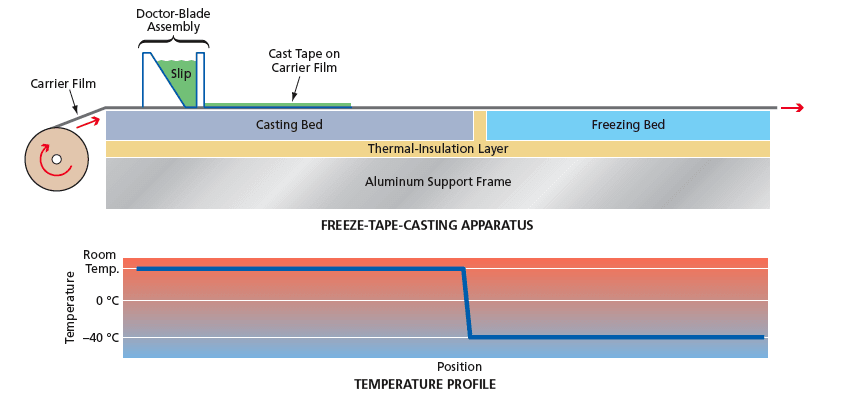
- In traditional tape casting, the water and any organic solvents are allowed to evaporate slowly before the tape is sintered to form the final ceramic. The evaporation can cause or be accompanied by undesired compositional and physical changes, including settling of particles out of suspension and density gradients. The freezing prevents such changes.
- Water alone or high melting point organic solvents (including benzene, cyclohexane, tertiary butyl alcohol, and camphene), can become formed into channels or other unique pore structures when directionally solidified. The channels or other pore structures can be tailored to some extent through control of the rate of freezing and/or the addition of such freezing additives as glycerol, glycols, antifreeze proteins, and/or alcohols.
- Porosity can also be tailored through choice of the concentration of suspended ceramic particles: typically, freeze-tape-cast ceramics contain open pore structures when the slips contain less than 45 volume percent of ceramic and/or metallic solids.
- In freeze tape casting, the solids loading can be made as low as 5 volume percent to obtain exceptionally high porosity.
After casting and freezing, the frozen tape is diced into sections for freeze-drying, in which the water and any other solvents are removed by sublimation. Because, in sublimation, the solidified solvents are transformed into gases without passing through intermediate liquid phases, there are no capillary forces like those associated with liquid-to-vapor transitions that occur during drying in traditional tape casting. Because of the absence of capillary forces, the changes in the dimensions of microstructures and in the overall thickness of the tape are negligible and hence processing is simplified with the absence of cracks and other drying defects notable in traditional tapes. After freeze-drying, the sections of tape are cut into the desired shape, then sintered.
This work was done by Stephen W. Sofie of QSS Group, Inc. for Glenn Research Center.
Inquiries concerning rights for the commercial use of this invention should be addressed to NASA Glenn Research Center, Innovative Partnerships Office, Attn: Steve Fedor, Mail Stop 4–8, 21000 Brookpark Road, Cleveland, Ohio 44135. Refer to LEW-17628-1.