Tech Briefs

A comprehensive library of technical briefs from engineering experts at NASA and major government, university, and commercial laboratories covering all aspects of innovations in electronics, software, photonics, imaging, motion control, automation, sensors, test, materials, manufacturing, mechanical, and mechatronics.

subscribe to newsletter
Each week get the latest tech briefs & key industry topics… delivered to your inbox!

Latest Tech Briefs

-1
0
30
Briefs: Robotics, Automation & Control
Missions to the moon and other planets will require large-scale infrastructure that would benefit from autonomous assembly by robots without on-site human intervention. NASA Ames Research Center has developed a novel and efficient mobile bipedal robot system to construct low-mass, high precision, and largescale infrastructure. Read on to learn more.
Feature Image
Briefs: Design
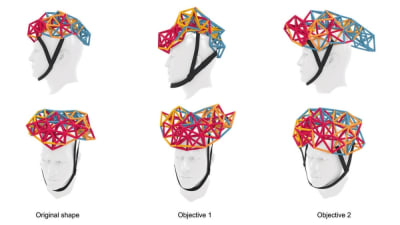
A team of UC Berkeley-led researchers has developed an AI-driven framework to optimize and automate the design of complex truss robots. This approach enables designers to create robots with extraordinary capabilities while maximizing control efficiency. Read on to learn more about it.
Feature Image
Briefs: RF & Microwave Electronics
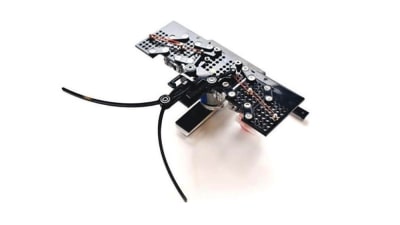
Mechanical engineering researchers in the Harvard John A. Paulson School of Engineering and Applied Sciences think there’s another way to design robots: Programming intended functions directly into a robot’s physical structure, allowing the robot to react to its surroundings without the need for extensive on-board electronics. Read on to learn more.
Feature Image
Briefs: Power
Researchers at the University of California San Diego have developed a soft robotic skin that enables vine robots that are just a few millimeters wide to navigate convoluted paths and fragile environments. Read on to learn more.
Feature Image
Briefs: Robotics, Automation & Control
Robots may soon have a new way to communicate with people. Not through words or screens, but with light and images projected directly onto the world around them. University of South Florida's Zhao Han is developing technology that could transform how people interact with robots in both emergencies and everyday life. Read on to learn more.
Feature Image
Briefs: Photonics/Optics
Optics researchers in the Harvard John A. Paulson School of Engineering and Applied Sciences created specially designed metasurfaces — flat devices etched with nanoscale light-manipulating patterns — to act as ultra-thin upgrades for quantum-optical chips and setups. Read on to learn more.
Feature Image
Briefs: Software
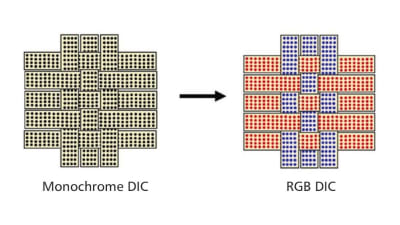
Innovators at NASA Johnson Space Center have developed a technology that can isolate a single direction of tensile strain in biaxially woven material. This is accomplished using traditional digital image correlation (DIC) techniques in combination with custom red-green-blue (RGB) color filtering software. Read on to learn more.
Feature Image
Briefs: Photonics/Optics
NASA's Glenn Research Center has developed a method of using entangled-photon pairs to produce highly secure mobile communications that require mere milliwatts of power. Read on to learn more.
Feature Image
Briefs: RF & Microwave Electronics
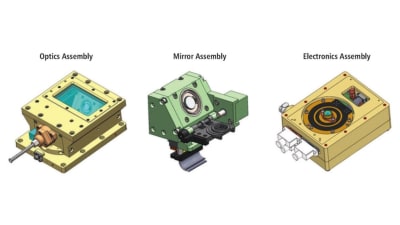
NASA Goddard Space Flight Center has developed a Space Qualified Rover LiDAR (SQRLi) system that will improve rover sensing capabilities in a small, lightweight package. The new SQRLi package is developed to survive the hazardous space environment and provide valuable image data during planetary and lunar rover exploration. Read on to learn more about it.
Feature Image
Briefs: RF & Microwave Electronics
Researchers from Sandia National Laboratories and Ohio State University are taking experimental navigation technology to the skies, pioneering a backup system to keep an airplane on course when it cannot rely on global positioning system satellites. Read on to learn more.
Feature Image
Briefs: RF & Microwave Electronics
Cornell researchers have developed a low-power microchip they call a “microwave brain,” the first processor to compute on both ultrafast data signals and wireless communication signals by harnessing the physics of microwaves. Read on to learn more about it.
Feature Image
Briefs: Information Technology
Researchers have successfully demonstrated the U.K.’s first long-distance ultra-secure transfer of data over a quantum communications network, including the U.K.’s first long-distance quantum-secured video call. Read on to learn more.
Feature Image
Briefs: Test & Measurement
A collaborative multidisciplinary team of researchers from the Perelman School of Medicine at the University of Pennsylvania and the Tandon School of Engineering at New York University has developed a miniature device that could transform how blood cancer treatments are tested and tailored for patients. Read on to learn more.
Feature Image
Briefs: Medical
Researchers from RMIT University have developed a wearable wound monitoring device with integrated sensors that could reduce infection risks by minimizing the need for frequent physical contact. Read on to learn more about it.
Feature Image
Briefs: Medical
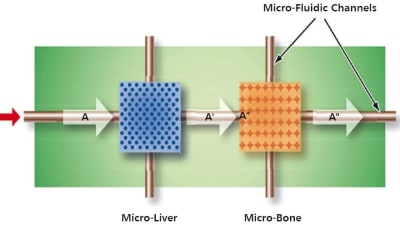
NASA Johnson Space Center has developed the Micro-Organ Device (MOD) platform technology that serves as a drug screening system with human or animal cell micro-organs to supplement and reduce animal studies while potentially increasing the success of clinical trials. Read on to learn more.
Feature Image
Briefs: Materials
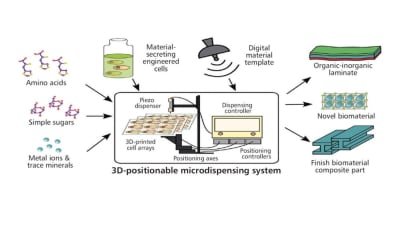
NASA has developed a novel approach for macroscale biomaterial production by combining synthetic biology with 3D printing. This innovation provides modern design and fabrication techniques for custom-designed organic or organic-inorganic composite biomaterials produced from limited resources. Read on to learn more.
Feature Image
Briefs: Green Design & Manufacturing
Researchers have created a simulation model to analyze how coastal management activities meant to protect barrier islands from sea-level rise can disrupt the natural processes that are keeping barrier islands above water. Read on to learn more about it.
Feature Image
Briefs: Energy
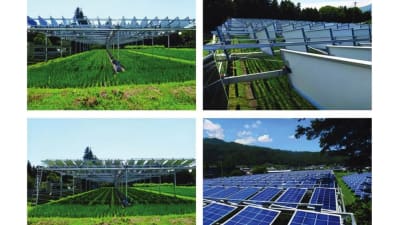
As countries race to expand renewable energy infrastructure, balancing clean electricity production with land use for food remains a pressing challenge — especially in Japan, where mountainous terrain limits space. A recent study led by researchers from the University of Tokyo explores a promising solution: integrating solar panels with traditional rice farming in a practice known as agrivoltaics. Read on to learn more.
Feature Image
Briefs: Green Design & Manufacturing
A team of researchers from ETH Zurich investigated a new approach to passive dehumidification of indoor spaces. Read on to learn more about it.
Feature Image
Briefs: Energy
The Korea Institute of Energy Research has successfully developed ultra-lightweight flexible perovskite/ CIGS (copper indium gallium selenide) tandem solar cells and achieved a power conversion efficiency of 23.64 percent, which is the world’s highest efficiency for flexible perovskite/CIGS tandem solar cells reported to date. Read on to learn more.
Feature Image
Briefs: Energy
Researchers from the National University of Singapore have developed a novel triple-junction perovskite/Si tandem solar cell that can achieve a certified world-record power conversion efficiency of 27.1 percent across a solar energy absorption area of 1 sq cm, representing the best-performing triple-junction perovskite/Si tandem solar cell thus far. Read on to learn more.


Feature Image
Briefs: Robotics, Automation & Control
Soft robots, medical devices and implants, and next-generation drug delivery methods could soon be guided with magnetism — thanks to a metal-free magnetic gel developed by researchers at the University of Michigan and the Max Planck Institute for Intelligent Systems in Stuttgart, Germany. Read on to learn more about it.
Feature Image
Briefs: Electronics & Computers
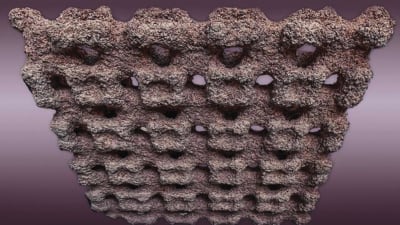
Innovators at NASA Johnson Space Center have developed additively manufactured thermal protection system (AMTPS) comprised of two printable heat shield material formulations. This technology could significantly decrease heat shield or thermal protection system (TPS) fabrication cost and time. Read on to learn more.
Feature Image
Briefs: Materials
Researchers at the U.S. Department of Energy (DOE)’s Oak Ridge National Laboratory (ORNL) have developed an innovative new technique using carbon nanofibers to enhance binding in carbon fiber and other fiber-reinforced polymer composites — an advance likely to improve structural materials for automobiles, airplanes and other applications that require lightweight and strong materials.
Feature Image
Briefs: Medical
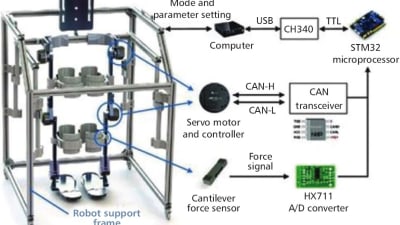
A study conducted by Fuyang Yu and his colleagues introduces an innovative approach to lower limb rehabilitation. Their research outlines the development of a lower limb rehabilitation robot designed to significantly improve the safety and effectiveness of gait training through a novel method based on human-robot interaction force measurement. Read on to learn more.
Feature Image
Briefs: Robotics, Automation & Control
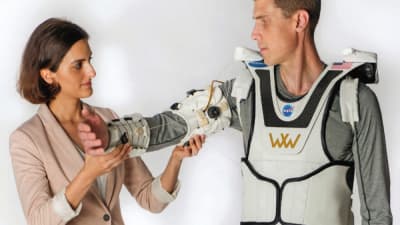
This lightweight, portable garment is designed for active shoulder and elbow positioning.
Feature Image
Briefs: Robotics, Automation & Control
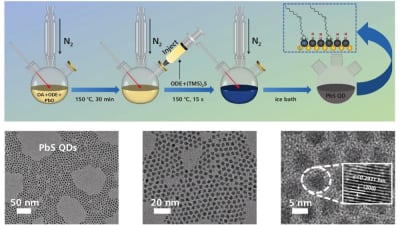
Researchers at Fuzhou University in China created a machine vision sensor that uses quantum dots to adapt to extreme changes in light far faster than the human eye can — in about 40 seconds — by mimicking eyes’ key behaviors. Their results could be a game changer for robotic vision and autonomous vehicle safety. Read on to learn more.
Feature Image
Briefs: Materials
Finding the next groundbreaking polymer is always a challenge, but now Georgia Tech researchers are using artificial intelligence (AI) to shape and transform the future of the field. Read on to learn more.
Feature Image
Briefs: Software
NASA has developed a new technology to track the status of, and changes to, enterprise level programmatic operations. Read on to learn more about it.
Feature Image

Videos