

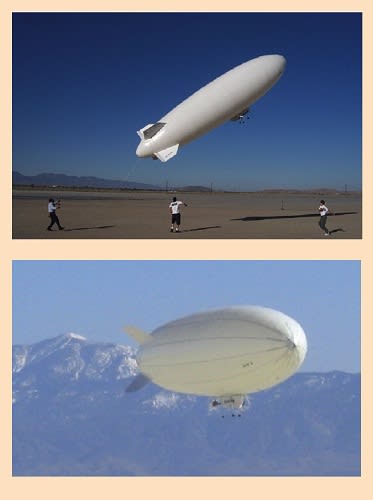
An architecture for autonomous operation of an aerobot (i.e., a robotic blimp) to be used in scientific exploration of planets and moons in the Solar system with an atmosphere (such as Titan and Venus) is undergoing development. This architecture is also applicable to autonomous airships that could be flown in the terrestrial atmosphere for scientific exploration, military reconnaissance and surveillance, and as radio-communication relay stations in disaster areas. The architecture was conceived to satisfy requirements to perform the following functions:
- Vehicle safing, that is, ensuring the integrity of the aerobot during its entire mission, including during extended communication blackouts.
- Accurate and robust autonomous flight control during operation in diverse modes, including launch, deployment of scientific instruments, long traverses, hovering or station-keeping, and maneuvers for touch-and-go surface sampling.
- Mapping and self-localization in the absence of a global positioning system.
- Advanced recognition of hazards and targets in conjunction with tracking of, and visual servoing toward, targets, all to enable the aerobot to detect and avoid atmospheric and topographic hazards and to identify, home in on, and hover over predefined terrain features or other targets of scientific interest.
This work was done by Alberto Elfes, Jeffery L. Hall, Eric A. Kulczycki, Jonathan M. Cameron, Arin C. Morfopoulos, Daniel S. Clouse, James F. Montgomery, Adnan I. Ansar, and Richard J. Machuzak of JPL for NASA’s Jet Propulsion Laboratory. For more information, contact










