

An improved assembly for inert-gas shielding of a metallic joint is designed to be useable during any of a variety of both laser-based and traditional welding and brazing processes. The basic purpose of this assembly or of a typical prior related assembly is to channel the flow of a chemically inert gas to a joint to prevent environmental contamination of the joint during the welding or brazing process and, if required, to accelerate cooling upon completion of the process.
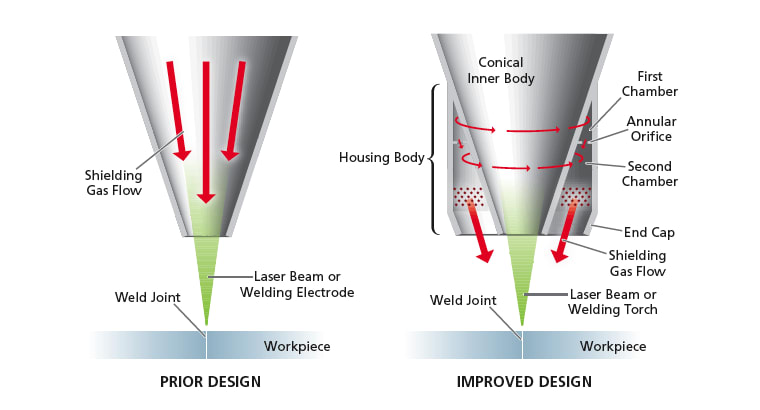
The present improved welding gas-shielding assembly, depicted in the right part of the figure, provides a column of evenly distributed gas flow directly surrounding the pool of molten metal in the weld joint to prevent oxidation and formation of plasma.
The assembly includes a conical inner body and an outer shell comprising a housing body and an end cap. The outer shell contains chambers sized and shaped to act, along with the conical inner body, to distribute the inert gas evenly around the conical inner body and to encapsulate the flow of the gas and direct the flow onto the desired region surrounding the weld joint.
The gas enters the assembly through a supply tube from an external source. The passage through which the gas enters is tangential, so the gas flows in tangentially, creating a vortex flow in the chambers between the outer shell and the conical inner body. The gas circulates as it fills the first chamber, then flows through an annular orifice to fill a second chamber and then flows through a series of diffusing screens. After flowing through the screens, the gas is directed to the weld joint area by means of a nozzle. The combination of the vortex flow, chambers, and screens provides even columnar flow around the entire heated area.
This work was done by Paul Gradl and Kevin Baker of Marshall Space Flight Center and Jack Weeks of Pratt & Whitney. For further information, contact Sammy Nabors, MSFC Commercialization Assistance Lead, at










