

You might think a wind turbine would have more in common with a plane’s propeller than an aircraft wing, but wind blades actually behave a lot more like wings than props. This fact has enabled a valuable spinoff from aerospace to wind energy involving the first software that NASA ever allowed to be commercialized as part of the Agency’s ongoing effort to transfer technology to U.S. business and industry.

As a Lockheed Engineering and Sciences contractor in the late 1980s, I was one of the original NASA Langley Research Center developers of a software code, ST-SIZE, which was first used at the Center for structural sizing and design optimization for a new, high-speed aircraft. The software tool works in a feedback loop with finite element analysis (FEA) to automatically search for composite (or metal) solutions that minimize weight while maximizing manufacturability.
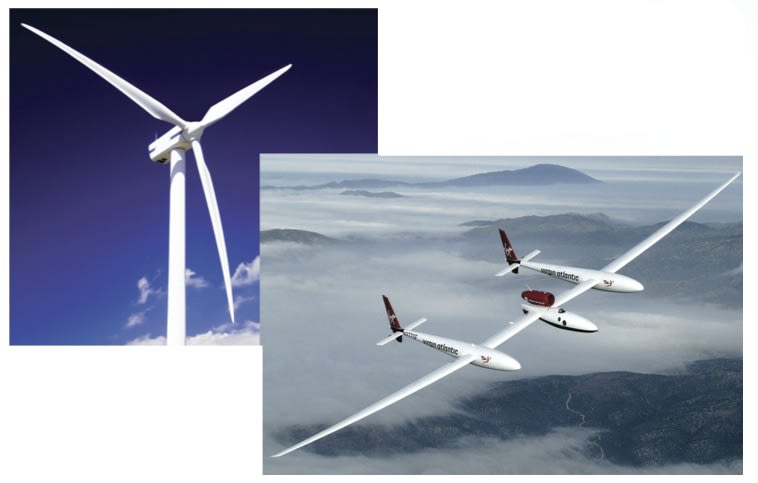
Since NASA allowed me to commercialize (and rename) HyperSizer software in 1994, Collier Research Corporation has continued to work closely with NASA and associated contractors on numerous other aircraft- and space-related projects. NASA’s Crew Launch Vehicle, the Ares I; Heavy Lift Vehicle, Ares V; and the Composite Crew Module (Figure 1) were all designed for zero-failure performance with the aid of HyperSizer. The software has also been used in the design of business jets such as Bombardier’s LearJet, commercial transport planes such as the C-series, and long-duration, high-altitude aircraft like Scaled Composites Global Flyer piloted by Steve Fossett (Figure 2).
If you look at a traditional aircraft wing, and then imagine the design thought that stretches it into the very long, slender wing of the Global Flyer, you can see that it’s all about lift and low drag at slow speed. And it’s not a big structural step from that wing to a wind turbine blade. Now think about the ever-increasing scale of wind turbines dictated by market pressures for greater economic efficiencies. Add materials advances in composites and hybrid laminates, and you can see how expertise in new-generation aircraft wing design and advanced analyses translates logically into wind blade engineering.
However, in the booming wind energy market, the “bigger is better” mantra is already coming up against reliability issues. Even today’s current standard (33-40 meter, 1.5 MW) wind blades see an average failure rate of 20 percent, according to Sandia National Laboratories’ estimates. Sandia conducts ongoing applied research in conjunction with academia and industry to increase the viability of wind technology by improving turbine performance, and has hosted annual wind blade workshops since 2004.
Design and Performance
Fortunately, for the engineering community, design solutions to performance issues involving wind turbine blades parallel techniques already in use for aircraft wings: the way blades behave, and structurally fail, make them suitable for analytical methods that have matured over decades in aerospace. For example, while smaller wind blades used to power homes rotate faster than the standard blades used by utilities, as blades get bigger, rotation speed decreases and the primary required design load changes from centripetal force to flap-wise lift that can be analyzed like an aircraft wing. Furthermore, the aeroelastic effects of larger wind blade-tip deflection, and resulting load-change issues, can be compensated for with stiffer, stronger materials in much the same way as aircraft wing-tip deflection is controlled. Although these materials need to be as lightweight as possible, stiffness and buckling stability become even higher priorities as blade (or wing) length increases. And fatigue life remains an issue for any component operating in harsh environments over long periods of time.
To meet these tougher requirements, earlier all-fiberglass wind blade designs are being redesigned to incorporate more structurally complex sections made of a mix of fiberglass with higher-performance graphite epoxy (carbon-fiber) similar to that seen in the aerospace industry. Of course, these newer composite materials require a more sophisticated design engineering approach, as well as different handling, fabrication, and curing methods.
This is where HyperSizer’s capabilities can be put to use as designers incorporate the aerodynamics lessons learned from aviation into wind blade structure and function. Among the issues for which the software provides insight are:
- The optimal number of shear webs (spars) and their placement.
- Whether to go with solid laminate versus sandwich or stiffened panels for unsupported areas.
- How to properly proportion the material around the chord of the blade (from leading edge to trailing edge), and then down its length.
- What is the strongest carbon-fiber/fiberglass percentage combination and layup stacking sequence that can be achieved at the lowest weight?
- How do you arrive at the optimum balance of least-complex, lightest-weight composite tape and fabric layup sequencing with minimal ply drops that results in the lowest fabrication costs within a 24-hour production cycle?
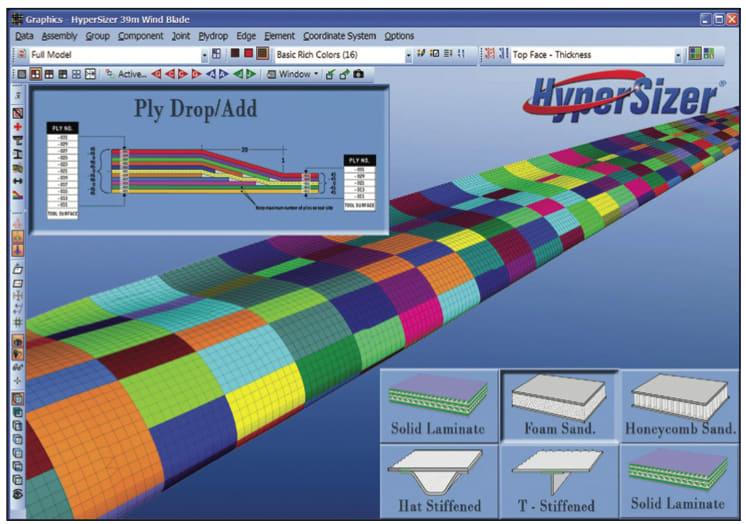
The sooner these questions can be answered in preliminary design, the more energy- and cost-efficient the final wind blade will be. The software surveys thousands and even millions of design-candidate dimensions and laminates, quickly evaluating early designs in a ply-by-ply, and even finite element-by-element manner. By sizing (optimizing) all possible permutations and combinations of composite laminate, the software gives engineers a highly accurate picture of the consequences of proposed design changes (Figure 3). Structural integrity is verified, failure modes are predicted for aeroelastic load cases, and required safety factors are achieved. Designs can be fine-tuned in this way to simultaneously target optimum manufacturability, minimum weight, and lowest cost, all of which can help wind power be more competitive with fossil fuels.
Size Matters
In the search for greater efficiencies, how much bigger can wind blades go? Offshore turbine blades are already being built at 60 meters. And there are prototype and concept blades on drawing boards that approach a staggering 100-meter length, which, from tip to tip, is more than three football fields in length. This scale of blade length requires significant architectural changes because the loading involved is not only flapwise (causing lift, as with an aircraft wing), but also edgewise, such as a cantilevered beam.
These huge blades have no aircraft parallel. Wind engineers are now entering into a “clean-paper” area of design where innovative thought, supported by architectural trade studies that quantify reliability, is in high demand. Collier Research is currently working with Sandia on very large offshore wind blade designs to help establish their credibility so that industry can take them to the next stage of manufacturing. Software tools created for flight — but now are applicable to creative responses for more earthbound challenges — have come a long way from their NASA Langley origins more than two decades ago.
This article was written by Craig Collier, President, Collier Research Corporation, Hampton, VA. For more information, Click Here .











