
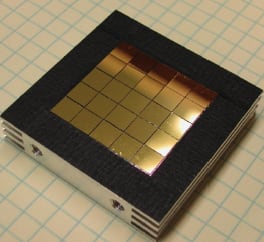
Optically driven deformable mirrors may eventually supplant electrically driven deformable mirrors in some adaptive-optics and active-optics applications. Traditionally, the mirror facets in electrically driven deformable mirrors are actuated, variously, by means of piezoelectric, electrostrictive, microelectromechanical, liquid-crystal, or thermal devices. At least one such device must be dedicated to each facet, and there must be at least one wire carrying a control or drive signal to the device. If a deformable mirror comprises many (e.g., thousands) of facets, then wiring becomes a major problem for design, and the problem is compounded in cases of piezoelectric or other actuators for which high drive voltages are required. In contrast, in optically driven mirrors, the wiring problem is eliminated.

This work was done by Hamid Hemmati and William Farr of Caltech for NASA’s Jet Propulsion Laboratory.
In accordance with Public Law 96-517, the contractor has elected to retain title to this invention. Inquiries concerning rights for its commercial use should be addressed to:
Innovative Technology Assets Management
JPL
Mail Stop 202-233
4800 Oak Grove Drive
Pasadena, CA 91109-8099
(818) 354-2240
E-mail: This email address is being protected from spambots. You need JavaScript enabled to view it.
Refer to NPO-42724.
This Brief includes a Technical Support Package (TSP).
Optically Driven Deformable Mirrors
(reference NPO-42724) is currently available for download from the TSP library.
Don't have an account?
Overview
The document is a Technical Support Package from NASA's Jet Propulsion Laboratory (JPL) concerning "Optically Driven Deformable Mirrors," identified by NTR Number 42724. It is part of NASA Tech Briefs, which disseminate information on aerospace-related innovations with potential wider applications in technology, science, and commerce.
Optically driven deformable mirrors are advanced optical devices that can change their shape in response to light. This capability allows for precise control of light waves, which is crucial in various applications, including adaptive optics, astronomy, and imaging systems. The technology aims to enhance the performance of optical systems by correcting distortions in real-time, thereby improving image quality and resolution.
The document emphasizes the importance of this technology within the framework of NASA's Commercial Technology Program, which seeks to promote the commercialization of aerospace innovations. By making such technologies available, NASA aims to foster partnerships and collaborations that can lead to further advancements and applications in various fields.
Additionally, the Technical Support Package provides information on how to access further resources related to research and technology in this area through the NASA Scientific and Technical Information (STI) Program Office. The STI Program Office serves as a repository for a wide range of publications and technical documents, offering support to those interested in aerospace technologies.
The document also includes a disclaimer stating that the United States Government and its representatives do not assume liability for the use of the information contained within it, nor do they guarantee that such use will be free from privately owned rights. It clarifies that any mention of trade names or manufacturers is for identification purposes only and does not imply official endorsement by NASA.
In summary, this Technical Support Package serves as a comprehensive overview of the optically driven deformable mirrors technology, highlighting its significance, potential applications, and the resources available for further exploration in the field. It reflects NASA's commitment to advancing aerospace technology and facilitating its transition into commercial use.