Deformable mirrors of a proposed type would be equipped with relatively-large-stroke microscopic piezoelectric actuators that would be used to maintain their reflective surfaces in precise shapes. These mirrors would be members of the class of MEMS-DM (formicroelectromechanical system deformable mirror) devices, which offer potential for a precise optical control in adaptive-optics applications in such diverse fields as astronomy and vision science.
In some respects, the proposed mirrors would be similar to the ones described in "Silicon Membrane Mirrors With Electrostatic Shape Actuators" (NPO-21120) NASA Tech Briefs, Vol. 27, No. 1 (January 2003), page 62. Like a mirror of the type reported previously, a mirror as proposed here would include a continuous-membrane reflector attached by posts to actuators that, in turn, would be attached by posts to a rigid base (see figure). Also as before, the proposed mirror would be fabricated, in part, by use of a membrane-transfer technique. However, the actuator design would be different. Instead of the electrostatic actuators reported previously, the proposed mirror would contain bimorph-type piezoelectric actuators.
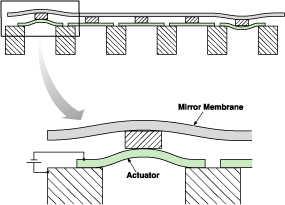
The reasons for the proposed choice of actuators are simple: In the mirror described in the cited prior article as well as in other previously reported membrane mirrors that feature piezoelectric and electrostrictive actuators, it is not possible, by use of modest actuation voltages, to obtain actuator strokes of the order of ±6 μm as needed in the intended adaptive-optics applications. The mechanical amplification inherent in the bimorph configuration would multiply the small displacements typically generated by piezoelectric devices, thereby making it possible to obtain the desired stroke magnitudes at voltages lower than would be needed to obtain the same stroke magnitudes from non-bimorph piezoelectric and electrostatic actuators.
A voltage applied to the piezoelectric layer in a given actuator would induce a stress that would cause the actuator layer to bend and thus to pull or push on the mirror membrane. It has been estimated that an applied potential of ±9 V should be sufficient to produce an actuator stroke, and thus a local reflector displacement, of ±6 μm. Inasmuch as the actuators would be essentially capacitors from an electrical perspective, the actuators would consume power only during changes in their position settings. During maintenance of a position setting, only the supporting electronic circuitry would consume power.
This work was done by Eui-Hyeok Yang of Caltech for NASA's Jet Propulsion Laboratory.
In accordance with Public Law 96-517, the contractor has elected to retain title to this invention. Inquiries concerning rights for its commercial use should be addressed to
Intellectual Property group
JPL
Mail Stop 202-233
4800 Oak Grove Drive
Pasadena, CA 91109
(818) 354-2240
Refer to NPO-30230.
This Brief includes a Technical Support Package (TSP).
Membrane Mirrors with Bimorph Shape Actuators
(reference NPO30230) is currently available for download from the TSP library.
Don't have an account?
Overview
The document presents a technical support package from NASA's Jet Propulsion Laboratory (JPL) detailing the development of a novel PZT (lead zirconate titanate) bimorph actuated, continuous membrane deformable mirror. This innovative mirror design aims to meet the stringent requirements of adaptive optics (AO) systems, particularly for applications in vision science and astronomy.
The key feature of this deformable mirror is its ability to achieve a stroke of +/- 6 micrometers with a modest actuation voltage of +/- 9 volts. This capability is crucial for correcting distortions caused by atmospheric turbulence in astronomical observations and imperfections in the human eye. The mirror's design incorporates a continuous membrane with a 100% fill factor, ensuring high optical quality while maintaining a low inter-actuator coupling.
The document outlines the advantages of using piezoelectric bimorph technology, which allows for small displacements to be mechanically amplified, resulting in significant strokes with low power consumption. The actuators function as capacitors, consuming power only when the position is altered, thus enhancing energy efficiency. The proposed system is compact, lightweight, and robust, making it suitable for various applications in adaptive optics.
The development process includes a membrane transfer technology that facilitates the fabrication of the mirror. This method has been validated through the successful testing of piezoelectric properties in PZT films, demonstrating the feasibility of the technology. The document also highlights the limitations of previous MEMS (Micro-Electro-Mechanical Systems) deformable mirrors, which failed to meet the required stroke and optical quality specifications.
In summary, the JPL's proposed PZT bimorph-based deformable mirror represents a significant advancement in the field of adaptive optics. By combining piezoelectric technology with innovative fabrication techniques, this mirror design addresses critical challenges in achieving high-performance optical systems. The research aims to enhance the clarity of astronomical images and improve visual technologies, ultimately contributing to advancements in both scientific and medical fields. The document serves as a comprehensive overview of the technology's potential and its implications for future applications in adaptive optics.