

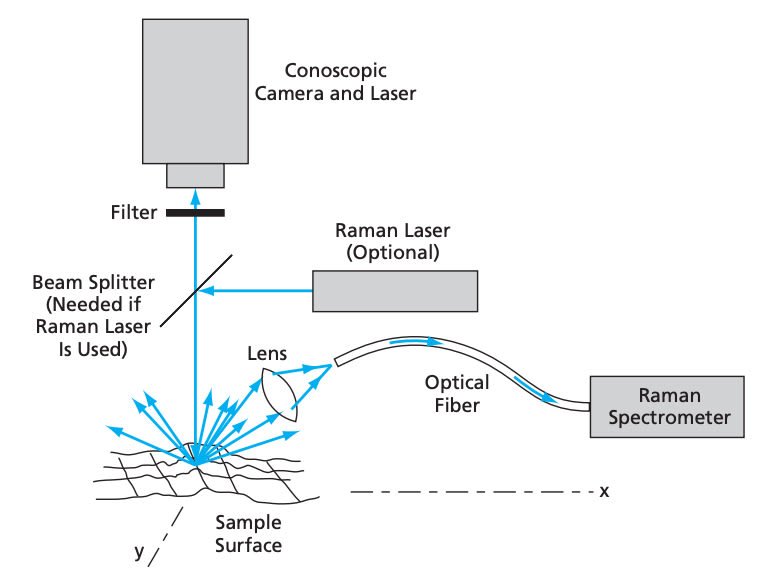
A new instrument was developed for chemical characterization of surfaces that combines the analytical power of Raman spectroscopy with the three-dimensional topographic information provided by conoscopic holography. The figure schematically depicts the proposed hybrid instrument. The output of the conoscopic holographic portion of the instrument is a topographical map of the surface; the output of the Raman portion of the instrument is hyperspectral Raman data, from which the chemical and/or biological composition of the surface would be deduced. By virtue of the basic principles of design and operation of the instrument, the hyperspectral image data would be inherently spatially registered with the topographical data.
In conoscopic holography, the object and reference beams of classical holography are replaced by the ordinary and extraordinary components generated by a single beam traveling through a birefringent, uniaxial crystal. In the basic conoscopic configuration, a laser light is projected onto a specimen and the resulting illuminated spot becomes a point source of diffuse light that propagates in every direction. The laser beam is raster-scanned in two dimensions (x and y) perpendicular to the beam axis (z), and at each x,y location, the pattern of interference between the ordinary and extraordinary rays is recorded. The recorded interferogram constitutes the conoscopic hologram. Of particular significance for the proposed instrument is that the conoscopic hologram contains information on the z coordinate (height) of the illuminated surface spot. Hence, a topographical map of the specimen is constructed point-by-point by rastering the laser beam in the x and y directions and correlating the x and y coordinates with the z information obtained from the interferograms. Conoscopic imaging is an established method, and conoscopic laboratory instruments for surface metrology are commercially available.
In Raman spectroscopy of a surface, one measures the spectrum of laser light scattered inelastically from a laser-illuminated spot on the surface. The wavelengths of the inelastically scattered light differ from that of the incident laser beam by amounts that correspond to the energies of molecular vibrations. The resulting vibrational spectrum can be used to identify the molecules. Raman spectroscopy is a standard laboratory technique for identifying mineralogical, biological, and other specific chemical compositions.
In the design and construction of the proposed instrument, a commercially available laboratory conoscopic holographic imaging system would be integrated with a Raman spectrometer (see figure). The on-axis back-scattered laser light would be used by the imaging system to generate the conoscopic hologram of the illuminated spot. Part of the off-axis back-scattered laser light would be collected by a lens, which would couple the light into an optical fiber, which, in turn, would feed the collected light to the Raman spectrometer. The lateral (x,y) resolution of the instrument would typically be of the order of microns, the exact value being determined primarily by the size of the laser-illuminated spot on the specimen.
In one of two configurations, the Raman-excitation and conoscopicholography beams would be generated by two different lasers and would be aligned and focused together on the same spot on the specimen. In a simpler configuration that would entail less weight, complexity, size, and cost, the same laser beam would be used for both conoscopic holography and Raman spectroscopy. The two-laser configuration would be preferable in cases in which the illumination needed for Raman excitation significantly exceeds that needed for conoscopic holography and, hence, it becomes necessary to alternate between conoscopic and Raman analysis of each scan spot.
The proposed instrument would be capable of mapping topography and chemical composition at lateral scales from microns to meters, with nanometer height resolution. Thus, the instrument could provide information on composition, roughness, porosity, and fractal dimension of specimens ranging from fine dust to large rocks, without need for any preparation of the specimens. The instrument would be mechanically noninvasive in that there would be no need for mechanical contact between a solid probe and a specimen. Because the probe would be a narrow laser beam, it would be possible to profile features at the bottoms of steep, narrow holes — for instance, crevices in a rock. The proposed instrument could also be combined with other optical spectroscopic instruments.
This work was done by Mark S. Anderson of Caltech for NASA’s Jet Propulsion Laboratory. For further information, access the Technical Support Package (TSP) free online at www.techbriefs.com/tsp under the Test & Measurement category. In accordance with Public Law 96-517, the contractor has elected to retain title to this invention. Inquiries concerning rights for its commercial use should be addressed to:
Innovative Technology Assets Management
JPL
Mail Stop 202-233
4800 Oak Grove Drive
Pasadena, CA 91109-8099
(818) 354-2240
E-mail: This email address is being protected from spambots. You need JavaScript enabled to view it.
Refer to NPO-30751, volume and number of this NASA Tech Briefs issue, and the page number.
This Brief includes a Technical Support Package (TSP).
Simultaneous Conoscopic Holography and Raman Spectroscopy
(reference NPO-30751) is currently available for download from the TSP library.
Don't have an account?
Overview
The document outlines a technical support package from NASA's Jet Propulsion Laboratory detailing a new instrument that combines Raman spectroscopy with conoscopic holography for advanced chemical characterization of surfaces. This innovative system aims to provide simultaneous topographic and chemical analysis, enhancing the capabilities of traditional analytical techniques.
Raman spectroscopy is a well-established method that utilizes laser illumination to measure the inelastic scattering of light, yielding vibrational spectra that can identify molecular compositions. This technique is widely used for qualitative and quantitative analysis in various fields, including mineralogy and biology. The integration of Raman spectroscopy with conoscopic imaging allows for a more comprehensive analysis, as the latter provides three-dimensional topographic information about the sample surface.
The proposed instrument employs a laser scanner that functions both as a profiling tool and a Raman excitation source. This dual functionality enables the collection of topographic data and Raman spectra from the same location on a sample, which is particularly beneficial for analyzing complex materials without the need for sample preparation. The system is designed to map topography and chemical structure across a range of scales, from microns to meters, with nanometer height resolution.
Key advantages of this hybrid system include its non-invasive nature, as it does not require mechanical contact with the sample, and its ability to profile features in deep crevices or holes. The co-axial design of the conoprobe minimizes sensitivity to optical components, enhancing the robustness of the technique. Additionally, the system can be combined with other optical spectroscopic methods, such as fluorescence and infrared spectroscopy, broadening its applicability.
The document emphasizes the potential applications of this technology in various fields, including environmental monitoring, materials science, and biological research. By enabling the simultaneous collection of topographic and chemical data, this instrument could significantly advance the analysis of unknown biological or chemical agents, making it a valuable tool for both scientific research and practical applications.
In summary, the document presents a cutting-edge instrument that merges the strengths of Raman spectroscopy and conoscopic holography, offering a powerful solution for detailed surface analysis across multiple disciplines.










