

Ultrashort laser pulses — that are shorter than a millionth of a millionth of a second — have transformed fundamental science, engineering and medicine. Despite this, their ultrashort duration has made them elusive and difficult to measure. About ten years ago, researchers from Lund University and Porto University introduced a tool for measuring pulse duration of ultrafast lasers. The same team has now achieved a breakthrough that enables the measurement of individual laser pulses across a wider parameter range in a more compact setup.
”The current standard measurements for femtosecond lasers, typically used in industry and medicine, give just an estimate of the pulse duration. Our approach gives a more complete measurement and can contribute to unleash the whole potential of ultrafast laser technology,” said Daniel Díaz Rivas, doctoral student in Atomic Physics at Lund University.
The concept of femtosecond pulses is difficult to grasp for most of us. Yet, they are used for a wide range of everyday applications, from eye surgery to micro-machining in industry. The extremely short laser pulses can even investigate the fastest processes in nature, such as energy transfer in photosynthesis and electron dynamics.
Even as they have been more and more widely used, the precise measurement of the pulses’ shape and duration remains a difficult task. Electronic instruments are too slow, which is why researchers have turned to optical methods.
Current Methods are Limited
However, these types of optical techniques typically require multiple measurements in a scanning sequence. This makes them unsuitable for capturing individual pulses in real time.
Single-shot versions have emerged for characterizing very short pulses commonly used in fundamental science - but struggle with longer pulses more commonly used in industrial and medical applications. The limitations are related to the complexity of sufficiently stretching the pulses within a compact optical setup.
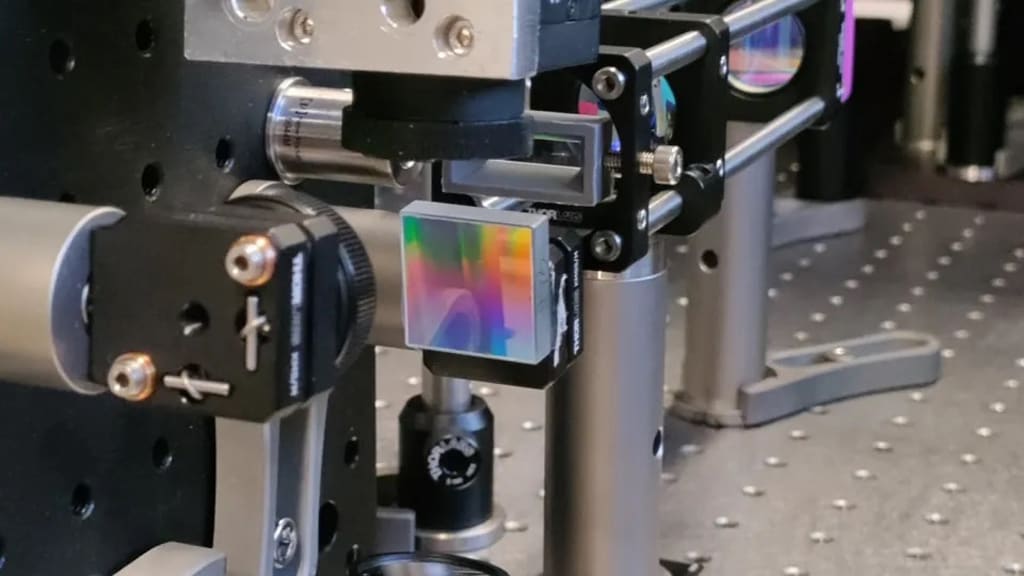
Researchers at Lund University have now developed a compact and elegant way for stretching ultrafast laser pulses using a simple optical principle. By sending a pulsed laser beam through a diffraction grating — a component that spatially separates light into its colors — and imaging the grating with a combination of lenses, they can precisely control the pulse duration across the laser beam.
This approach allows femtosecond pulses to be lengthened more than tenfold within a compact optical setup.
This enables full characterization in a single shot, without the need for pre-compensation optical elements. The result of this work is a versatile technique that can work for pulse durations ranging from a few femtoseconds to hundreds, thus covering scientific, industrial and medical applications. It opens the door to real-time monitoring of individual pulses, something previously out of reach for many laser platforms.
Looking Ahead
Beyond pulse characterization, this optical principle can be applied to shape the spatiotemporal properties of light pulses and explore different ways to study light-matter interactions.
”As ultrafast lasers continue to drive innovation in science and technology, tools like this will be key to pushing the boundaries of precision and understanding,” Cord Arnold, Senior Lecturer in Atomic Physics at Lund University concludes.
This article was written by Lund University. For more information, contact Daniel Diaz Rivas,







