

An intelligent integrated health management system (IIHMS) incorporates major improvements over prior such systems. The particular IIHMS is implemented for any system defined as a hierarchical distributed network of intelligent elements (HDNIE), comprising primarily: (1) an architecture (Figure 1), (2) intelligent elements, (3) a conceptual framework and taxonomy (Figure 2), and (4) and ontology that defines standards and protocols.
Some definitions of terms are prerequisite to a further brief description of this innovation:
- A system-of-systems (SoS) is an engineering system that comprises multiple subsystems (e.g., a system of multiple possibly interacting flow subsystems that include pumps, valves, tanks, ducts, sensors, and the like).
- "Intelligent" is used here in the sense of artificial intelligence. An intelligent element may be physical or virtual, it is network enabled, and it is able to manage data, information, and knowledge (DIaK) focused on determining its condition in the context of the entire SoS.
- As used here, "health" signifies the functionality and/or structural integrity of an engineering system, subsystem, or process (leading to determination of the health of components).
- "Process" can signify either a physical process in the usual sense of the word or an element into which functionally related sensors are grouped.
- "Element" can signify a component (e.g., an actuator, a valve), a process, a controller, an actuator, a subsystem, or a system.
- The term Integrated System Health Management (ISHM) is used to describe a capability that focuses on determining the condition (health) of every element in a complex system (detect anomalies, diagnose causes, prognosis of future anomalies), and provide data, information, and knowledge (DIaK) — not just data — to control systems for safe and effective operation.

A major novel aspect of the present development is the concept of intelligent integration. The purpose of intelligent integration, as defined and implemented in the present IIHMS, is to enable automated analysis of physical phenomena in imitation of human reasoning, including the use of qualitative methods. Intelligent integration is said to occur in a system in which all elements are intelligent and can acquire, maintain, and share knowledge and information.
In the HDNIE of the present IIHMS, an SoS is represented as being operationally organized in a hierarchical-distributed format. The elements of the SoS are considered to be intelligent in that they determine their own conditions within an integrated scheme that involves consideration of data, information, knowledge bases, and methods that reside in all elements of the system.
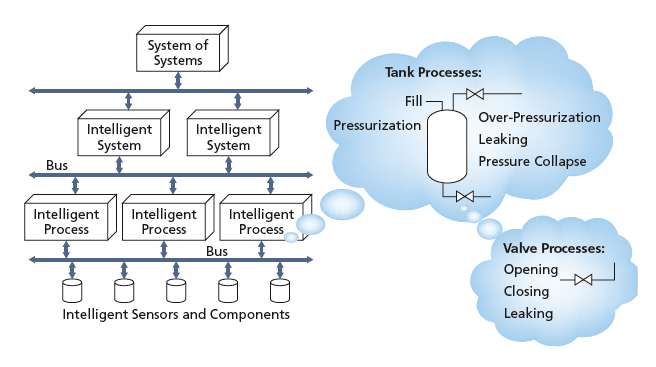
The conceptual framework of the HDNIE and the methodologies of implementing it enable the flow of information and knowledge among the elements so as to make possible the determination of the condition of each element. The necessary information and knowledge is made available to each affected element at the desired time, satisfying a need to prevent information overload while providing context-sensitive information at the proper level of detail.
Provision of high-quality data is a central goal in designing this or any IIHMS. In pursuit of this goal, functionally related sensors are logically assigned to groups denoted processes. An aggregate of processes is considered to form a system. Alternatively or in addition to what has been said thus far, the HDNIE of this IIHMS can be regarded as consisting of a framework containing object models that encapsulate all elements of the system, their individual and relational knowledge bases, generic methods and procedures based on models of the applicable physics, and communication processes (Figure 2). The framework enables implementation of a paradigm inspired by how expert operators monitor the health of systems with the help of (1) DIaK from various sources, (2) software tools that assist in rapid visualization of the condition of the system, (3) analytical software tools that assist in reasoning about the condition, (4) sharing of information via network communication hardware and software, and (5) software tools that aid in making decisions to remedy unacceptable conditions or improve performance.
This work was done by Fernando Figueroa of Stennis Space Center, John Schmalzel of Rowan University, and Harvey Smith of Jacobs Sverdrup.
Inquiries concerning rights for the commercial use of this invention should be addressed to
the Intellectual Property Manager
Stennis Space Center
(228) 688-1929.
Refer to SSC-00234.







