Aligning Optical Fibers by Means of Actuated MEMS Wedges
Wedges would be fabricated using gray-scale exposure of photoresist.
Goddard Space Flight Center, Greenbelt, Maryland
Microelectromechanical systems (MEMS) of a proposed type would be designed and fabricated to effect lateral and vertical alignment of optical fibers with respect to optical, electro-optical, optoelectronic, and/or photonic devices on integrated circuit chips and similar monolithic device structures. A MEMS device of this type would consist of a pair of oppositely sloped alignment wedges attached to linear actuators that would translate the wedges in the plane of a substrate, causing an optical fiber in contact with the sloping wedge surfaces to undergo various displacements parallel and perpendicular to the plane. In making it possible to accurately align optical fibers individually during the packaging stages of fabrication of the affected devices, this MEMS device would also make it possible to relax tolerances in other stages of fabrication, thereby potentially reducing costs and increasing yields.
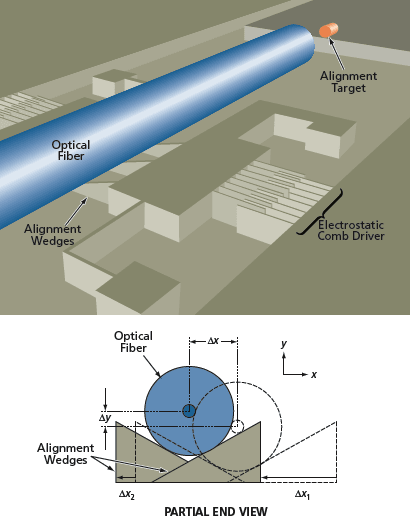
Figure 1. The Optical Fiber Would Be Displaced Vertically as Well as Horizontally in response to horizontal (only) displacements of the alignment wedges. In a typical system according to the proposal (see Figure 1), one or more pair(s) of alignment wedges would be positioned to create a V groove in which an optical fiber would rest. The fiber would be clamped at a suitable distance from the wedges to create a cantilever with a slight bend to push the free end of the fiber gently to the bottom of the V groove. The wedges would be translated in the substrate plane by amounts Δx1 and Δx2, respectively, which would be chosen to move the fiber parallel to the plane by a desired amount Δx and perpendicular to the plane by a desired amount Δy. The actuators used to translate the wedges could be variants of electrostatic or thermal actuators that are common in MEMS.
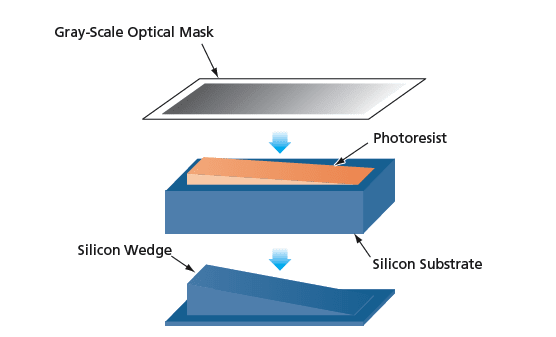
Figure 2. A Gray-Scale Optical Mask would be used to create a wedge of photoresist. Upon etching, a corresponding wedge shape would be imparted to the remaining silicon. The wedges would be fabricated in batch processes by a method, already established in the art of MEMS, that involves gray-scale exposure of photoresist masks to create arbitrarily sloped features. To make such a wedge, one would begin by designing and fabricating an optical mask for use in partially exposing a photoresist film on a substrate of silicon or other suitable material. After a development step, each photoresist mask would have a desired shape — in this case, a wedge shape characterized by a variable height proportional to that of the desired final wedge shape (see Figure 2). Next, the workpiece would be subjected to a suitable dry plasma etching process (e.g., reactive-ion etching); what would remain after etching would be a wedge of substrate material having the desired slope.
In this gray-scale-based approach, subtle changes could be made in fabrication processes to tailor the angles and linear dimensions of the wedges in order to tailor the displacement characteristics. This gray-scale approach could also be exploited to modify actuator characteristics by, for example, altering suspension geometries or profiles of capacitive surfaces.
This work was done by Brian Morgan and Reza Ghodssi of the University of Maryland as part of a joint activity among the U.S. Army Research Laboratory, the Laboratory for Physical Sciences, and Goddard Space Flight Center. For further information, contact the Goddard Innovative Partnerships Office at (301) 286-5810. GSC-14959-1