
A digital receiver in a 1.26-GHz spaceborne radar scatterometer now undergoing development includes a module for detecting radio-frequency interference (RFI) that could contam-inate scientific data intended to be acquired by the scatterometer. The role of the RFI-detection module is to identify time intervals during which the received signal is likely to be contaminated by RFI and thereby to enable exclusion, from further scientific data processing, of signal data acquired during those intervals. The underlying concepts of detection of RFI and rejection of RFI-contaminated signal data are also potentially applicable in advanced terrestrial radio receivers, including software-defined radio receivers in general, receivers in cellular telephones and other wireless consumer electronic devices, and receivers in automotive collision-avoidance radar systems.

The RFI-detection module is part of a digital square-law scatterometer processor (SP) implemented in a field-programmable gate array (FPGA). The raw scatterometer output signal used to generate an input signal for the SP is a down-converted signal at offset video frequencies in the range from 2 to 6 MHz. This signal is alternated in time with either radar echo pulses or a receiver “noise-only” measurement signal. The video signal is processed by an analog-to-digital converter (ADC) at a sampling rate of 16 MHz (greater than the Nyquist sampling rate) before being sent to the SP FPGA. The main part of the SP calculates the signal power by use of square-and-accumulate logic during each successive receiving time window. At the same time, raw magnitude (absolute-value) information from the ADC is fed to the RFI-detection module at the full 16-MHz sampling rate.
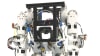
The RFI-detection module (see figure) compares raw data samples to a pair of register values that can be programmed to set the sensitivity of an RFI-detection algorithm. The first register value defines an amplitude threshold for counting a radar return sample as being “strong.” The second register value defines a “count-exceed” value for strong samples: if this value is exceeded during a given time window, an RFI flag for that time window is triggered. In effect, the RFI-detection module performs a coarse calculation of the probability density function of the received signal by gauging whether there are many outliers in an otherwise weak signal. Because the accounting is done at the full 16-MHz Nyquist sampling rate, temporal information is preserved in the algorithm down to the time scale of one sample (62.5 ns).
Gate signals that delineate the successive processing windows are sent from a separate FPGA radar-control-and-timing unit. The signal-power values calculated by the SP are sent to a buffer memory. At the beginning of a time window, a 12-bit down counter is loaded with the “count-exceed” value. During the window, the absolute-value sample data are compared with the RFI amplitude threshold register value. If a sample equals or exceeds the threshold, it is deemed to be an RFI-contaminated sample, and the 12-bit down-counter is decremented. If the down-counter reaches a value of zero before the end of the window, then the RFI flag is set, and buffered data for this window are labeled accordingly to tprevent further processing. The flag is cleared at the beginning of the next window.
For an electrically quiet scene, the noise-only voltage measurement yields a low-level Gaussian-distributed thermal noise signal (receiver noise plus the antenna brightness temperature). If RFI is present in sufficient strength, it contributes a coherent signal component that spreads the probability density function of the signal in such a manner as to cause the signal to be flagged by the RFI-detection module in the SP. It has been estimated that in the original intended spaceborne-radar-scatterometer application, the effects of RFI could be effectively mitigated by commanding the SP to detect peak power levels about 10 dB above the thermal noise floor of the radar receiver.
This work was done by Mark Fischman, Andrew Berkun, Anhua Chu, Adam Freedman, Michael Jourdan, Dalia McWatters, and Mimi Paller of Caltech for NASA’s Jet Propulsion Laboratory.
In accordance with Public Law 96-517, the contractor has elected to retain title to this invention. Inquiries concerning rights for its commercial use should be addressed to:
Innovative Technology Assets Management
JPL
Mail Stop 202-233
4800 Oak Grove Drive
Pasadena, CA 91109-8099
E-mail: This email address is being protected from spambots. You need JavaScript enabled to view it.
Refer to NPO-45045, volume and number of this NASA Tech Briefs issue, and the page number.
This Brief includes a Technical Support Package (TSP).
Interference-Detection Module in a Digital Radar Receiver
(reference NPO-45045) is currently available for download from the TSP library.
Don't have an account?
Overview
The document discusses the development of an Interference-Detection Module for a digital radar receiver, specifically designed for the Aquarius/SAC-D mission. This module addresses the challenges posed by Radio Frequency Interference (RFI), which can significantly affect the accuracy of radar measurements in satellite applications. Traditional radar scatterometers have limitations in detecting RFI due to their reliance on magnitude-squared detection methods, which can lose critical statistical information when averaging signals.
The newly developed Scatterometer Processor (SP) electronics unit operates in the L-band (1.26 GHz) and incorporates advanced square-law detection techniques. It enhances the ability to flag unwanted RFI in radar echoes by analyzing signal statistics at a high timescale resolution, allowing for improved signal-to-noise performance. The SP processes data at a bandwidth of up to 8 MHz, which is a significant improvement over previous systems that operated at lower bandwidths.
The RFI detection module is designed with a simple and efficient architecture, utilizing Field Programmable Gate Arrays (FPGAs) or Application-Specific Integrated Circuits (ASICs). The design includes programmable threshold and count-exceed registers that can be adjusted via ground command, allowing for real-time sensitivity adjustments while the instrument is in orbit. The RFI detection logic operates at a resolution of 62.5 ns, enabling timely decisions on whether to flag an echo as contaminated by RFI.
The document also provides insights into the reliability of the processor, noting a worst-case mean-time between failures of 2.2 years due to a low single-event upset rate of 3.6e-6 upsets/bit-day. This error rate is considered acceptable as errors are flushed within 10 ms, minimizing their impact on scientific data collection.
Overall, the document highlights the innovative technology developed for the Aquarius mission, which aims to improve the detection and processing of radar signals in the presence of RFI. This advancement is crucial for enhancing the quality of data collected from Earth observation satellites, ultimately contributing to better understanding and monitoring of environmental changes.