

The objectives of this work were to take the initial steps needed to develop a field programmable gate array (FPGA)- based wideband digital radiometer backend (>500 MHz bandwidth) that will enable passive microwave observations with minimal performance degradation in a radiofrequency- interference (RFI)-rich environment. As man-made RF emissions increase over time and fill more of the microwave spectrum, microwave radiometer science applications will be increasingly impacted in a negative way, and the current generation of spaceborne microwave radiometers that use broadband analog back ends will become severely compromised or unusable over an increasing fraction of time on orbit.
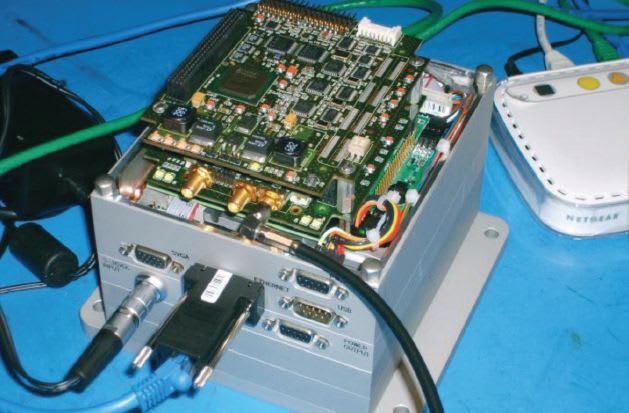
Ultimately, the objective is to incorporate all processing necessary in the back end to take contaminated input spectra and produce a single output value free of manmade signals to minimize data rates for spaceborne radiometer missions. But, to meet these objectives, several intermediate processing algorithms had to be developed, and their performance characterized relative to typical brightness temperature accuracy requirements for current and future microwave radiometer missions, including those for measuring salinity, soil moisture, and snow pack.
Digital radiometer back ends with similar capabilities currently exist based on older FPGA technology with significantly narrower input bandwidths (l0s of MHz). Wider bandwidths are now possible that will allow these back ends to meet the requirements of a much broader range of radiometer applications and future missions.
The approach was to design DSP modules for implementation using a commercial FPGA evaluation board with an integrated dual-channel analog-to-digital converter (ADC), high-speed interfaced FPGA, and high-data-rate embedded computer interface. The board was packaged with a PC104 embedded computer running a real-time O/S for data analysis, packetization, and storage. The complete system was programmed with appropriate firmware and software to function as an agile digital radiometer back end, capable of spectral sub-banding, kurtosis detection, RFI mitigation, and fully polarimetric complex correlation. It should be noted that this functionality duplicates and exceeds that of the existing Soil Moisture Active Passive brassboard digital back end, but with a factor of ~40 higher bandwidth.
This work advances the state-of-the-art in digital radiometer back ends by improving the system bandwidth by over an order of magnitude compared to other existing systems. It also makes possible the potential to include RFI mitigation onboard, which is critical for widebandwidth, multi-channel systems.
(At the time of this reporting, the SMAP mission has not been formally approved by NASA. The decision to proceed with the mission will not occur until the completion of the National Environmental Policy Act (NEPA) process. Material in this document related to SMAP is for information purposes only.)
This work was done by Todd C. Gaier and Shannon T. Brown of Caltech, and Christopher Ruf and Steven Gross of the University of Michigan for NASA’s Jet Propulsion Laboratory. NPO-48287
This Brief includes a Technical Support Package (TSP).
Wideband Agile Digital Microwave Radiometer
(reference NPO-48287) is currently available for download from the TSP library.
Don't have an account?
Overview
The document outlines the development of the Wideband Agile Digital Microwave Radiometer, a project led by Principal Investigator Shannon Brown at NASA's Jet Propulsion Laboratory (JPL). The primary objective of the project is to create a Field Programmable Gate Array (FPGA) based digital radiometer backend capable of operating with a bandwidth exceeding 500 MHz. This advancement aims to facilitate passive microwave observations while minimizing performance degradation in environments with significant radio-frequency interference (RFI).
The project has achieved several key milestones, including the development of a complete set of digital signal processing algorithms necessary for the wideband digital backend. These algorithms were successfully ported to firmware using Nallatech design tools, and the FPGA was designed to meet high-speed timing and synchronization requirements. The system digitizes pre-detection radiometric signals at a rate of 1.5 GS/s, allowing for the synchronous digitization of both vertical and horizontal polarized signals. This setup enables complex correlation for fully polarimetric detection.
The processing pipeline involves dividing the digitized signals into 14 spectral sub-bands, each 47 MHz wide, using a poly-phase filter bank. This spectral decomposition allows for the digital quadrature demodulation of the signals, generating In Phase (I) and Quadrature (Q) components. The I and Q components from both polarizations are then cross-correlated to compute the third and fourth Stokes components of brightness temperature.
The final processing stage computes the first, second, third, and fourth moments of the I and Q signals, which are essential for power-based radiometry and RFI detection. The second moments serve as square-law detectors, while the complete set of moments is used to assess the kurtosis of the incident signals, enabling the detection of low-level RFI.
The significance of this project lies in its potential to enhance the capabilities of future microwave radiometers for Earth science. The current generation of radiometer digital backends has demonstrated RFI mitigation only for analog bandwidths of around 24 MHz, which is insufficient for higher frequency applications. The successful demonstration of RFI-mitigating digital backends with bandwidths of 500 MHz or greater represents a crucial step forward for scientific objectives at frequencies above 10 GHz.
Overall, this project not only showcases advancements in microwave radiometry but also highlights the importance of developing technologies that can operate effectively in challenging environments, ultimately benefiting various Earth science missions.











