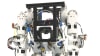

A control system strives to maintain the correct alignment of a laser beam in an interferometer dedicated to measuring the displacement or distance between two fiducial corner-cube reflectors. The correct alignment of the laser beam is parallel to the line between the corner points of the corner-cube reflectors: Any deviation from parallelism changes the length of the optical path between the reflectors, thereby introducing a displacement or distance measurement error.
On the basis of the geometrical optics of corner-cube reflectors, the length of the optical path can be shown to be L = L0cosθ, where L0 is the distance between the corner points and θ is the misalignment angle. Therefore, the measurement error is given by ΔL = L0(cosθ - 1). In the usual case in which the misalignment is small, this error can be approximated as ΔL ≈ -L0θ2/2.

The laser beam makes a round trip to both corner-cube reflectors and then interferes with the launched beam. The interference is detected on a photodiode. The length of the optical path is measured by a heterodyne technique: A 100-kHz frequency shift between the launched beam and a reference beam imposes, on the detected signal, an interferometric phase shift proportional to the length of the optical path. A phase meter comprising analog filters and specialized digital circuitry converts the phase shift to an indication of displacement, generating a digital signal proportional to the path length.
If the axis of the conical scan is correctly aligned, then the path-length signal is steady and the path-length error remains constant at about -L0θ02/2, where, in this case, θ0 is the half cone angle. If, however, the axis of the conical scan is slightly misaligned, then the misalignment angle consists of a steady component θ0 plus a small fluctuating component Δθ. In this case, the optical-path length fluctuates by approximately -L0θ0Δθ. In a lockin amplifier, the digital path-length signal is high-pass-filtered to eliminate the steady component, then the remaining fluctuating component is synchronously demodulated to generate DC signals proportional to the two tilt angles that characterize the misalignment. These signals are superimposed upon the voltages applied to the piezoelectric actuators to counteract the misalignment.
This work was done by Peter Halverson, Martin Regehr, Robert Spero, Oscar Alvarez- Salazar, Frank Loya, and Jennifer Logan of Caltech for NASA's Jet Propulsion Laboratory. For further information, access the Technical Support Package (TSP) free on-line at www.techbriefs.com/tsp under the Electronics/ Computers category. NPO-40957
This Brief includes a Technical Support Package (TSP).
Automatic Alignment of Displacement-Measuring Interferometer
(reference NPO-40957) is currently available for download from the TSP library.
Don't have an account?
Overview
The document is a Technical Support Package from NASA's Jet Propulsion Laboratory (JPL) concerning the "Automatic Alignment of Displacement-Measuring Interferometer," identified by NTR Number 40957. It is part of NASA Tech Briefs, which disseminate information on aerospace-related developments with potential broader technological, scientific, or commercial applications.
The primary focus of the document is on the innovation of automatic alignment techniques for displacement-measuring interferometers, which are critical tools in precision measurement and metrology. These devices are used to measure small displacements, changes in distance, or variations in surface profiles with high accuracy, making them essential in various fields, including aerospace, manufacturing, and scientific research.
The document references a conference presentation at the International Conference on Space Optics (ICSO 2000) held on December 5, 2000, where this technology was likely discussed in detail. It also cites a related publication in "Applied Optics," authored by Jennifer E. Logan, Peter G. Halverson, Martin W. Regehr, and Robert E. Spero, which provides further insights into the automatic alignment of a displacement-measuring heterodyne interferometer. This publication can be accessed online for more in-depth information.
Additionally, the document emphasizes the importance of compliance with U.S. export regulations, indicating that the information may contain proprietary data and is subject to export control. It encourages users to adhere to all applicable regulations when utilizing the information provided.
For those seeking further assistance or information, the document provides contact details for the NASA Scientific and Technical Information (STI) Program Office, including a website link and contact information for the NASA STI Help Desk. This resource is intended to support individuals looking for additional research and technology information related to the field of displacement metrology and interferometry.
In summary, this Technical Support Package serves as a valuable resource for understanding the advancements in automatic alignment technology for interferometers, highlighting its significance in precision measurement and its potential applications across various industries.