A metrology system that contains no moving parts simultaneously measures the bearings and ranges of multiple reflective targets in its vicinity, enabling determination of the three-dimensional (3D) positions of the targets with submillimeter accuracy. The system combines a direction-measuring metrology camera and an interferometric range-finding subsystem. Because the system is based partly on a prior instrument denoted the Modulation Sideband Technology for Absolute Ranging (MSTAR) sensor and because of its 3D capability, the system is denoted the MSTAR3D. Developed for use in measuring the shape (for the purpose of compensating for distortion) of large structures like radar antennas, it can also be used to measure positions of multiple targets in the course of conventional terrestrial surveying.
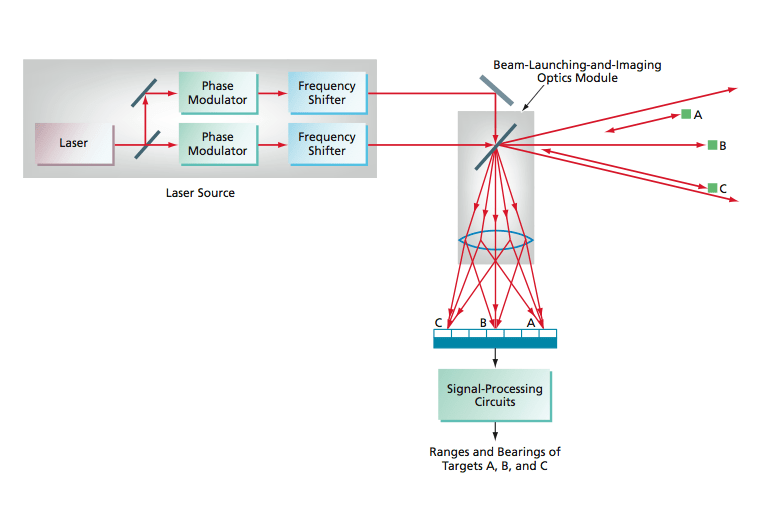
A diagram of the system is shown in the figure. One of the targets is a reference target having a known, constant distance with respect to the system. The system comprises a laser for generating local and target beams at a carrier frequency; a frequency shifting unit to introduce a frequency shift offset between the target and local beams; a pair of high-speed modulators that apply modulation to the carrier frequency in the local and target beams to produce a series of modulation sidebands, the high-speed modulators having modulation frequencies of FL and FM; a target beam launcher that illuminates the targets with the target beam; optics and a multi-pixel photodetector; a local beam launcher that launches the local beam towards the multi-pixel photodetector; a mirror for projecting to the optics a portion of the target beam reflected from the targets, the optics being configured to focus the portion of the target beam at the multi-pixel photodetector; and a signal-processing unit connected to the photodetector.
The portion of the target beam reflected from the targets produces spots on the multi-pixel photodetector corresponding to the targets, respectively, and the signal-processing unit centroids the spots to determine bearings of the targets, respectively. As the spots oscillate in intensity because they are mixed with the local laser beam that is flood illuminating the focal plane, the phase of oscillation of each spot is measured, the phase of sidebands in the oscillation of each spot being proportional to a distance to the corresponding target relative to the reference target A.
This work was done by Serge Dubovitsky, Carl Christian Liebe, Robert Peters, and Oliver Lay of Caltech for NASA’s Jet Propulsion Laboratory. NPO-42187
This Brief includes a Technical Support Package (TSP).
Metrology Camera System Using Two- Color Interferometry
(reference NPO-42187) is currently available for download from the TSP library.
Don't have an account?
Overview
The document discusses NASA's Metrology Camera System using Two-Color Interferometry, a technology designed to achieve high-precision measurements of the coordinates of multiple fiducial points on large aerospace structures. This capability is essential for applications such as controlling the figure of spaceborne antennas and phased array radars, where precise adjustments are necessary based on structural deflections.
The system operates by using a laser beam to flood illuminate retroreflectors placed on the target structure. The retroreflectors return the laser light, which is captured by a high-speed camera, producing images that appear as bright spots. The position of these spots allows for the determination of the bearing angles of the targets. Simultaneously, a second beam, known as the Local Oscillator (LO), illuminates the camera's focal plane. The interference between the returning light from the targets and the LO beam creates intensity variations at a difference frequency, which the camera measures.
The key innovation lies in the ability to measure the phase of these oscillations, which is proportional to the distance to each target. This phase information, combined with an additional phase modulation technique known as Modulation Sideband Technology for Absolute Ranging (MSTAR), enables the system to determine absolute distances to the targets with sub-millimeter accuracy.
The document highlights the advantages of this technology over traditional methods, which often require multiple gauges or moving parts, leading to increased complexity, cost, and potential reliability issues. The MSTAR3D system, a combination of the MSTAR sensor and the Array Heterodyne Interferometer, allows for simultaneous measurement of multiple targets without moving parts, significantly enhancing operational efficiency.
Furthermore, the document outlines the performance predictions and error budgets associated with the technology, indicating that it can accurately determine the positions of thousands of targets simultaneously. This capability is particularly beneficial for applications in aerospace, where precise measurements are critical for the successful operation of instruments and systems.
In summary, NASA's Metrology Camera System using Two-Color Interferometry represents a significant advancement in metrology technology, offering a reliable, efficient, and accurate solution for measuring the three-dimensional positions of multiple targets in aerospace applications.