An experimental traveling-wave photomixing device generates narrow-band electromagnetic radiation at frequencies up to a few terahertz. The device is, potentially, a prototype of terahertz local oscillators for heterodyne instrumentation for submillimeter-wavelength spectrometry and related scientific applications.
Devices that exploit traveling-wave photomixing to generate radio-frequency signals have been developed previously, but not for the terahertz frequency range. Conventional photomixers (that are not based on traveling waves) with terahertz outputs have also been developed previously, but have been limited as follows: In a conventional photomixer, the output power is proportional to the square of the photocurrent, and the bandwidth is limited by the lifetimes of photoexcited charge carriers and by the electrode capacitance. Therefore, such a photomixer must be designed to have (1) a narrow electrode gap for high photocurrent and (2) a small active area for small capacitance in order to obtain adequate bandwidth. Unfortunately, the smallness of the area of such a device limits its power-handling capability and thus its terahertz output power.
The present device is designed to overcome the limitations of conventional photomixers. It exploits a traveling-wave principle to distribute the generation of the terahertz signal over a relatively large area, so that a relatively large amount of power can be handled without exceeding the damage-threshold laser power density. Another essential element of the design is that the illuminated traveling-wave area is occupied by a transmission-line structure, which is not subject to the electrode-capacitance bandwidth limitation.
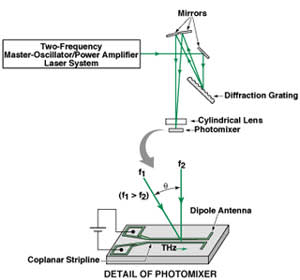
The device (see figure) consists of a dc-biased coplanar strip line terminated by an antenna fabricated on a low-temperature-grown GaAs film. The active area is illuminated by two laser beams that differ somewhat in frequency and are tilted at an angle with respect to each other in order to generate optical interference fringes that move along the strip line. The heterodyne mixing process generates charge-density waves that oscillate at the difference frequency and that are accompanied by terahertz traveling electromagnetic waves. If the velocity of the optical fringes and the group velocity of the terahertz waves are equalized, then the terahertz waves become coherently superposed and are effectively emitted by the antenna. For a given difference frequency, the angle between the two laser beams is adjusted to obtain the phase and velocity match needed for coherent superposition.
This work was done by Rolf Wyss and Shuji Matsuura of Caltech for NASA's Jet Propulsion Laboratory. For further information, access the Technical Support Package (TSP) free on-line at www.techbriefs.com under the Electronic Components and Systems category.
NPO-20717
This Brief includes a Technical Support Package (TSP).
Traveling-Wave Photomixer With Angle-Tuned Phase Matching
(reference NPO20717) is currently available for download from the TSP library.
Don't have an account?
Overview
The document discusses an innovative experimental device called a traveling-wave photomixer, developed by Rolf Wyss and Shuji Matsuura at NASA's Jet Propulsion Laboratory. This device is designed to generate narrow-band electromagnetic radiation at terahertz frequencies, which could serve as a prototype for local oscillators in heterodyne instrumentation for submillimeter-wavelength spectrometry and other scientific applications.
Traditional photomixers have limitations in the terahertz frequency range, primarily due to their output power being proportional to the square of the photocurrent and bandwidth constraints imposed by the lifetimes of photoexcited charge carriers and electrode capacitance. Conventional designs require a narrow electrode gap for high photocurrent and a small active area to minimize capacitance, which in turn limits power-handling capability and terahertz output power.
The traveling-wave photomixer addresses these limitations by utilizing a traveling-wave principle that distributes terahertz signal generation over a larger area. This design allows for handling a greater amount of power without exceeding the damage-threshold laser power density. The device features a dc-biased coplanar strip line terminated by an antenna, fabricated on a low-temperature-grown GaAs film. It operates by illuminating the active area with two laser beams of slightly different frequencies, which are angled to create optical interference fringes that move along the strip line. This setup generates charge-density waves oscillating at the difference frequency, accompanied by terahertz traveling electromagnetic waves.
A key aspect of the device is the phase matching between the optical fringes and the group velocity of the terahertz waves, which enables coherent superposition and effective emission of terahertz waves by the antenna. The angle between the two laser beams can be adjusted to achieve the necessary phase and velocity match.
The document emphasizes the novelty of this approach, highlighting its ability to generate submillimeter radiation in a distributed structure, which enhances both the intrinsic bandwidth and total output power. The design also allows for large active areas with laser power densities well below damage thresholds, reducing radiation losses and facilitating integration with planar antenna technology.
Overall, this traveling-wave photomixer represents a significant advancement in terahertz technology, with potential applications in various scientific fields.