A scheme for stabilizing the frequency of a microwave signal is proposed that exploits the operational characteristics of a coupled optoelectronic oscillator (COEO) and related optoelectronic equipment. An essential element in the scheme is a fiber mode-locked laser (MLL), the optical frequency of which is locked to an atomic transition. In this scheme, the optical frequency stability of the mode-locked laser is transferred to that of the microwave in the same device. Relative to prior schemes for using wideband optical frequency comb to stabilize microwave signals, this scheme is impler and lends itself more readily to implementation in relatively compact, rugged equipment. The anticipated development of small, low-power, lightweight, highly stable microwave oscillators based on this scheme would afford great benefits in communication, navigation, metrology, and fundamental sciences.
COEOs of various designs, at various stages of development, in some cases called by different names, have been described in a number of prior NASA Tech Briefs articles. A COEO is an optoelectronic apparatus that generates both short (picosecond) optical pulses and a steady microwave signal having an ultra-high degree of spectral purity. The term “coupled optoelectronic” in the full name of such an apparatus signifies that its optical and electronic oscillations are coupled to each other in a single device.
The present frequency-stabilization scheme is best described indirectly by describing the laboratory apparatus used to demonstrate it. The apparatus (see figure) includes a COEO that generates a comb-like optical spectrum, the various frequency components of which interfere, producing short optical pulses. This spectrum is centered at a nominal wavelength of 1,560 nm. The spectrum separation of this comb is about 10 GHz, as determined primarily by the length of an optical loop and the bandpass filter in the microwave feedback loop. The optical loop serves as microwave resonator having a very high value of the resonance quality factor (Q). The optical frequency of MLL is then stabilized by locking it to an atomic transition as described below.
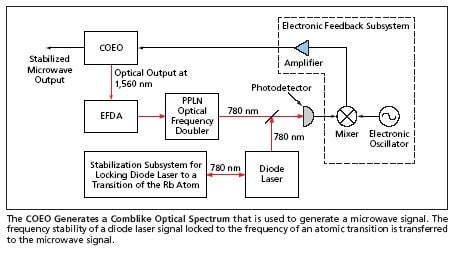 The COEO contains a tunable 1-nm band-pass optical filter and a piezoelectric transducer (PZT) drum over which a stretch of fiber is wound. The 1-nm-wide pass band of the filter provides coarse tuning to overlap the frequency comb with the atomic transition frequency. Controlled stretching of the fiber by means of the PZT drum can be used in conjunction with temperature control for locking the laser frequency. To reference to an atomic resonance at 780 nm in this demonstration setup, the optical output of the COEO at 1,560 nm is fed through an erbium-doped fiber amplifier (EDFA) to a frequency doubler in the form of a periodically poled lithium niobate (PPLN) crystal. The frequency doubled output is combined with the output of a separate frequency-stabilized diode laser at a photodetector. As described thus far, the two 780-nm laser subsystems are nominally independent of each other and can, therefore, operate at different frequencies. Hence, at the photodetector, the two laser beams interfere, so that the output of the photodetector includes a beat note (a component at the difference between the two laser frequencies).
The beat note is used to stabilize the relative frequency between the two optical signals through a simple electronic feedback subsystem that adjusts the voltage applied to the PZT to lock the optical frequency of the COEO to that of the diode laser. The diode laser is frequency stabilized to the atomic absorption of Rb vapor through frequency modulation (FM) saturation spectroscopy. The fractional frequency stability of it has been shown to be 10–12 at 1 second. After further optimization of design to minimize destabilizing effects, it may be possible to attain a longterm stability at 10–13. Such optical frequency stability can be transferred to the microwave in the COEO device where the optical and microwave oscillators are coupled, and hence producing a highly stable microwave signal.
This work was done by Lute Maleki, Nan Yu, and Meirong Tu of Caltech for NASA’s Jet Propulsion Laboratory. For further information, access the Technical Support Package (TSP) free on-line at www.techbriefs.com/tsp under the Electronics/Computers category. NPO-43026
This Brief includes a Technical Support Package (TSP).
Stabilizing Microwave Frequency of a Photonic Oscillator
(reference NPO-43026) is currently available for download from the TSP library.
Don't have an account?
Overview
The document titled "Stabilizing Microwave Frequency of a Photonic Oscillator" (NPO-43026) is a Technical Support Package from NASA's Jet Propulsion Laboratory (JPL) that outlines advancements in the stabilization of microwave frequencies in photonic oscillators. This innovation is particularly relevant for applications in aerospace technology, where precise frequency control is crucial for various systems, including communication and navigation.
The primary focus of the document is on the frequency stabilization of coupled optoelectronic oscillators by stabilizing their optical frequency. This process is essential for enhancing the performance and reliability of photonic oscillators, which are devices that generate microwave signals using light. By stabilizing the optical frequency, the document suggests that the overall stability and accuracy of the microwave output can be significantly improved.
The Technical Support Package is part of NASA's Commercial Technology Program, which aims to disseminate aerospace-related developments that have broader technological, scientific, or commercial applications. The document serves as a resource for researchers, engineers, and industry professionals interested in the latest innovations in photonic technology and its potential applications.
Additionally, the document provides information on how to access further resources and assistance through NASA's Scientific and Technical Information (STI) Program Office. It includes contact details for the NASA STI Help Desk, which can provide additional support and information regarding research and technology in this field.
The document also includes a notice regarding the proprietary nature of the information contained within, emphasizing compliance with U.S. export regulations and the importance of acknowledging privately owned rights. It clarifies that the use of any trade names or manufacturers' names is for identification purposes only and does not imply official endorsement by NASA.
In summary, the Technical Support Package on "Stabilizing Microwave Frequency of a Photonic Oscillator" presents a significant advancement in the field of optoelectronics, highlighting the importance of frequency stabilization for enhancing the performance of photonic oscillators. It serves as a valuable resource for those involved in aerospace technology and related fields, providing insights into innovative developments and access to further information through NASA's resources.