
Capillography (from the Latin capillus, “hair”, and the Greek graphein, “to write”) is a recently conceived technique for forming mats of nanofibers into useful patterns. The concept was inspired by experiments on carpet-like mats of multi-walled carbon nanotubes. Capillography may have the potential to be a less-expensive, less-time-consuming alternative to electron-beam lithography as a means of nanoscale patterning for the fabrication of small devices and instruments.

In capillography, one exploits the lateral capillary forces exerted on small objects that pierce the surface of a liquid. If the small objects are identical, then the forces are always attractive. Two examples of the effects of such forces are the agglomeration of small particles floating on the surface of a pond and the drawing together of hairs of a wet paintbrush upon removal of the brush from water. Because nanoscale objects brought into contact remain stuck together indefinitely due to Van der Waals forces, patterns formed by capillography remain even upon removal of the liquid.
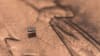
For the experiments on the mats of carbon nanotubes, a surfactant solution capable of wetting carbon nanotubes (which are ultra- hydrophobic) was prepared. The mats were wetted with the solution, then dried. Once the mats were dry, it was found that the nanotubes had become ordered into various patterns, including nestlike indentations, trenches, and various combinations thereof (see figure).
It may be possible to exploit such ordering effects through controlled wetting and drying of designated portions of mats of carbon nanotubes (and, perhaps, mats of nanofibers of other materials) to obtain patterns similar to those heretofore formed by use of electron-beam lithography. For making patterns that include nestlike indentations, it has been conjectured that it could be possible to control the nesting processes by use of electrostatic fields. Further research is needed to understand the physics of the patterning processes in order to develop capabilities to control patterns formed in capillography.
This work was done by Flavio Noca, Elijah Sansom, Jijie Zhou, and Mory Gharib of Caltech for NASA’s Jet Propulsion Laboratory.
In accordance with Public Law 96-517, the contractor has elected to retain title to this invention. Inquiries concerning rights for its commercial use should be addressed to:
Innovative Technology Assets Management
JPL
Mail Stop 202-233
4800 Oak Grove Drive
Pasadena, CA 91109-8099
(818) 354-2240
E-mail: This email address is being protected from spambots. You need JavaScript enabled to view it.
Refer to NPO-40980, volume and number of this NASA Tech Briefs issue, and the page number.
This Brief includes a Technical Support Package (TSP).
Capillography of Mats of Nanofibers
(reference NPO-40980) is currently available for download from the TSP library.
Don't have an account?
Overview
The document titled "Capillography of Mats of Nanofibers" (NPO-40980) from NASA's Jet Propulsion Laboratory discusses an innovative technique for nanoscale patterning that leverages capillary forces, presenting a promising alternative to traditional e-beam lithography, which is often time-consuming and expensive.
The core problem addressed is the inefficiency of e-beam lithography for patterning surfaces at the nanoscale. The proposed solution involves using capillary forces generated during the drying of wet films to create patterns of fibers on surfaces. When small particles penetrate a fluid interface, they experience significant attractive forces due to surface tension, which can be harnessed to manipulate nanoscale materials effectively.
The document specifically focuses on carbon nanotubes, which are cylindrical structures made entirely of carbon arranged in hexagonal patterns. These nanotubes can be produced in large, ordered arrays on substrates, resembling a field of grass at a microscopic scale. The research highlights the use of surfactant solutions to treat carbon nanotube mats, allowing the liquid to penetrate and wick through the mat. This process results in many nanoscale fibers interacting with the liquid-air interface, where lateral capillary forces act to assemble the fibers into specific patterns.
Experiments demonstrated that the wetting and drying of carbon nanotube mats lead to the reorientation of the nanotubes, transforming their configurations into distinct formations, referred to as "nests." These nests exhibit various shapes, such as semi-circular or trench-like structures, formed by the strong lateral capillary forces acting on the nanotubes.
The novelty of this approach lies in its ability to assemble large numbers of nanoscale structures in predetermined ways, addressing a significant challenge in current technologies involving carbon nanotubes and other nanoscale materials. The document emphasizes that using fluids to control the arrangement of nanoscale objects offers a promising solution to this problem.
In summary, the document outlines a groundbreaking method for nanoscale patterning using capillary forces, particularly focusing on carbon nanotube mats. This technique not only provides a faster and more cost-effective alternative to traditional methods but also opens new avenues for research and applications in various technological fields.