Fiber geometries could be tailored for pumping, filtering, mixing, separating, and other effects.
NASA’s Jet Propulsion Laboratory, Pasadena, California
Nanowicks are dense mats of nanoscale fibers that are expected to enable the development of a variety of novel capillary pumps, filters, and fluidic control devices. Nanowicks make it possible obtain a variety of novel effects, including capillary pressures orders of magnitude greater than those afforded by microscale and conventional macroscale wicks. While wicking serves the key purpose of transporting fluid, the nanofiber geometry of a nanowick makes it possible to exploit additional effects — most notably, efficient nanoscale mixing, fluidic effects for logic or control, and ultrafiltration (in which mats of nanofibers act as biomolecular sieves).
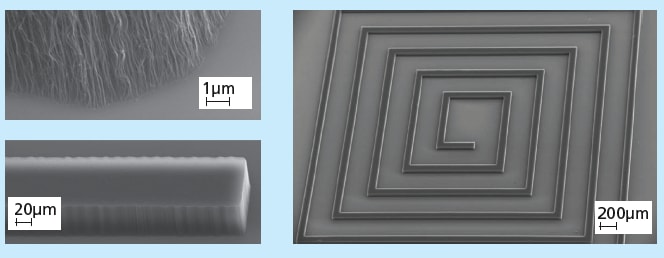
Figure 1. This Scanning Electron Micrograph depicts a nanowick in the form of a mat of carbon nanotubes,which can be grown in a tailorable pattern as shown on the right. A nanowick (see Figure 1) typically consists of carbon nanotubes grown normal to a substrate in a tailorable pattern. The liquid of interest is constrained to flow in the interstices between the fibers. (In practice, the liquid must include a surfactant because carbon nanotubes are hydrophobic.) By suitable control of the growth process, the interfiber distance and/or the fiber length can be made to range from nanometers to millimeters and to vary with position (in one or two dimensions) on the substrate. Similarly, the fiber diameter can be made to vary with position. The spatial variation in spacing and/or diameter can be chosen to obtain such effects as prescribed spatial variations in wicking speed or prescribed degrees of separation among different biomolecules.
The following are examples of potential applications and potential variations in designs of nanowicks:
Figure 2. A Drop of Liquid would be placed on ananowick. The liquid would be absorbed intothe wick and transported by capillary action. Somewhat analogously to strips of litmus paper, wicking chips could be made as disposable devices for rapid testing of liquids. To start a test, a drop of liquid would be placed on top of the array of nanofibers on a wicking chip (see Figure 2). After absorption of the drop and transport of the liquid by wicking, the liquid could be filtered and analyzed (for viscosity, for example) in a very simple manner, without need for any complicated pumping mechanism.
A liquid could be made to flow continuously, as in a capillary-pumped loop. The liquid would enter a nanowick at one end, would flow through the mat of fibers by capillary action, and would be made to evaporate at the other end. The evaporation would sustain the pumping action in the same manner in which evaporation of water from leaves sustains capillary pumping in living plants.
A nanowick could serve as both a filter and a pump: While a liquid was flowing through a nanowick, the fibers could trap particles and large molecules (for example, protein and deoxyribonucleic acid molecules).
The pattern of nanofibers could be tailored to exploit a combination of diffusion and extensional flow to promote nanoscale mixing of two liquids.
Nanowicks could be patterned to act as various fluidic logic devices, including ones that exert fluidic effects analogous to the electrical effects of transistors and diodes. Unlike macroscale and microscale fluidic devices, the nanowickbased fluidic devices could, conceivably, be designed and built without channels and could operate without mechanical pumps.
It might be possible to construct nanowicks in which selective wicking could be controlled electrically.
Although capillary forces would suffice to contain a liquid within a nanowick, without need to place the wick in a channel, the nanowick could be capped, if desired, to prevent evaporation.
Nanowicks could be used to transport liquids through interstitial spaces into which tubes could not inserted.
This work was done by Flavio Noca, Michael Bronikowski, Elijah Sansom, Jijie Zhou, and Morteza Gharib of Caltech for NASA's Jet Propulsion Laboratory. For more information, download the Technical Support Package (free white paper) at www.techbriefs.com/tsp under the Materials category.
In accordance with Public Law 96-517, the contractor has elected to retain title to this invention. Inquiries concerning rights for its commercial use should be addressed to:
Innovative Technology Assets Management
JPL
Mail Stop 202-233
4800 Oak Grove Drive
Pasadena, CA 91109-8099
(818) 354-2240
E-mail: This email address is being protected from spambots. You need JavaScript enabled to view it.
Refer to NPO-40440, volume and number of this NASA Tech Briefs issue, and the page number.
This Brief includes a Technical Support Package (TSP).
Nanowicks
(reference NPO-40440) is currently available for download from the TSP library.
Don't have an account?
Overview
The document is a technical support package from NASA's Jet Propulsion Laboratory (JPL) detailing advancements in nanofluidic technology, specifically focusing on a novel fluid transport device known as the "nanowick." This device operates without pumps, utilizing capillary-like forces to move fluids through dense mats of nanoscale fibers with adjustable spacing. The nanowick addresses significant challenges in fluid transport at the nanoscale, particularly the high pressures required to push fluids through small channels, which can be impractical due to viscosity effects.
The document outlines the motivation behind the development of the nanowick, emphasizing its potential applications in aeronautics and space activities, particularly for NASA. Traditional methods of pumping fluids through sub-micron channels necessitate bulky pumps that contradict the miniaturization goals of space technology. The nanowick offers a solution by generating significantly higher capillary pressures, making it suitable for applications such as astrobiology and space medicine.
Key features of the nanowick include its ability to facilitate efficient nanoscale mixing, act as a biomolecular sieve for ultrafiltration, and function as fluidic components like diodes and transistors. The design allows for easy optical access and fluid injection, enhancing its utility in various experimental setups. Additionally, the wick can be capped to enable conventional channel flow with limited evaporation, making it versatile for different fluid transport scenarios.
The document also references ongoing work at NASA Goddard on Capillary Pumped Loops (CPL) for satellite cooling, which utilize wicks based on microscale porous media. The nanowick technology represents a significant advancement over these existing systems, providing a more efficient means of fluid transport in space applications.
In summary, the document presents the nanowick as a groundbreaking innovation in fluid transport technology, with the potential to revolutionize how fluids are managed in micro and nanoscale environments, particularly in the context of space exploration and aeronautics. The research highlights the importance of addressing the challenges of fluid dynamics at the nanoscale and the implications for future technological developments in these fields.