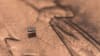
IMLI offers several potential advantages over conventional MLI.
John H. Glenn Research Center
Integrated multilayer insulation (IMLI) is being developed as an improved alternative to conventional multilayer insulation (MLI), which is more than 50 years old. A typical conventional MLI blanket comprises between 10 and 120 metallized polymer films separated by polyester nets. MLI is the best thermal-insulation material for use in a vacuum, and is the insulation material of choice for spacecraft and cryogenic systems. However, conventional MLI has several disadvantages: It is difficult or impossible to maintain the desired value of gap distance between the film layers (and consequently, it is difficult or impossible to ensure consistent performance), and fabrication and installation are labor-intensive and difficult. The development of IMLI is intended to overcome these disadvantages to some extent and to offer some additional advantages over conventional MLI.
Figure 1. In this Prototype Assembly, a discrete matrix comprising a square array of square frames is placed on a metallized polymer film. In constructing a multilayer insulation blanket, arrays like this one would be placed between all the metallized polymer film layers. The main difference between IMLI and conventional MLI lies in the method of maintaining the gaps between the film layers. In IMLI, the film layers are separated by what its developers call a micro-molded discrete matrix, which can be loosely characterized as consisting of arrays of highly engineered, small, lightweight, polymer (typically, thermoplastic) frames attached to, and placed between, the film layers (see Figure 1). The term “micro-molded” refers to both the smallness of the frames and the fact that they are fabricated in a process that forms precise small features, described below, that are essential to attainment of the desired properties. The term “discrete” refers to the nature of the matrix as consisting of separate frames, in contradistinction to a unitary frame spanning entire volume of an insulation blanket.
Figure 2. Post-and-Beam Frames would be molded as integral units. Posts in each layer would be joined end-to-end with posts in the next layer by means of integral snap joints. Figure 2 depicts selected aspects of a frame according to one design concept. The frame would consist of posts and beams. Assembly would be relatively easy. The ends of the posts would mate with holes in the film layers. Posts in successive frame layers would be joined end-to-end by snap joints that would be molded as integral parts of the posts. The desired separation distance between film layers would be maintained consistently because the film layers would be clamped between adjoining posts at the snap joints. The snap joints would have features that would make it easy to snap the posts together and impossible to snap apart. The posts and frames would maintain sufficient gaps for outgassing. For a terrestrial application in which it is required to evacuate the interior spaces, the posts could also support an outer metal layer that would serve as a vacuum shell.
Because the distance between layers could be maintained consistently, it would be possible to optimize this distance and the concomitant dimensions of the frames to provide the necessary structural support while minimizing the contact area and the associated conductive heat leak through the frame. Thus, relative to conventional MLI, IMLI would be a more highly engineered system. The matrix spacer is designed to reduce heat conduction to minimum levels, and the multiple radiation shields reduce radiative heat leak, so that the entire insulation system is near the radiation limit. Thermal modeling indicated IMLI should have a thermal conductivity 63% that of conventional MLI. It has been estimated that in a typical application, the mass of an IMLI panel with a vacuum shell would be approximately one-third that of an equivalent conventional MLI with a vacuum shell. Phase II work in progress has developed a second generation IMLI system with a calculated heat leak of 0.139 W/m2 (e* = 0.000325) for a 40-layer blanket, which is less than half the heat leak of traditional MLI.
This work was done by Scott Dye of Quest Product Development Corp. for Glenn Research Center.
Inquiries concerning rights for the commercial use of this invention should be addressed to NASA Glenn Research Center, Innovative Partnerships Office, Attn: Steve Fedor, Mail Stop 4–8, 21000 Brookpark Road, Cleveland, Ohio 44135. Refer to LEW- 18270-1/1-1.