A further improvement has been made to reduce the high-temperature thermal conductivities of the aerogel-matrix composite materials described in “Improved Silica Aerogel Composite Materials” (NPO-44287), NASA Tech Briefs, Vol. 32, No. 9 (September 2008), page 50. Because the contribution of infrared radiation to heat transfer increases sharply with temperature, the effective high-temperature thermal conductivity of a thermal-insulation material can be reduced by opacifying the material to reduce the radiative contribution. Therefore, the essence of the present improvement is to add an opacifying constituent material (specifically, TiO2 powder) to the aerogel-matrix composites.
To recapitulate from the cited prior article: A material of the type to which this improvement applies consists of a silica aerogel matrix reinforced with silica fibers and silica powder. The advantage of an aerogel-matrix composite material of this type, relative to neat aerogels and prior aerogel-matrix composites, lies in formulations and processes that result in superior properties, which include (1) much less shrinkage during a supercritical-drying process employed in producing a typical aerogel, (2) much less shrinkage during exposure to high temperature, and (3) as a result of the reduction in shrinkage, much less or even no cracking.
An opacified aerogel-matrix/silicapowder/ silica-fiber composite is synthesized by means of a sol-gel process. Except for the addition of the TiO2 powder, the process is almost identical to that used to make the prior, non-opacified version. The first step is to make a silica sol composed of tetramethylorthosilicate, methanol, acetonitrile, and nitric acid through refluxing. The second step is to prepare a solution for casting the composite aerogel: Fumed silica (325-mesh powder having specific surface area of about 200 m2/g), silica powder (particle sizes between 1 and 2 μm) and TiO2 powder (also in particle sizes between 1 and 2 μm) are suspended in acetonitrile and then the silica sol, water, and ammonium hydroxide base are added to the acetonitrile/powder suspension. After thus preparing the aerogel-casting solution, a piece of silica fiber felt (destined to become the fiber reinforcement in the composite) isplaced in a mold. Then the aerogel-casting solution is poured into the mold, where it permeates the silica fiber felt. After the solution has gelled, the casting is transferred to an autoclave filled with acetonitrile, wherein the casting is subjected to supercritical drying at a temperature of 295 °C and pressure of 5.5 MPa.
This work was done by Jong-Ah Paik, Jeffrey Sakamoto, Steven Jones, Jean-Pierre Fleurial, Salvador DiStefano, and Bill Nesmith of Caltech for NASA’s Jet Propulsion Laboratory. For more information, download the Technical Support Package (free white paper) at www.techbriefs.com/tsp under the Materials category.
In accordance with Public Law 96-517, the contractor has elected to retain title to this invention. Inquiries concerning rights for its commercial use should be addressed to:
Innovative Technology Assets Management
JPL
Mail Stop 202-233
4800 Oak Grove Drive
Pasadena, CA 91109-8099
E-mail: This email address is being protected from spambots. You need JavaScript enabled to view it.
Refer to NPO-44732, volume and number of this NASA Tech Briefs issue, and the page number.
This Brief includes a Technical Support Package (TSP).
Composite Silica Aerogels Opacified With Titania
(reference NPO-44732) is currently available for download from the TSP library.
Don't have an account?
Overview
The document titled "Composite Silica Aerogels Opacified With Titania" from NASA's Jet Propulsion Laboratory discusses advancements in aerogel technology, specifically focusing on the incorporation of titanium dioxide (TiO2) to enhance the thermal insulation properties of silica aerogels. Aerogels are known for their exceptional thermal insulation capabilities, and the addition of TiO2 is aimed at optimizing their performance across various temperature ranges.
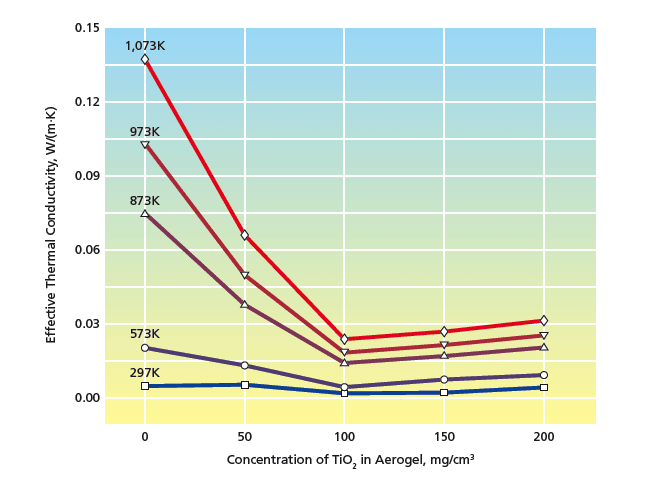
Key findings from the research indicate that the thermal conductivity of aerogels decreases with the addition of TiO2 up to a certain point. Specifically, the study shows that aerogels with 100 mg/cc of TiO2 exhibit the lowest thermal conductivity below 500 °C, while those with 150 mg/cc TiO2 perform better at higher temperatures. The results suggest that the optimal concentration of TiO2 for effective thermal insulation lies between 100 mg/cc and 150 mg/cc. Beyond this range, the increase in conductive heat transfer due to additional TiO2 outweighs the benefits of reduced radiative heat transfer, leading to an overall increase in thermal conductivity.
The document also highlights the effectiveness of aerogels in blocking both conductive and convective heat transfer, making them superior thermal insulators compared to traditional materials like Microtherm® at lower temperatures. The unique nano-scale structure of aerogels contributes to their ability to scatter radiation heat transfer, which is crucial for applications requiring high thermal resistance.
Thermal diffusivity measurements were conducted using the step heat method, and specific heat was assessed using a differential scanning calorimeter. The findings are visually represented in figures comparing the thermal conductivities of various aerogel samples with differing TiO2 concentrations.
Overall, the research underscores the potential of optimized aerogel formulations for a wide range of applications, particularly in aerospace and other industries where efficient thermal insulation is critical. The document serves as a technical support package, providing insights into the development of advanced materials that can meet the demands of modern technology while also being subject to export control regulations.