

A system of electronic hardware and software for synchronizing recordings from multiple, physically separated video cameras is being developed, primarily for use in multiple-look- angle video production. The system, the time code used in the system, and the underlying method of synchronization upon which the design of the system is based are denoted generally by the term “GeoTimeCode™.” The system is embodied mostly in compact, lightweight, portable units (see figure) denoted video timecode units (VTUs) — one VTU for each video camera. The system is scalable in that any number of camera recordings can be synchronized. The estimated retail price per unit would be about $350 (in 2006 dollars).
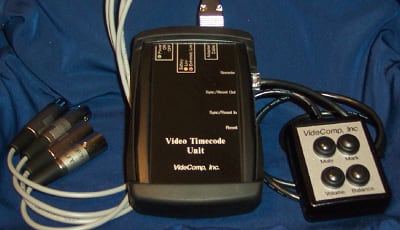
Each VTU contains a free-running, extremely stable clock, based on a 32,768-Hz (215-Hz) quartz-crystal oscillator. The clock begins a binary count up from zero when reset and continues counting up until reset again (or until it automatically restarts from zero when the time code repeats after more than 136 years). Each VTU also contains digital and analog audio circuitry required for synchronization of video recording.
The GeoTimeCode is a variant of the Inter Range Instrumentation Group B (IRIG-B) time code, which is widely used in the aerospace industry. The GeoTimeCode can easily be converted to other standard time codes, including the Society of Motion Picture and Television Engineers (SMPTE) time code. The GeoTimeCode is similar enough to the IRIG-B time code that software can easily be adapted to read either code.
A VTU can be synchronized to a Universal Time source (e.g., an Internet time server or a radio time signal) or to other, possibly distant VTUs by use of a computer equipped with the appropriate software and ancillary electronic hardware. Optionally, without using a computer, multiple VTUs can be synchronized with each other by temporarily connecting them together via standard patch cables and pressing a reset button. At the instant when synchronization is performed, the synchronization is accurate to within less than a millisecond. Synchronization can be done either before or after a video recording is made; the clock in a VTU is stable and accurate enough that as long as synchronization is performed within about 8 hours of recording, timing is accurate to within 0.033 second (a typical video frame period).
A portion of the time code is reserved for a serial number that identifies each VTU and, hence, the camera from which each recording is taken. Another portion of the time code is reserved for event markers, which can be added manually during recording by means of a pushbutton switch. Each event marker includes an event number from a counter that is incremented for each event. The serial numbers and event markers can be used to identify specific image sequences during post processing of video images by editing software.
This work was done by William “Bud” Nail, William L. Nail, Jasper M. Nail, and Duong T. Le of Technological Services Co. for Stennis Space Center.
Inquiries concerning rights for the commercial use of this invention should be addressed to:
Technological Services Company
100 Street A, Suite B
Picayune, MS 39466
(601) 799-2403
E-mail:
Refer to SSC-00253, volume and number of this NASA Tech Briefs issue, and the page number










