

A very-large-scale- integrated-circuit (VLSI) turbo decoder has been designed to serve as a compact, high-throughput, low-power, lightweight decoder core of a receiver in a data-communication system. In a typical contemplated application, such a decoder core would be part of a single integrated circuit that would include the rest of the receiver circuitry and possibly some or all of the transmitter circuitry, all designed and fabricated together according to an advanced communication-system-on-a-chip design concept.
Turbo codes are forward-error-correction (FEC) codes. Relative to older FEC codes, turbo codes enable communication at lower signal-to-noise ratios and offer greater coding gain (closer to the Shannon theoretical limit). In addition, turbo codes can be implemented by relatively simple hardware. Therefore, turbo codes have been adopted as standard for some advanced broadband communication systems.
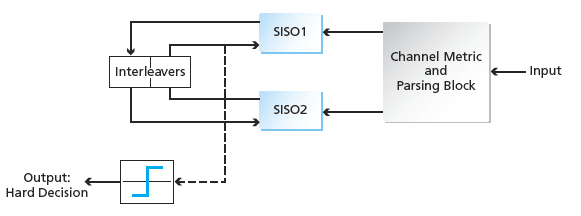
In general, a turbo encoder is equivalent to two convolutional encoders plus a lookup table that stores interleaver addresses; a turbo decoder (see figure) includes a channel metric and parsing block, two soft-input/ soft-output (SISO) decoders (denoted SISO1 and SISO2), and a random-access memory (RAM) for interleaving/deinterleaving functions. The received signal is first processed and parsed through the channel metric and parsing block, the output of which is a sequence of estimates that indicate how closely each received bit is deemed to resemble a one or a zero. On the basis of these estimates, SISO1 makes “soft” decisions: a soft decision is a statement of the probability that each received bit is a one or a zero, based on the preceding sequence of bits.
The soft decisions made by SISO1 are interleaved to be included in the input to SISO2, which then makes soft decisions based on both the estimates from the channel metric and parsing block and the soft decisions from SISO1. These soft decisions are again interleaved and sent as input to SISO1. Now, SISO1 has more information to use than it had on the previous iteration and it strives to use the additional information to make a more accurate decision. The iterative decoding process is repeated either a fixed number of times or until some other criterion is satisfied. Then hard decisions are made on the basis of the soft decisions. Intuitively, if the probability of a zero exceeds that of a one for a given bit, then the hard decision will be that a zero was transmitted.
A description of the practical implementation of the above-described decoder architecture in terms of functional blocks of circuitry, the functions (including memory reading and writing, calculations, and comparisons) performed by the blocks, and timing of the functions would greatly exceed the space available for this article. It must suffice to summarize by reporting that some details of the architecture of the implementation are especially important for the overall design: The details in question include those of the timing of memory reading and writing operations, a finite state machine in each SISO decoder, a module in each SISO decoder that performs forward and backward calculations, a module in each SISO decoder that performs the soft-output calculations, and the interleaver/deinterleaver module.
Overall, the design of the decoder is paramaterizable: that is, by adjusting the parameters of an otherwise generic design, one can modify the design to fit into such communication-on-a-system products as transceivers in satellite communication systems, transceivers in wireless local-area networks, digital television receivers, cable modems, digital video broadcast receivers, and digital subscriber lines. A prototype of the decoder has been implemented in a field-programmable gate array (FPGA) chip that performs forward error correction on data streaming at a rate of 15 Mb/s while consuming a power of only 0.1 W.
This work was done by Wai-Chi Fang of Caltech for NASA’s Jet Propulsion Laboratory. For more information, download the Technical Support Package (free white paper) at www.techbriefs.com/tsp under the Electronics/Computers category.
In accordance with Public Law 96-517, the contractor has elected to retain title to this invention. Inquiries concerning rights for its commercial use should be addressed to:
Innovative Technology Assets Management JPL
Mail Stop 202-233
4800 Oak Grove Drive
Pasadena, CA 91109-8099
(818) 354-2240
E-mail: This email address is being protected from spambots. You need JavaScript enabled to view it.
Refer to NPO-40392, volume and number of this NASA Tech Briefs issue, and the page number.
This Brief includes a Technical Support Package (TSP).
VLSI Design of a Turbo Decoder
(reference NPO-40392) is currently available for download from the TSP library.
Don't have an account?
Overview
The document is a Technical Support Package from NASA's Jet Propulsion Laboratory (JPL) concerning the VLSI Design of a Turbo Decoder, identified by NPO-40392. It is part of NASA Tech Briefs, which aim to disseminate aerospace-related technological advancements with potential wider applications in various fields.
The primary focus of the document is on the development of a Turbo Decoder designed for integrated communication systems, specifically for System-On-Chip (SoC) applications. Turbo Decoders are crucial in modern communication systems as they enhance error correction capabilities, thereby improving the reliability and efficiency of data transmission. The design discussed in this document is particularly relevant for applications that require high performance in terms of speed and power efficiency, which are critical in both aerospace and commercial sectors.
The document references a specific paper authored by Wai-Chi Fang, Sethuram, and A. Belevi, which was presented at the 2003 International Symposium on Circuits and Systems (ISCAS '03). This paper details the technical aspects of the VLSI design, including the architecture and implementation strategies that make the Turbo Decoder effective for integrated applications.
Additionally, the Technical Support Package emphasizes the importance of compliance with U.S. export regulations, indicating that the information may contain proprietary data. It also provides contact information for further inquiries, specifically directing interested parties to the Innovative Technology Assets Management office at JPL.
The document serves as a resource for researchers, engineers, and industry professionals interested in advanced communication technologies and their applications. It highlights NASA's commitment to sharing innovative technologies developed through its research programs, which can have significant implications beyond aerospace, including telecommunications and consumer electronics.
In summary, this Technical Support Package encapsulates the innovative work being done at JPL in the field of VLSI design for Turbo Decoders, showcasing the intersection of aerospace technology and broader commercial applications, while also providing avenues for further exploration and collaboration in this cutting-edge area of research.











