A custom high-speed charge-coupled-device (CCD) camera that features a capability for real-time readout from multiple regions of interest (subwindows) within its field of view is undergoing development. The camera was designed initially as a means of tracking a remote laser beacon in a free-space optical communication system. The basic camera design is also adaptable to eye-tracking, target-tracking, and machine-vision systems.
The figure depicts the camera as installed in a laboratory test bed. The camera includes a 658 x 496-pixel commercial CCD integrated-circuit chip capable of subwindow readout. The CCD chip is mounted on a circuit card, denoted the CCD imager card. Also mounted on the imager card are (1) level-translator and buffer circuitry for the CCD strobe lines and (2) a pair of commercial analog signal-processor chips, each of which performs correlated double sampling, includes a 10-bit analog-to-digital converter, and accommodates serial programming for setting amplifier gain, pixel bias level, and other operational parameters.
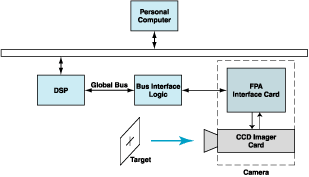
Preliminary test data suggests that it is possible to achieve a frame rate of 6 kHz for 8 x 8-pixel subwindows with a pixel resolution and dynamic range of 7 bits. Planned refinements in camera and test bed are expected to increase the frame rate in the fastest area of the CCD to 17 kHz and the pixel resolution to 10 bits.
This work was done by Steve Monacos and Angel Portillo of Caltech for NASA's Jet Propulsion Laboratory. For further information, access the Technical Support Package (TSP) free on-line at www.nasatech.com/tsp under the Electronic Components and Systems category.
NPO-30564
This Brief includes a Technical Support Package (TSP).
High-Frame-Rate CCD Camera Having Subwindow Capability
(reference NPO-30564) is currently available for download from the TSP library.
Don't have an account?
Overview
The document is a technical support package prepared under the sponsorship of the National Aeronautics and Space Administration (NASA) and details a high-frame-rate CCD camera with subwindow capability, developed by inventors Angel A. Portillo and Steve P. Monacos. This technology is particularly relevant for applications requiring precise tracking and acquisition of incoming signals in free-space optical communications.
The report highlights the limitations of commercially available cameras, which are typically designed for full-frame video streams or non-real-time control of sub-windows for region-of-interest (ROI) capture. These cameras do not support the simultaneous requirements of high-speed streaming digital video and real-time control over multiple sub-windows, which is essential for applications that demand high pointing accuracy and rapid response times.
The motivation for developing this camera stems from the need for a tracking apparatus capable of acquiring and maintaining accurate tracking of beacon signals. The performance of such a system is influenced by various link parameters, including bit rate, bit error rate (BER), and the characteristics of the transmission media. To achieve the necessary accuracy, the camera must support real-time sub-window control and readout rates of several kilohertz, with a resolution exceeding eight bits per pixel.
The solution presented in the document is a CCD camera that allows for the control of multiple sub-windows within the field of view (FOV) on a per-frame basis. This capability enables users to adjust exposure, window size, and location in real-time, facilitating on-line processing of image data. The camera's design and testing demonstrate its effectiveness in meeting the stringent requirements of high-speed optical communication systems.
Additionally, the document references a publication by the inventors, which provides further details on the camera's design and capabilities. The report emphasizes that the work was conducted at the Jet Propulsion Laboratory (JPL) under contract with NASA, and it clarifies that any mention of specific commercial products or manufacturers does not imply endorsement by the U.S. Government or JPL.
In summary, this technical support package outlines a significant advancement in camera technology, addressing critical needs in optical communications through innovative design and real-time processing capabilities.