Displacements are increased in a departure from traditional electrode configurations.
advertisement:
In a recently invented class of piezoelectric
diaphragm pumps, the electrode
patterns on the piezoelectric diaphragms
are configured so that the electric fields
in the diaphragms have symmetrical radial
(along-the-surface) components in
addition to through-the-thickness components.
Previously, it was accepted in the
piezoelectric-transducer art that in order
to produce the out-of-plane bending displacement
of a diaphragm needed for
pumping, one must make the electric
field asymmetrical through the thickness,
typically by means of electrodes placed
on only one side of the piezoelectric
material. In the present invention, electrodes
are placed on both sides and patterned
so as to produce substantial radial
as well as through-the-thickness components.
Moreover, unlike in the prior art,
the electric field can be symmetrical
through the thickness. Tests have shown
in a given diaphragm that an
electrode configuration according
to this invention produces
more displacement than does a
conventional one-sided electrode
pattern.
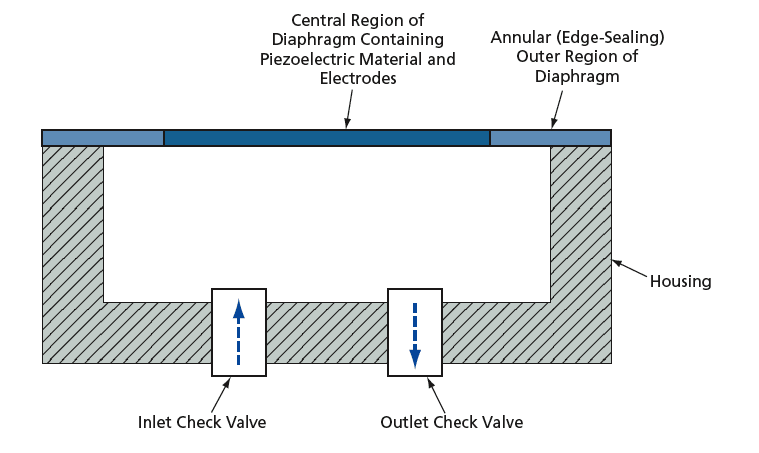
Figure 1. This Piezoelectric Diaphragm Pump is similar to other piezoelectric diaphragm pumps, except for the advanced design of the diaphragm.
The invention admits of
numerous variations characterized
by various degrees of complexity.
Figure 1 is a simplified
depiction of a basic version. As in
other piezoelectric diaphragm
pumps of similar basic design,
the prime mover is a piezoelectric
diaphragm. Application of a
suitable voltage to the electrodes
on the diaphragm causes it to
undergo out-of-plane bending.
The bending displacement pushes
a fluid out of, or pulls the fluid
into, a chamber bounded partly
by the diaphragm. Also as in
other diaphragm pumps in general,
check valves ensure that the
fluid flows only in through one
port and only out through
another port.
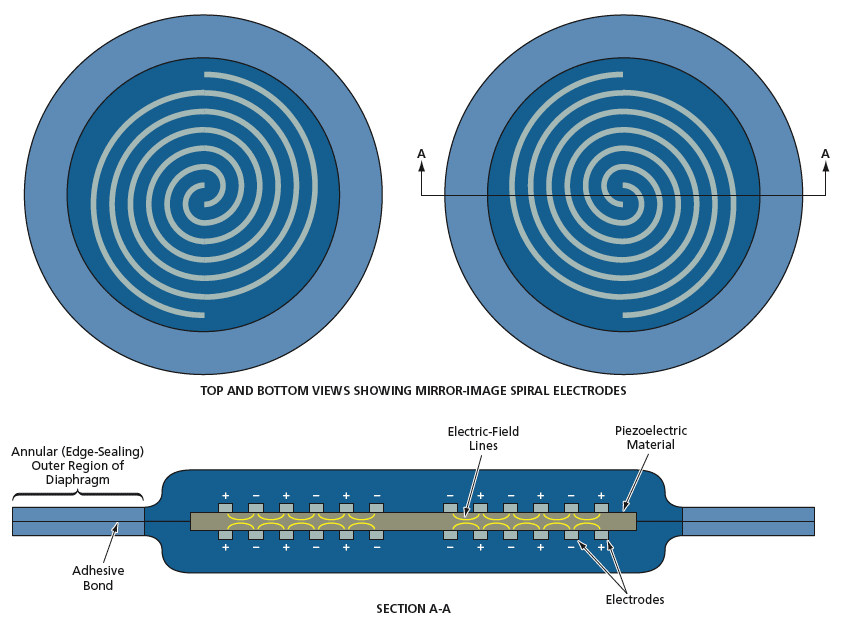
Figure 2. The Diaphragm features a central region containing a piezoelectric actuator and an annular outer region for sealing to the housing. The electrode pattern is chosen to ensure that the electric field has a substantial radial component.
Figure 2 shows the diaphragm in more detail. In this case, the diaphragm is circular. The central region of the
diaphragm contains the piezoelectric material. There are two
centrally located, intercirculating spiral electrodes on the top
side of the piezoelectric material and two mirror-image replicas
of them on the bottom side. The polarities of the voltages
applied to the electrodes are chosen to produce a nearly symmetrical,
substantially radial electric field. The piezoelectric
material and electrodes are adhesively bonded together and
sandwiched between adhesive-coated sheets of a flexible
dielectric material, which extends radially outward to form an
outer annular region for sealing the diaphragm to the pump
housing.
This work was done by Robert G. Bryant and Dennis C. Working of
Langley Research Center and Karla Mossi, Nicholas D. Castro, and Poorna
Mane of Virginia Commonwealth University.
LAR-16363-1
This Brief includes a Technical Support Package (TSP).
Radial-Electric-Field Piezoelectric Diaphragm Pumps (reference LAR-16363-1) is currently available for download from the TSP library.