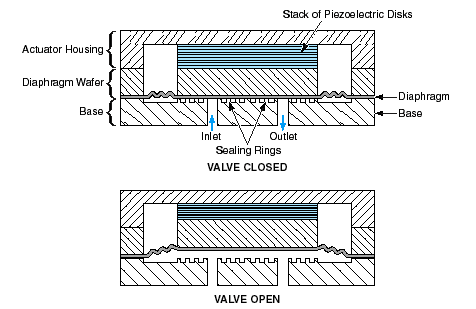
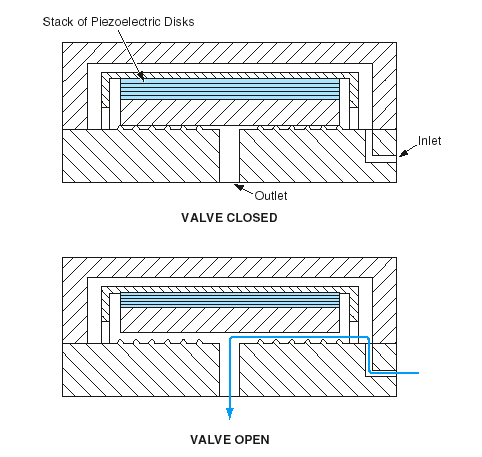
The improvements are being pursued because of the following deficiencies of the previous version of the valve:
- The valve-seat design was marginal in that dirt particles easily became stuck between the diaphragm and the tops of sealing rings, contributing to leakage.
- By virtue of the placement of the inlet orifice under the actuator, the inlet flow and pressure opposed the sealing force, thereby reducing the ability to seal against high pressure with low leakage.
- The piezoelectric actuator stack could not be machined as precisely as could the silicon parts. As a consequence, if the valve cap (the item designated the actuator housing in Figure 1) was flexible and the piezoelectric stack was thicker than the actuator housing, then the valve could not be actively opened. If the piezoelectric stack was thinner than the actuator housing, then the valve would always be open.
This work was done by Eui-Hyeok Yang and David Bame of Caltech for NASA's Jet Propulsion Laboratory. For further information, access the Technical Support Package (TSP) free on-line at www.nasatech.com/tsp under the Mechanics category. NPO-30158
This Brief includes a Technical Support Package (TSP).
Improved Piezoelectrically Actuated Microvalve
(reference NPO-30158) is currently available for download from the TSP library.
Don't have an account?
Overview
The document discusses the development of an improved piezoelectrically actuated microvalve, aimed at enhancing microfluidic systems and micro-electromechanical systems (MEMS). This project, conducted by NASA's Jet Propulsion Laboratory (JPL), builds upon a previous design described in a NASA Tech Brief from January 2001. The original valve design included a base with a seat, inlet, outlet, diaphragm, and a piezoelectric actuator. However, it faced issues such as leakage due to dirt particles getting stuck between the diaphragm and sealing rings, and a design that reduced the sealing ability against high pressure.
The new design addresses these deficiencies by incorporating a novel valve seat and a custom-designed piezoelectric actuator. The improvements focus on enhancing the sealing capability and reducing leakage rates, which are critical for applications in space environments where reliability is paramount. The new valve is designed to open under high pressure (3000 psia) and is capable of producing a sealing force greater than what is required, thanks to the actuator's strength (50 MPa).
Key innovations include a normally closed sealing feature, low-temperature indium hermetic bonding, and a detailed seat filter design that is currently under development. These enhancements are particularly important for microfluidic MEMS systems, which are being explored for applications such as micro propulsion and miniature chemistry labs in space. The document emphasizes that typical commercial-off-the-shelf (COTS) MEMS valves do not adequately address the specific needs of space applications, often relying on thermal or magnetic actuation methods that are not suitable for the required sealing performance.
The motivation behind this development stems from the need for reliable valves that can provide precise fluid control in microfluidic systems. The new valve design aims to overcome the limitations of previous models and existing commercial options, ensuring that it meets the rigorous demands of space exploration and other advanced applications.
Overall, this document outlines a significant advancement in valve technology, highlighting the ongoing efforts to improve the functionality and reliability of microvalves for critical applications in challenging environments.