A normally closed, piezoelectrically actuated microvalve is being developed as a prototype of valves in microfluidic systems and other microelectromechanical systems (MEMS) intended for operation in outer space. Terrestrial MEMS in which such valves could also prove useful include implantable pumps to administer precisely metered medications, controllers for tightly regulating flows of chemicals in semiconductor-manufacturing processes, and flow controllers for environmental and biological monitoring systems.
Like other devices originally intended for use aboard spacecraft, the present microvalve must be designed to withstand the extreme mechanical stresses of launch, to operate reliably over a wide temperature range and in the presence of ionizing radiation, and to operate reliably after a long time in storage or transit under the aforementioned temperature and radiation conditions. Additional requirements with regard to its specific function include an extremely low leak rate and immunity to disruption by small contaminant particles that may slip into the gaps between actuated valve sealing surfaces.
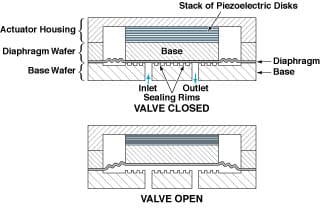
The design of this valve (see figure) is based partly on the designs of larger, commercially available diaphragm valves. Although the dimensions of this valve exceed the dimensions of most microelectromechanical devices, one is justified making this valve somewhat larger than a typical microvalve because the leak rate of a valve tends to decrease with increasing sealing area.
The valve begins as three separate parts: the base (which includes the seat), the diaphragm, and the actuator. The base, which is micromachined out of silicon wafer, contains the inlet and the outlet. The seat area on the inner (upper in the figure) surface of the base is textured with two sets of sealing rings: one centered on the inlet, the other centered on the outlet. The diaphragm, also micromachined out of a silicon wafer, features circular corrugations near its outer diameter and a central circular boss that covers both openings in the seat. The actuator consists of a stack of piezoelectric disks in a rigid housing machined out of a silicon wafer. A Ti/Pt/Au layer is evaporatively deposited on the faying surfaces of the three parts, then the parts are heated and pressed together to join the pieces with metal-to-metal diffusion bonds.
To apply a large sealing force on the two openings to ensure that the valve is normally closed, the piezoelectric stack is compressed into a slightly contracted condition during the bonding process. Application of a voltage across the stack causes the stack to contract further; this action lifts the diaphragm away from the seat, thereby creating a narrow channel between the inlet and outlet.
The geometry of the seal is expected to impart substantial immunity to disruption by small contaminant particles. The sealing rings are about 20 μm high and are numerous and closely spaced. Because they are many and dense, they still provide a large sealing area despite the valleys between them. At the same time, any small particles that are entrained in the fluid controlled by the valve and that come to rest in the seal area are expected to become trapped in the valleys between the rings, so that they will not disrupt the seal. Also, any single scratch that might occur would likely affect only a limited number of rings and thus be unlikely to create an open path from the inlet to the outlet.
This work was done by Indrani Chakraborty, William Tang, David Bame, and Tony Tang of Caltech for NASA's Jet Propulsion Laboratory. For further information, access the Technical Support Package (TSP) free on-line at www.nasatech.com/tsp under the Mechanics category.
In accordance with Public Law 96-517, the contractor has elected to retain title to this invention. Inquiries concerning rights for its commercial use should be addressed to
Technology Reporting Office
JPL
Mail Stop 122-116
4800 Oak Grove Drive
Pasadena, CA 91109
(818) 354-2240
Refer to NPO-20782, volume and number of this NASA Tech Briefs issue , and the page number.
This Brief includes a Technical Support Package (TSP).
Normally Closed, Piezoelectrically Actuated Microvalve
(reference NPO-20782) is currently available for download from the TSP library.
Don't have an account?
Overview
The document discusses the development of a Micro-Electro-Mechanical Systems (MEMS) valve designed for space applications, specifically by researchers at the Jet Propulsion Laboratory (JPL). The valve aims to meet the stringent performance requirements necessary for various space missions, including micro-propulsion, in-situ chemical analysis on other planets, and micro-fluidics experiments in microgravity environments.
Current commercial MEMS valves do not adequately address the unique challenges posed by space travel, such as exposure to radiation, mechanical shock, vibration, and extreme temperature variations. Traditional MEMS valves often utilize thermal or magnetic actuation, which can be problematic in the space environment due to their reliance on precise temperature control and the difficulties associated with scaling magnetic components down to MEMS sizes.
In contrast, the JPL team has developed a piezoelectrically actuated valve that promises superior sealing capabilities and lower leak rates. The valve consists of three main components: the seat, diaphragm, and actuator. The seat interfaces with the micro-fluidic system and includes inlet and outlet ports with seal rings to prevent leaks. The design features a square footprint of 1.6 cm and a height of less than three millimeters, which, while larger than typical MEMS devices, is still compact for its intended applications.
The document emphasizes the novelty of this MEMS valve, highlighting its improvements over existing technologies. The piezoelectric actuator provides a higher force density, which is crucial for achieving the low leak rates required in space applications. Additionally, the design incorporates careful attention to sealing surfaces and the implementation of a filter to keep contaminants away from these critical areas.
The work is part of a broader effort to advance microfluidic MEMS systems for space exploration, where reliable valves are essential for controlling fluid flow and sealing in various scientific instruments. The research is conducted under NASA's contract, and the findings are intended to contribute to the development of more robust and efficient systems for future space missions.
Overall, this document outlines a significant advancement in MEMS technology, addressing the specific needs of space applications while also holding potential for terrestrial uses in fields such as medical devices and chemical processing.