An experimental miniature peristaltic pump exploits piezoelectrically excited flexural waves that travel around a ring: A fluid is carried in the containers formed in the valleys between the peaks of the flexural waves (see Figure 1). The basic action of this pump is similar to that described in "Piezoelectric Flexural- Traveling- Wave Pumps" (NPO-19737), NASA Tech Briefs, Vol. 21, No. 4 (April 1997), page 66.
What sets the present pump apart from other pumps that exploit piezoelectrically excited flexural waves is the ring shape, which makes it possible to take advantage of some of the desirable characteristics of previously developed piezoelectric rotary motors. A major advantage of the circular (in contradistinction to a straight-line) wave path is that the flexural waves do not come to a stop and, instead, keep propagating around the ring. Hence, a significant portion of the excitation energy supplied during each cycle is reused during the next cycle, with the result that the pump operates more effectively than it otherwise would.
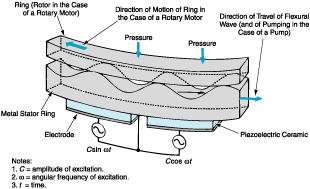

The polarities and phases of the voltages applied to the piezoelectric ring segments are chosen to excite a desired flexural-traveling-wave mode. For maximum pumping effectiveness, the excitation frequency should equal the resonance frequency of the desired wave mode.
This work was done by Yoseph Bar-Cohen, Zensheu Chang, Xiaoqi Bao, and Shyh-Shiuh Lih of Caltech for NASA's Jet Propulsion Laboratory. For further information, access the Technical Support Package (TSP) free on-line at www.techbriefs.com/tsp under the Machinery/Automation category.
In accordance with Public Law 96-517, the contractor has elected to retain title to this invention. Inquiries concerning rights for its commercial use should be addressed to:
Intellectual Assets Office
JPL
Mail Stop 202-233
4800 Oak Grove Drive
Pasadena, CA 91109
(818) 354-2240
E-mail:
Refer to NPO-30415, volume and number of this NASA Tech Briefs issue, and the page number.
This Brief includes a Technical Support Package (TSP).
Miniature Ring-Shaped Peristaltic Pump
(reference NPO30415) is currently available for download from the TSP library.
Don't have an account?
Overview
The document presents a technical report on the Piezopump, a novel miniature ring-shaped peristaltic pump developed by a team of inventors including Xiaoqi Bao, Yoseph Bar-Cohen, Zensheu Chang, and Shyh-Shiuh Lih, under the auspices of NASA's Jet Propulsion Laboratory. The Piezopump is distinguished by its unique design that employs flexural traveling waves to drive fluid movement without any physically moving parts, setting it apart from conventional pumps.
The report outlines the challenges faced in creating a pump that operates in a ring configuration, where traditional entry and exit points for fluid are not defined. The solution involved utilizing the peaks and valleys of flexural waves to form wave base containers, effectively allowing the pump to recycle energy and enhance efficiency. The design incorporates a top plate made of Plexiglas, which features inlet and outlet ports, and flexible bonding strips that confine the pumping chambers. This innovative structure enables the pump to operate in both forward and reverse directions.
The document also references previous works and patents related to piezoelectric and ultrasonic technologies, highlighting the foundational research that informed the development of the Piezopump. Notable references include a paper on piezoelectrically actuated miniature pumps and patents concerning traveling wave pumps and rotary piezoelectric motors.
In addition to its technical specifications, the report emphasizes the advantages of the Piezopump, such as its compact size, lack of moving parts, and the potential for reduced maintenance and increased reliability. These features make it suitable for various applications, particularly in environments where traditional pumps may be less effective or feasible.
Overall, the Piezopump represents a significant advancement in pump technology, combining innovative engineering with practical applications. The report serves as a comprehensive overview of the design, functionality, and potential impact of this cutting-edge device, showcasing the ongoing efforts of NASA and its partners to push the boundaries of technology in fluid transport systems.