

A system that includes a Global Positioning System (GPS) antenna and associated apparatus for keeping the antenna aimed upward has been developed for use aboard a remote-sensing-survey airplane. The purpose served by the system is to enable minimum-cycle-slip reception of GPS signals used in precise computation of the trajectory of the airplane, without having to restrict the airplane to maneuvers that increase the flight time needed to perform a survey.
The two principal causes of cycle slip are weakness of signals and multipath propagation. Heretofore, it has been standard practice to mount a GPS antenna rigidly on top of an airplane, and the radiation pattern of the antenna is typically hemispherical, so that all GPS satellites above the horizon are viewed by the antenna during level flight. When the airplane must be banked for a turn or other maneuver, the reception hemisphere becomes correspondingly tilted; hence, the antenna no longer views satellites that may still be above the Earth horizon but are now below the equatorial plane of the tilted reception hemisphere. Moreover, part of the reception hemisphere (typically, on the inside of a turn) becomes pointed toward ground, with a consequent increase in received noise and, therefore, degradation of GPS measurements.
To minimize the likelihood of loss of signal and cycle slip, bank angles of remote-sensing survey airplanes have generally been limited to 10° or less, resulting in skidding or slipping uncoordinated turns. An airplane must be banked in order to make a coordinated turn. For small-radius, short-time coordinated turns, it is necessary to employ banks as steep as 45°, and turns involving such banks are considered normal maneuvers. These steep banks are highly desirable for minimizing flight times and for confining airplanes as closely as possible to areas to be surveyed.
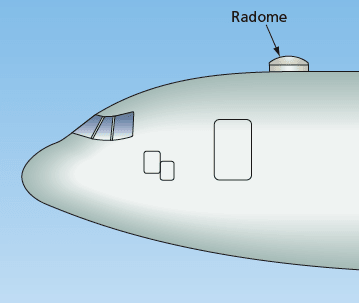
The idea underlying the design is that if the antenna can be kept properly aimed, then the incidence of cycle slips caused by loss or weakness of signals can be minimized. The system includes an articulating GPS antenna and associated electronic circuitry mounted under a radome atop an airplane. The electronic circuitry includes a microprocessor-based interface-circuit-and-data-translation module. The system receives data on the current attitude of the airplane from the inertial navigation system of the airplane. The microprocessor decodes the attitude data and uses them to compute commands for the GPS-antenna-articulating mechanism to tilt the antenna, relative to the airplane, in opposition to the roll or bank of the airplane to keep the antenna pointed toward the zenith.
The system was tested aboard the hurricane-hunting airplane of the National Oceanic and Atmospheric Administration (NOAA) [see figure] during an 11-hour flight to observe the landfall of Hurricane Bret in late summer of 1999. No bank-angle restrictions were imposed during the flight. Post-flight analysis of the GPS trajectory data revealed that no cycle slip had occurred.
This work was done by C. Wayne Wright of Goddard Space Flight Center.
This invention has been patented by NASA (U.S. Patent No. 6,844,856 B1). Inquiries concerning nonexclusive or exclusive license for its commercial development should be addressed to the Patent Counsel, Goddard Space Flight Center, (301) 286-7351. Refer to GSC-14436-1










