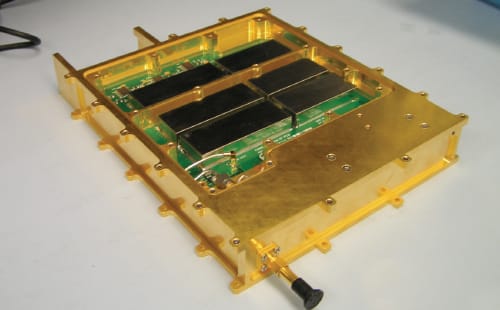
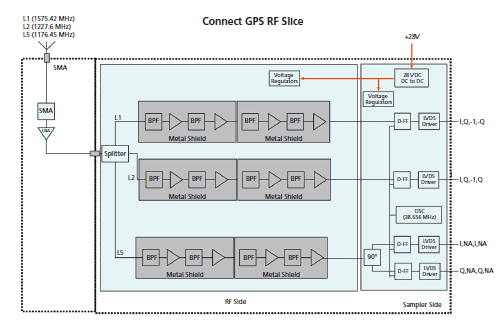
The CoNNeCT Global Positioning System RF Module (GPSM) slice is part of the JPL CoNNeCT Software Defined Radio (SDR). CoNNeCT is the Communications, Navigation, and Networking reconfigurable Testbed project that is part of NASA’s Space Communication and Navigation (SCaN) Program. The CoNNeCT project is an experimental demonstration that will lead to the advancement of SDRs and provide a path for new space communication and navigation systems for future NASA exploration missions. The JPL CoNNeCT SDR will be flying on the International Space Station (ISS) in 2012 in support of the SCaN CoNNeCT program.
This work was done by Garth W. Franklin, Lawrence E. Young, Michael A. Ciminera, Jeffrey Y. Tien, Jacob Gorelik, Brian Bachman Okihiro, and Cynthia L. Koelewyn of Caltech for NASA’s Jet Pro pulsion Laboratory. NPO-47764
This Brief includes a Technical Support Package (TSP).
Connect Global Positioning System RF Module
(reference NPO-47764) is currently available for download from the TSP library.
Don't have an account?
Overview
The document is a Technical Support Package from NASA's Jet Propulsion Laboratory (JPL) detailing the Connect Global Positioning System (GPS) RF Module, part of the Software Defined GPS Receiver designed for the International Space Station (ISS). It outlines the development and integration of advanced GPS technology aimed at enhancing navigation and communication capabilities in space.
Key components of the system include the Baseband Processor Module (BPM), which features a Sparc 697 processor operating at 66 MHz, along with 128 Mbytes of SDRAM and 512 Mbytes of Flash memory. The BPM is supported by two Virtex II 3000 processors, each equipped with 160 Mbytes of SDRAM and 512 Mbytes of Flash, connected via a 92-wire data bus. This architecture is designed to handle the complex processing requirements of GPS signals in a space environment.
The document notes that the GPS receiver was delivered to the Glenn Research Center (GRC) for integration and was scheduled to be sent to Japan in the summer of 2011. The launch of the system to the ISS was planned for January 2012 aboard a JAXA H-II Transfer Vehicle (HTV-3). This timeline highlights the collaborative efforts between NASA and international partners in advancing space technology.
The Technical Support Package emphasizes the importance of the Connect GPS RF Module within the broader context of aerospace technology, showcasing its potential applications beyond space exploration. It is part of NASA's Commercial Technology Program, which aims to disseminate aerospace-related developments that have wider technological, scientific, or commercial implications.
The document also includes contact information for further inquiries, specifically directing interested parties to the Innovative Technology Assets Management office at JPL. It underscores the proprietary nature of the information and the necessity to comply with U.S. export regulations.
Overall, this Technical Support Package serves as a comprehensive overview of the Connect GPS RF Module, detailing its specifications, integration process, and significance in enhancing the operational capabilities of the ISS, while also promoting the broader application of such technologies in various fields.