

An improved Global Positioning System (GPS) receiver, which processes an encrypted P-code signal without knowledge of the encryption code (denoted here as A-codeless mode), includes an auxiliary antenna and associated additional signal-processing circuitry. The improved design of this receiver makes it possible to achieve signal-to-noise ratios (SNRs) greater than that of prior A-codeless-mode GPS receivers, especially when GPS satellites appear at low elevation angles.
The GPS P-code signals are sometimes modulated by a secret binary code, denoted here as the "A-code," for use in sensitive military and other government applications to prevent jamming signals from being accepted as GPS satellite signals. Full precision in timing and positioning measurements can be obtained by correcting for the A-code, if it is known. In the absence of knowledge of the A-code, one can still obtain useful precision by estimating the A-code.
The need for the improved design arises because, in the A-codeless mode, performance deteriorates significantly when antenna gain is low. For example, the choke-ring antennas customarily used in some GPS receivers are designed to have very low gains at low elevation angles in order to reduce multipath errors. These low gains result in low SNRs, particularly in the A-codeless mode.
The basis of the improved design is the following: The A-codeless-mode SNR of a GPS receiver can be greatly increased at low elevation angle or low gain, without compromising the multipath rejection of choke-ring antenna, by use of an auxiliary antenna with a gain pattern that complements that of the choke-ring antenna; that is, with a high gain at low elevation angles. The signal received by the auxiliary antenna is used solely to improve the estimate of the A-code in the signals received by the primary antenna. The signals received by the choke-ring or other primary antenna are subjected to the customary GPS processing to obtain delays and phases, but now the estimates of the delays and phases are improved by use of the improved estimate of the A code.
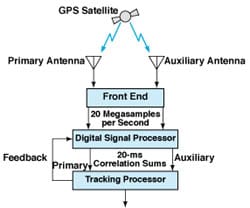
The auxiliary antenna is either placed near the primary antenna or else is part of the primary antenna structure. In the front end of the receiver (see figure), the radio-frequency signal collected by the auxiliary antenna is down-converted to baseband and converted to digital samples in the same fashion as that of the signal from the primary antenna. The resulting quadrature baseband samples are fed to a digital signal processor (DSP), where they are processed in a separate channel with the same operations as those performed on the signal from the primary antenna.
The DSP operates in a feedback relationship with a tracking processor, wherein the main and auxiliary signals are tracked in separate channels by use of separate tracking loops for delay and phase in each channel. As is typical in a GPS receiver when in lock, the in-phase (I) component in each antenna channel contains almost all of the counterrotated signal strength, while the quadrature (Q) component is small and reflects the phase-tracking error.
When the stand-alone SNR of the primary channel is approximately equal to or less than the stand-alone SNR of the auxiliary channel (as when the GPS satellites appear at low elevation angles), the effective SNR for phase and delay in the primary channel can be increased by making use of the prompt I component in the auxiliary channel to improve multiplicative corrections in the primary channel that tend to remove the A-code signal from I and Q components. Logic circuitry in the tracking processor determines when and how to use the prompt I component in the auxiliary channel for this purpose. A description of how this is done would greatly exceed the space available for this article. Suffice it to say that the effective SNR for phase and delay can be increased by an amount that typically lies between 0 dB (for an auxiliary signal weaker than the primary signal) and approximately 14 dB (for an auxiliary signal stronger than the primary signal).
This work was done by J. Brooks Thomas, Thomas Meehan, and Lawrence Young of Caltech for NASA's Jet Propulsion Laboratory. For further information, access the Technical Support Package (TSP) free on-line at www.nasatech.com/tsp under the Electronics & Computers category. NPO-20784
This Brief includes a Technical Support Package (TSP).
Improved Encryption-Mode GPS Reciever
(reference NPO-20784) is currently available for download from the TSP library.
Don't have an account?
Overview
The document discusses advancements in Global Positioning System (GPS) technology, specifically focusing on an improved GPS receiver designed to process encrypted P-code signals without requiring knowledge of the encryption code, referred to as A-codeless mode. This innovative receiver incorporates an auxiliary antenna and additional signal-processing circuitry to enhance signal quality, particularly when GPS satellites are at low elevation angles, which typically results in weaker signals.
The core of the improvement lies in the use of a feedback relationship between a digital signal processor (DSP) and a tracking processor. The system tracks main and auxiliary signals in separate channels, utilizing distinct tracking loops for delay and phase. In a typical GPS receiver, the in-phase (I) component of the signal contains most of the counterrotated signal strength, while the quadrature (Q) component reflects phase-tracking errors. The document highlights that when the stand-alone signal-to-noise ratio (SNR) of the primary channel is equal to or less than that of the auxiliary channel, the effective SNR can be enhanced by leveraging the prompt I component from the auxiliary channel. This process can increase the effective SNR for phase and delay by up to 14 dB, depending on the strength of the auxiliary signal.
The document also describes a preferred embodiment of the auxiliary antenna method, which involves combining correlation sums from both L1 and L2 channels to improve A-code demodulation. The auxiliary antenna is designed to provide strong gain where the primary antenna's gain is weak, particularly at low elevations. The RF signals from both antennas are processed similarly, allowing for improved estimates of the A-code signal.
Furthermore, the document outlines how the effective SNR can be significantly improved through complementary gain patterns of the two antennas. In specific scenarios, the effective SNR can increase by factors of 5 or more, translating to substantial improvements in signal quality.
Overall, the advancements presented in this document represent a significant leap in GPS technology, enabling more reliable and accurate positioning and timing capabilities, especially in challenging environments. The work was conducted by researchers at NASA’s Jet Propulsion Laboratory, emphasizing its importance in enhancing GPS applications.











