
An ultimate goal of the climate change, snow science, and hydrology communities is to measure snow water equivalent (SWE) from satellite measurements. Seasonal SWE is highly sensitive to climate change and provides fresh water for much of the world population. Snowmelt from mountainous regions represents the dominant water source for 60 million people in the United States and over one billion people globally. Determination of snow grain sizes comprising mountain snowpack is critical for predicting snow meltwater runoff, understanding physical properties and radiation balance, and providing necessary input for interpreting satellite measurements. Both microwave emission and radar backscatter from the snow are dominated by the snow grain size stratigraphy. As a result, retrieval algorithms for measuring snow water equivalents from orbiting satellites is largely hindered by inadequate knowledge of grain size.
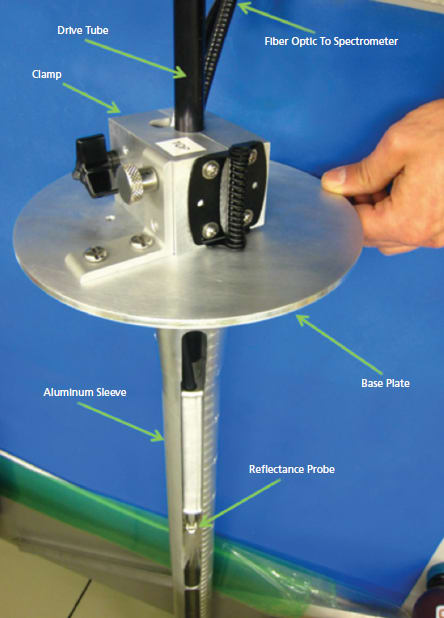
A prototype compact probe was developed that can be inserted into the snowpack to rapidly measure grain size without the need for digging a snowpit. The probe is portable and can be easily transported to take many measurements over a large area. The probe sends into the snowpack an optical package consisting of an optical infrared reflectance probe with near right-angle mirror, an optical camera, and a light source. In typical field operation, a standard federal snow sampler is used to drill a 2-in. (≈5-cm)-diameter hole vertically into the snow and remove the core. A thin aluminum sleeve (comprised of tubing assembled in sections) is then inserted into the empty hole. The probe optical package is then lowered inside the sleeve by an aluminum shaft, assembled in sections. The sleeve has a machined slot running the length of the sleeve, except at the joints, allowing the probe optics to view the snow surface horizontally through the slot.
The reflectance probe couples light reflected from the snow surface into an optical fiber bundle that carries the light to a spectrometer on the surface, which records the reflectance spectrum. A manual clamping mechanism mounted to the top of the sleeve allows the user to move the shaft up and down and clamp in place during each measurement. Vertical location measurement is accomplished manually by observing the alignment of centimeter graduation markings on the shaft with the top of the clamping mechanism.
The fiber optic bundle coming from the reflectance probe is bifurcated as it comes out of the probe, so that two separate cables go to the surface. One cable connects to the spectrometer, and the other cable connects to another light source on the surface. With this configuration, two different modes of operation are possible. In the first, the external light source is not energized, and the internal light source on the probe tip is energized, shining directly onto the snow surface. This provides strong lighting and is preferable to use under low reflectance conditions, such as large crystals in the snow or large amounts of contamination. The second mode uses the external light source through the fiber optic cable and does not use the inbore light. This mode couples less heat into the snow and eliminates any melting concern due to the light source.
The probe provides approximately 1 cm vertical spatial resolution for measuring the stratigraphy. Grain size is determined by integrating the normalized 1,020-nm absorption feature in the ice reflectance spectrum and comparing it to a look up table generated from an optical scattering model of uniform ice spheres.
The entire probe assembly can be dismantled and stowed into a large backpack for cross-country transport over large distances.
This work was done by Daniel F. Berisford, Noah P. Molotch, and Thomas Painter of Caltech for NASA’s Jet Propulsion Laboratory. NPO-47992
This Brief includes a Technical Support Package (TSP).
Spectral Profiler Probe for In Situ Snow Grain Size and Composition Stratigraphy
(reference NPO-47992) is currently available for download from the TSP library.
Don't have an account?
Overview
The document is a Technical Support Package from NASA's Jet Propulsion Laboratory (JPL) detailing the Spectral Profiler Probe designed for in situ measurement of snow grain size and composition stratigraphy. This technology is part of NASA's efforts to advance aerospace-related developments with broader scientific and commercial applications.
The Spectral Profiler Probe is specifically engineered to analyze snow properties, which are crucial for understanding various environmental and climatic processes. The probe utilizes Near-Infrared (NIR) contact spectroscopy, a method originally developed for snow pits. This technique offers several advantages over traditional methods, including reduced subjectivity, repeatability, and faster data collection. The data obtained can also be applied to remote sensing, enhancing the ability to monitor snow characteristics over larger areas.
The document outlines the probe's configurations, including bifurcated fiber optics that allow for two types of light sources: an external light source to minimize heating effects on the snow and an in-bore light source for improved illumination in challenging conditions, such as when dealing with large snow crystals or contamination.
Field testing of the probe has been conducted at locations like Storm Peak Lab in Steamboat Springs, Colorado, and Niwot Ridge, Colorado. These tests are essential for validating the probe's performance in real-world conditions, ensuring its reliability and accuracy in measuring snow properties.
The Technical Support Package emphasizes the importance of this technology in advancing our understanding of snow stratigraphy, which has implications for hydrology, climate science, and remote sensing applications. The document also provides contact information for further inquiries and assistance related to the technology, highlighting NASA's commitment to sharing knowledge and fostering innovative partnerships.
In summary, the Spectral Profiler Probe represents a significant advancement in snow analysis technology, offering a reliable and efficient means of measuring snow grain size and composition. Its development reflects NASA's broader mission to leverage aerospace innovations for scientific exploration and environmental monitoring.