

An imaging spectroscopic technique is undergoing development for use in remote detection of ice and mapping of the thickness of ice on aircraft surfaces. The technique is based on the variation of local spectral reflectance with the depth of ice and/or water on a surface of known aircraft material (typically, aluminum). The spectrum of white light reflected from each surface point includes absorption dips characteristic of any water or and/or ice present at that point, as distinguished from the relatively flat spectral reflectance of aluminum. Thus, the local thickness of ice (and, optionally, water) can be computed from the local spectral reflectance, and the thickness of ice can be mapped by performing this computation for all points in the image.
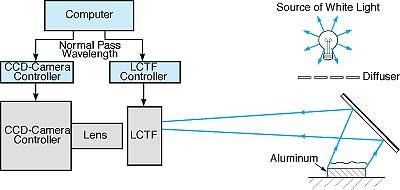
In experiments to demonstrate the technique, a band-pass liquid-crystal tunable filter (LCTF) and a 16-bit charge-coupled-device (CCD) camera (see Figure 1) were used to image chilled aluminum cells that were, variously, empty or filled with ice or water to various thicknesses. Reference images of a 99-percent-reflectance standard were also acquired. The aluminum, water, ice, and reflectance-standard images were acquired in 21 wavelength bands, each about 10 nm wide, at nominal pass wavelengths from 850 to 1,050 nm. An independent set of data for verification of the spectral images was acquired by use of a point spectrometer.
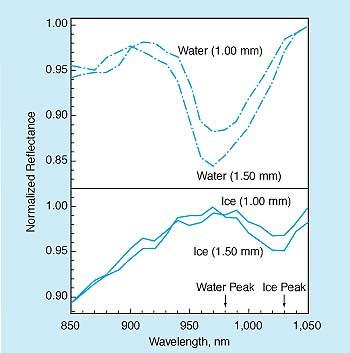
The spectral image data were corrected for CCD dark current and bias and converted to reflectance units, and regions of interest were chosen for determining the spatially averaged reflectance spectra. Some of the results are plotted in Figure 2, which illustrates how spectra can be used to distinguish between, and estimate thicknesses of, water and ice. The experiments revealed one shortcoming; namely, that specular reflection from the surface of interest can cause saturation in affected CCD pixels. Fortunately, saturated pixels can simply be excluded from processing of image data; this was done during the processing of image data in the experiments.
This work was done by Gregory Bearman, Abhijit Biswas, Thomas Chrien, Robert O. Green, and Peter Green of Caltech for NASA's Jet Propulsion Laboratory. NPO-19929
This Brief includes a Technical Support Package (TSP).
Optical remote detection of ice on aircraft surfaces
(reference NPO19929) is currently available for download from the TSP library.
Don't have an account?
Overview
The document presents a technical support package from NASA detailing a novel optical remote detection system designed to assess icing conditions on aircraft surfaces prior to flight. The system employs imaging spectroscopy using a Liquid Crystal Tunable Filter (LCTF) and a CCD camera to create false color images that indicate iced areas and provide information on ice thickness.
The primary objective of the research is to develop a reliable and straightforward method for detecting the presence and extent of ice coverage on aircraft wings. The system operates within a wavelength range of 650 to 1100 nm, utilizing a white light tungsten source for illumination. The CCD camera's shutter control and the LCTF's wavelength pass-band settings are managed through LabVIEW software, allowing for precise control over exposure times, which range from 2 to 40 seconds depending on the wavelength.
The experimental setup includes an aluminum (Al) cell attached to copper tubing, through which dry helium gas, cooled by liquid nitrogen, is circulated. This setup allows for the freezing of water in the Al cell's indentations, enabling the collection of spectral data for both the water-filled indentations and the bare Al surface. The data is processed to correct for CCD dark current and bias, converting the images into reflectance units for analysis.
The results demonstrate the system's effectiveness in distinguishing between ice and water based on their spectral signatures. The spectral analysis reveals clear absorption peaks for both ice and water, which correlate with the thickness of the ice or water present. However, the study also notes challenges such as pixel saturation due to specular reflectance from the surface, which necessitates careful exclusion of affected regions during data processing.
Overall, the document highlights the potential of this imaging spectroscopy technique to enhance safety in aviation by providing real-time, non-contact assessments of icing conditions. The research represents a significant advancement in the field of remote sensing and could lead to improved operational protocols for aircraft in icy conditions. The findings are supported by comparative data obtained from a point spectrometer, reinforcing the reliability of the imaging spectroscopy approach.











