

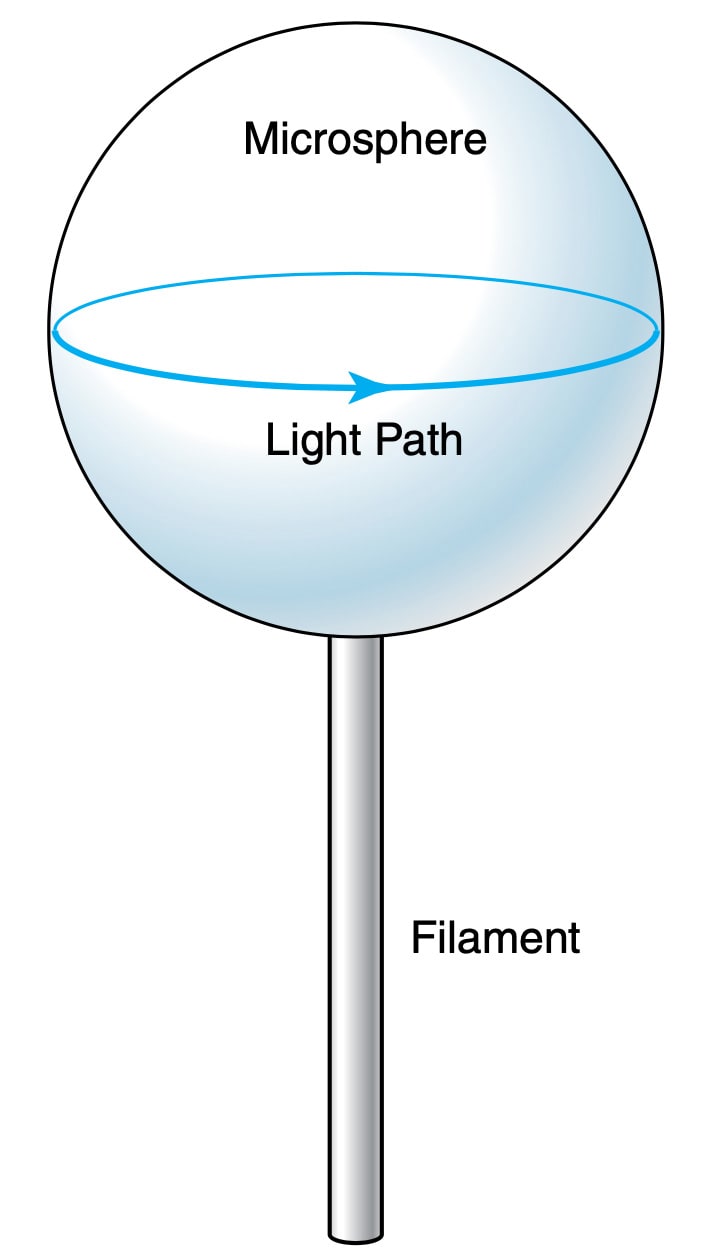
In one of several alternative approaches to the design and fabrication of a "whispering-gallery" optical microresonator of high resonance quality (high Q), the index of refraction of the resonator material and, hence, the resonance frequencies (which depend on the index of refraction) are tailored by use of ultraviolet (UV) light. The principles of operation of optical microresonators, and other approaches to the design and fabrication of optical microresonators, have been described in prior NASA Tech Briefs articles, including the two immediately preceding this one.
In this approach, a microresonator structure is prepared by forming it from an ultraviolet-sensitive material. Then the structure is subjected to controlled exposure to UV light while its resonance frequencies are monitored. This approach is applicable, for example, to the fabrication of optical microresonators from silica doped with germanium. This material exhibits low optical loss at a wavelength of 1,550 nm - a wavelength often used in optical communication systems. It is also highly sensitive to UV light: its peak sensitivity occurs at a wavelength of 334 nm, and its index of refraction can be shifted by as much as 10-2 by irradiating it at an argon- ion- laser wavelength of 351 nm.
Fabrication begins with softening a Ge-doped SiO2 rod by use of a hydrogen/oxygen microburner and stretching the rod into a filament ≈30 μm wide. The tip of the filament is heated in the hydrogen/oxygen flame to form a sphere having a diameter between about 100 μ and about 1 mm (see Figure 1). Then the resonance frequencies of the sphere used as a microresonator are measured while the sphere is irradiated with UV light at a power of 1.5 W from an argon-ion laser that can be operated at either of two wavelengths: 379 or 351 nm. Irradiation at the longer wavelength heats the sphere and thereby temporarily shifts the resonance frequencies but does not cause a permanent change in the index of refraction. Irradiation at the shorter wavelength changes the index of refraction permanently.

At first, for the purpose of adjusting the optics that focus the laser light on the sphere, the laser is operated at the longer wavelength and the adjustments performed to maximize the shift of resonance frequencies. Then the laser is operated at the shorter wavelength while the resonance frequencies are monitored. The UV radiation is terminated when the resonance frequencies have shifted by the desired amount. For example, a typical shift of ≈10 GHz can be achieved in a microsphere of 240-μm diameter (see Figure 2).
This work was done by Anatoliy Savchenkov, Lute Maleki, Vladimir Iltchenko, and Timothy Handley of Caltech for NASA's Jet Propulsion Laboratory. For further information, access the Technical Support Package (TSP) free on-line at www.techbriefs.com/tsp under the Physical Sciences category.
In accordance with Public Law 96-517, the contractor has elected to retain title to this invention. Inquiries concerning rights for its commercial use should be addressed to:
Innovative Technology Assets Management
JPL
Mail Stop 202-233
4800 Oak Grove Drive
Pasadena, CA 91109-8099
(818) 354-2240
E-mail: This email address is being protected from spambots. You need JavaScript enabled to view it.
Refer to NPO-30589, volume and number of this NASA Tech Briefs issue, and the page number.
This Brief includes a Technical Support Package (TSP).
Exact Tuning of High-Q Optical Microresonators By Use of UV
(reference NPO-30589) is currently available for download from the TSP library.
Don't have an account?
Overview
The document discusses a novel approach for engineering the spectrum of high-Q optical microcavities using UV light, specifically focusing on Ge-doped silica as the material for fabrication. High-Q microcavities are essential components in various optical and photonics applications, including microlasers, opto-electronic oscillators, and spectroscopy. Traditional methods for controlling the geometry of these resonators often fall short in achieving the desired spectral parameters.
The proposed solution involves utilizing a UV-sensitive material, Ge-doped silica, which exhibits low optical losses at 1550 nm and high UV sensitivity. By irradiating this material with 351 nm UV radiation, the refractive index can be altered significantly, allowing for precise tuning of the microcavity's eigenfrequency. This method enables shifts in the optical spectrum pattern, facilitating the engineering of the resonator's eigenfrequency to a predetermined value.
The fabrication process involves stretching a Ge-doped silica rod into a thin filament and heating its tip to create a microsphere, which serves as the UV-sensitive microcavity. The document details the use of a Coherent I-400 Ar laser for UV irradiation, highlighting the ability to monitor and control the eigenfrequency shifts of the microcavity. The technique allows for a typical frequency shift of approximately 10 GHz in microspheres with a diameter of 240 µm.
One of the key advantages of this method is that the frequency shift is permanent, eliminating the need for additional processing to maintain the fixed spectrum. This approach also allows for the simultaneous tuning of multiple microresonators and can align the eigenfrequency with specific molecular levels. Importantly, the technique preserves the high Q-factors of the microspheres and maintains the relative positions of the spectral lines, as the entire frequency grid shifts uniformly.
Overall, this innovative technique combines simplicity and effectiveness, relying solely on UV irradiation without mechanical or chemical steps. The document emphasizes the potential applications of this technology in various fields, including telecommunications and sensing, while also noting that further technical details are not provided to maintain the scope of coverage.











