

Assemblies containing curved piezoceramic fiber composite actuators have been invented as means of stretching optical fibers by amounts that depend on applied drive voltages. Piezoceramic fiber composite actuators are conventionally manufactured as sheets or ribbons that are flat and flexible, but can be made curved to obtain load-carrying ability and displacement greater than those obtainable from the flat versions. A curved actuator of this type can be fabricated by bonding a conventional flexible flat actuator to a thin metal backing sheet in a flat configuration at an elevated temperature so that upon cooling to room temperature, differential thermal contraction of the layers causes the laminate to become curved. Alternatively, such a curved actuator can be fabricated by bonding the layers together at room temperature using a curved mold.
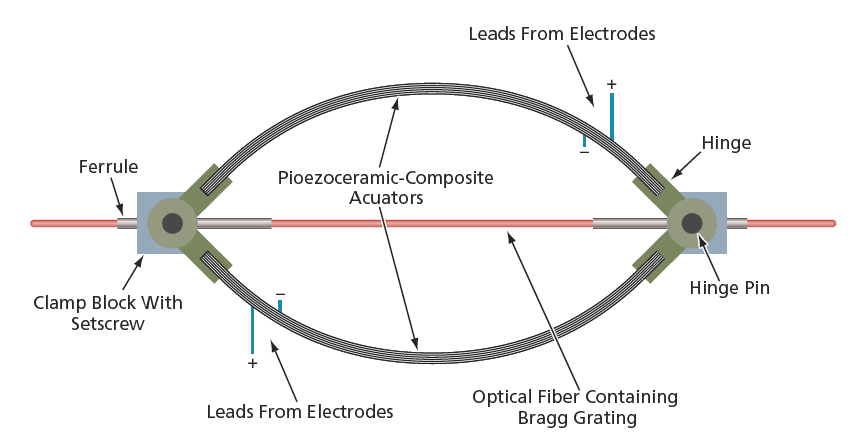
In the primary embodiment of this invention, piezoceramic fibers are oriented parallel to the direction of longitudinal displacement of the actuators so that application of drive voltage causes the actuator to flatten, producing maximum motion. Actuator motion can be transmitted to the optical fiber by use of hinges and clamp blocks (see figure). Each clamp block includes a setscrew that tightens down onto a metal ferrule through which the optical fiber is bonded. Each hinge contains a clearance hole for a hinge pin, slots to accept the piezoceramic fiber composite actuators, and a clearance groove for the ferrule.
In the original application of this invention, the optical fiber contains a Bragg grating and the purpose of the controlled stretching of the fiber is to tune the grating as part of a small, lightweight, mode-hop-free, rapidly tunable laser for demodulating strain in Bragg-grating strain-measurement optical fibers attached to structures. The invention could also be used to apply controllable tensile force or displacement to an object other than an optical fiber.
Prior tunable lasers that are not fiberoptic lasers are relatively bulky and are limited to tuning frequencies of the order of 1 Hz. Tunable fiber-optic lasers could potentially be made much smaller, lighter in weight, and more rapidly tunable if strained by use of this invention. Prior actuators that could be used to strain-tune fiber-optic lasers or gratings include piezoelectric stacks that produce displacements smaller than those needed and that, in comparison with assemblies according to the present invention, are heavier. Displacements produced by piezoelectric stacks can be amplified mechanically, but the mechanisms needed to effect amplification add considerable weight, which can be unacceptable in aeronautical or aerospace applications because of the high perunit- weight cost of flight.
This work was done by Sidney G. Allison, Qamar A. Shams and Robert L. Fox of Langley Research Center. For further information, contact the Langley Innovative Partnerships Office at (757) 864-4015.
LAR-17356-1










