

Tunable Laser Light

A team at Harvard and Vienna University of Technology have invented a new tunable laser that uses a series of rings to smoothly emit many light wavelengths from a single chip. Tunable lasers, or lasers whose light output wavelengths can be changed and controlled, are integral to many technologies, from high-speed telecommunications to medical diagnostics to safety inspections of gas pipelines. The new laser consists of multiple tiny ring-shaped lasers, each a slightly different size, and all connected to the same waveguide. Each ring emits light of a different wavelength, and by adjusting electric current input, the laser can smoothly tune between different wavelengths. The clever and compact design ensures the laser emits only one wavelength at a time, remains stable even in harsh environments, and can be easily scaled. The rings function either one at a time or all together to make a stronger beam. The device could one day replace many types of tunable lasers in a smaller, more cost-effective package.
Contact: Anne J. Manning
617-495-2840
This email address is being protected from spambots. You need JavaScript enabled to view it.
Self-Illuminating Biosensor

Engineers at EPFL have harnessed quantum physics to detect the presence of biomolecules without the need for an external light source, overcoming a significant obstacle to the use of optical biosensors in healthcare and environmental monitoring settings. The design of the team’s nanostructure creates just the right conditions for an electron passing upward through it to cross a barrier of aluminum oxide and arrive at an ultrathin layer of gold. In the process, the electron transfers some of its energy to a collective excitation called a plasmon, which then emits a photon. Their design ensures that the intensity and spectrum of this light changes in response to contact with biomolecules, resulting in a powerful method for extremely sensitive, real-time, label-free detection. This work delivers a fully integrated sensor that combines light generation and detection on a single chip with potential applications ranging from point-of-care diagnostics to detecting environmental contaminants.
Contact: Celia Luterbacher
+41 216-938-759
This email address is being protected from spambots. You need JavaScript enabled to view it.
Smart Capsule
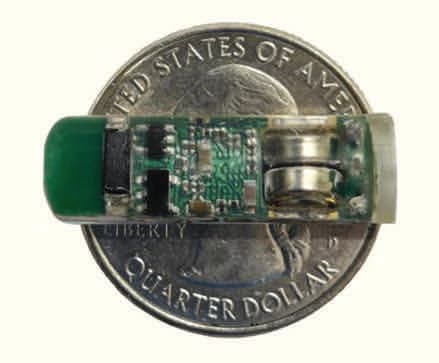
A team of Caltech engineers has developed a smart capsule called PillTrek, which can measure pH, temperature, and a variety of different biomarkers. It incorporates simple, inexpensive sensors in a miniature wireless electrochemical workstation that relies on low-power electronics. PillTrek is tiny, measuring 7 millimeters in diameter and 25 millimeters in length, making it smaller than commercially available capsule cameras used for endoscopy but capable of executing a range of electrochemical measurements. the electrochemical workstation within the capsule is reconfigurable. A variety of different sensors could easily be swapped into place to enable measurements of different parameters in the gut. As a proof of concept, PillTrek was used in the study to measure pH and temperature as well as changing levels of glucose and the neurotransmitter serotonin in animal models.











