

Extremely lightweight, compact, non-invasive, rugged, relatively inexpensive strain- gauge transducers have been developed for use in measuring pressures of fluids in tubes. These gauges were originally intended for measuring pressures of spacecraft-propulsion fluids, but they are also attractive for use in numerous terrestrial applications — especially those involving fluids that are extremely chemically reactive, fluids that must be isolated for hygienic purposes, fluids that must be allowed to flow without obstruction, and fluid-containing tubes exposed to severe environments.
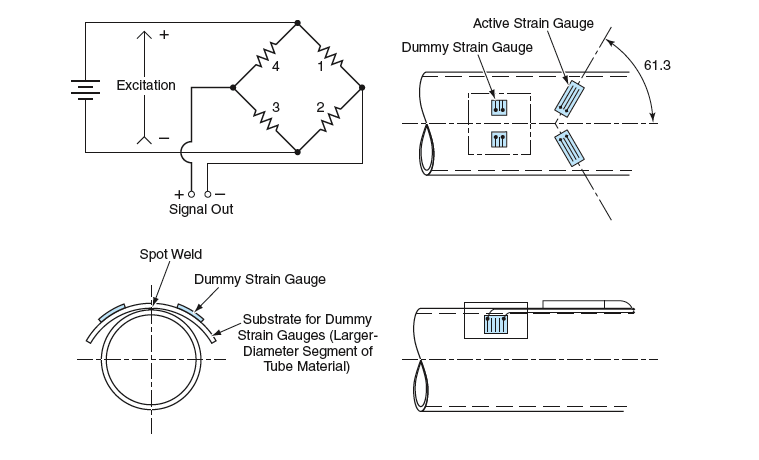
The active strain gauges are oriented to obtain an adequate response to hoop strain while minimizing the response to torsional and bending strains, which can be induced by mechanical coupling between the tube and other components of the fluid-handling system. The precise optimum orientation for this purpose depends on the Poisson’s ratios of the materials used; a representative approximate optimum orientation is specified as an angle of 61.3° between the gauge axis and the tube axis.
The strain gauges are formed by sputter deposition of a dielectric film directly on the tube, followed by sputter deposition of a film of a suitable piezoresistive material (typically, a nickel-chromium alloy), followed by laser cutting of strain- gauge grid lines into the piezoresistive film. These gauges have been characterized by the term “zero-mass,” which is not entirely an exaggeration: the sputtered layers are so thin that when one accounts for tube material removed by polishing in preparation for sputtering, one could find that the net mass of the tube plus pressure transducer is equal to or less than that of the plain tube.
The connections between the strain gauges and the external parts of the Wheatstone bridge are made with thinfilm flexible electrical leads. A thin film of dielectric material can be sputtered over the strain gauges and bridge wiring to protect the gauge circuitry, to prevent outgassing, and/or to prevent chemical reactions between the strain gauges and the environment.
In addition to the advantages already mentioned, these pressure transducers offer several advantages over prior pressure transducers, including those based on strain gauges bonded to tubes by use of adhesives:
- The intimate coupling between strain gauges and tubes increases the magnitudes and speeds of gauge responses, simplifies accounting for thermal coefficients, reduces thermal-response times, and diminishes long-term drifts and zero shifts.
- A pressure transducer of this type is essentially part of the tube on which it is mounted, with little or no protuberances or additional mass, with high resilience in the face of shock and vibrational loads.
- The high dissociation temperatures of the dielectric and piezoresistive films enables operation at high temperatures, while the thin-film, intimate-coupling nature of the gauge structures extends the lower operating-temperature limit down to the cryogenic range.
This work was done by Frank T. Hartley of Caltech for NASA’s Jet Propulsion Laboratory. NPO-21194
This Brief includes a Technical Support Package (TSP).
Zero-Mass Noninvasive Pressure Transducers
(reference NPO-21194) is currently available for download from the TSP library.
Don't have an account?
Overview
The document is a Technical Support Package from NASA's Jet Propulsion Laboratory (JPL) concerning Zero-Mass Noninvasive Pressure Transducers, referenced as NPO-21194 in NASA Tech Briefs. It is part of the Commercial Technology Program aimed at disseminating aerospace-related developments that may have broader technological, scientific, or commercial applications.
The Zero-Mass Noninvasive Pressure Transducers represent a significant advancement in pressure measurement technology. These transducers are designed to operate without the need for invasive procedures, which can be critical in various applications, including medical diagnostics, environmental monitoring, and aerospace systems. The noninvasive nature of these devices allows for continuous monitoring without the risks associated with traditional invasive methods, such as infection or discomfort.
The document emphasizes the importance of compliance with U.S. export regulations, indicating that the information may contain proprietary data and is subject to export control laws. Users are advised to adhere to these regulations when utilizing the technology described.
For further inquiries or assistance regarding the technology, the document provides contact information for the Innovative Technology Assets Management office at JPL. This office can offer additional insights into research and technology related to the Zero-Mass Noninvasive Pressure Transducers and their potential applications.
The document also includes a disclaimer stating that neither the United States Government nor any representatives assume liability for the use of the information contained within. It clarifies that any mention of trade names or manufacturers is for identification purposes only and does not imply official endorsement by NASA.
In summary, this Technical Support Package serves as a resource for understanding the capabilities and applications of Zero-Mass Noninvasive Pressure Transducers, highlighting their potential impact across various fields while ensuring compliance with relevant regulations. It reflects NASA's commitment to sharing innovative technologies that can benefit a wide range of industries beyond aerospace.










