The Cryogenic Moisture Apparatus (CMA) is designed for quantifying the amount of moisture from the surrounding air that is taken up by cryogenic-tank-insulating material specimens while under typical conditions of use. More specifically, the CMA holds one face of the specimen at a desired low temperature (e.g., the typical liquid-nitrogen temperature of 77 K) while the opposite face remains exposed to humid air at ambient or near-ambient temperature. The specimen is weighed before and after exposure in the CMA. The difference between the “after” and “before” weights is determined to be the weight of moisture absorbed by the specimen.
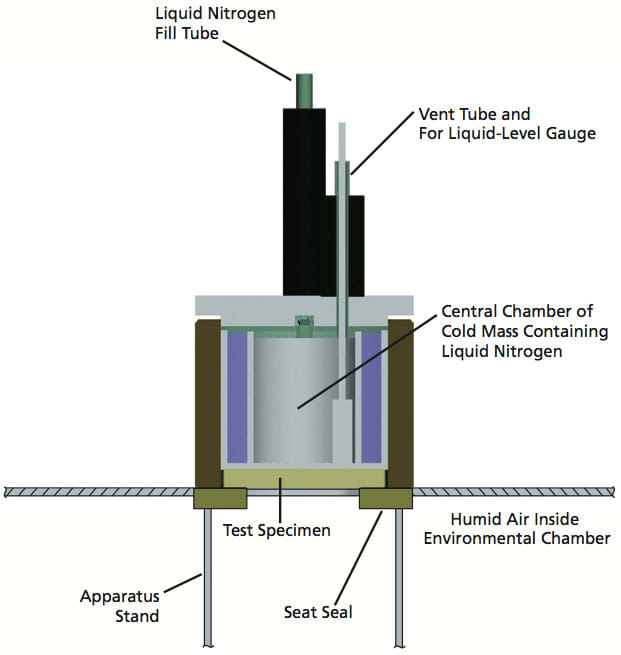
The CMA (see figure) includes a cold mass in the form of an insulated vessel filled with liquid nitrogen or other suitable liquid at a desired below-ambient temperature. The 200-mm diameter specimen is placed over an opening on the top of an environmental chamber, wherein a temperature of 293 K and relative humidity of 90 percent are maintained in still air at ambient atmospheric pressure. The cold mass is placed atop the specimen, and a 152-mm-diameter cold surface at the bottom of the cold mass makes contact with the top surface of the specimen. The bottom surface of the specimen is exposed to the atmosphere inside the environmental chamber. Temperatures at the top and bottom surfaces of the specimen are measured by thermocouples and are monitored and recorded. The cold mass includes features that guard the outer edge surface of the specimen against substantial heat leakage and
against intrusion of moisture so that the uptake of water or ice occurs only or primarily in the vertical, through-the-thickness direction. A typical test run lasts 8 hours from the beginning of cooldown, but test time can be changed as needed to achieve steady-state uptake of moisture.
This work was done by James Fesmire, Trent Smith, Robert Breakfield, and Kevin Boughner of Kennedy Space Center and Kenneth Heckle and Barry Meneghelli of Sierra Lobo, Inc. For more information, download the Technical Support Package (free white paper) at www.techbriefs.com/tsp under the Physical Sciences category. KSC-13049