The figure depicts the main parts of a prototype miniature, lightweight, one-time- opening valve. Like some other miniature one-time-opening valves reported in previous issues of NASA Tech Briefs, this valve is opened by melting a material that blocks the flow path. This valve is designed to remain closed at some temperature between room temperature and cryogenic temperature until the time of opening.
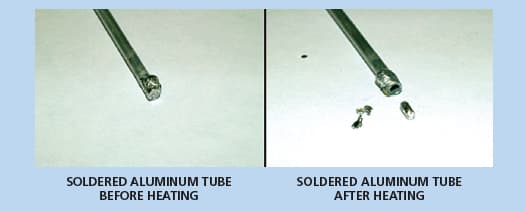
In a test, the plugged tube was pressurized to 1,000 psi (6.9 MPa) with helium and leak-tested. It was then cooled to a temperature of 77 K (about –196 °C) and again leak-tested at the same pressure. Finally, at a lower pressure, the plugged end of the tube was heated to about 200 °C (the melting temperature of the solder is 183°C), causing the solder plug to be ejected (see figure). It has been estimated that in a subsequent version of the valve, the plug could be melted by electrical heating, using a nichrome wire having a mass of only 10 g.
This work was done by Jack Jones, Juinn Jenq Wu, and Robert Leland of Caltech for NASA's Jet Propulsion Laboratory.
NPO-42236
This Brief includes a Technical Support Package (TSP).
Miniature, Lightweight, One-Time- Opening Valve
(reference NPO-42236) is currently available for download from the TSP library.
Don't have an account?
Overview
The document outlines the development of a Miniature, Lightweight, One-Time-Opening Valve, specifically designed for use in gas-pressurized sample collection mechanisms intended for space exploration on comets and planets such as Mars and Titan. The primary challenge addressed was the need for a small, reliable cryogenic valve that could operate effectively in extreme conditions while minimizing weight and contamination.
Traditional cryogenic valves were found to be too heavy, with the smallest existing valve weighing at least 500 grams, which would significantly increase the overall mass of the sample collection device. The innovative solution proposed involves a meltable cryogenic valve that utilizes a lead-tin solder (Pb37-Sn63) within a 1/8" (3-mm) aluminum tube. This design takes advantage of the similar coefficients of thermal expansion of the solder and aluminum, allowing for effective sealing and operation at cryogenic temperatures.
The testing process involved filling the aluminum tube with lead-tin solder, followed by rigorous leak testing at 1000 psi both at room temperature and at liquid nitrogen temperatures (77 K or -196 °C). The solder was then melted out at approximately 200 °C, well below the melting point of aluminum, successfully demonstrating the valve's functionality. The valve operates by melting the solder plug to release a gas supply, which can propel a penetrator into the surface of a comet or planet.
This new valve design is notable for its lightweight nature, weighing significantly less than previous cryogenic valves, which often exceeded 1 kg. The use of a nichrome wire heater, weighing only 10 grams, further contributes to the overall reduction in mass. The valve's one-time opening mechanism ensures that it is suitable for missions where reliability and minimal contamination are critical.
In summary, the document presents a significant advancement in cryogenic valve technology, enabling more efficient and effective sample collection for future space missions. The development aligns with NASA's goals of enhancing exploration capabilities while addressing the challenges posed by extreme environments in space.