

Pneumatically actuated miniature peristaltic vacuum pumps have been proposed for incorporation into advanced miniature versions of scientific instruments that depend on vacuum for proper operation. These pumps are expected to be capable of reaching vacuum-side pressures in the torr to millitorr range (from ≈133 down to ≈0.13 Pa). Vacuum pumps that operate in this range are often denoted roughing pumps. In comparison with previously available roughing pumps, these pumps are expected to be an order of magnitude less massive and less power-hungry. In addition, they would be extremely robust, and would operate with little or no maintenance and without need for oil or other lubricants. Portable mass spectrometers are typical examples of instruments that could incorporate the proposed pumps. In addition, the proposed pumps could be used as roughing pumps in general laboratory applications in which low pumping rates could be tolerated.
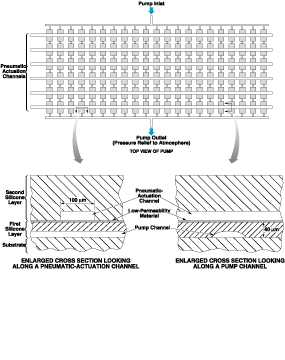
The pneumatic-actuation channels would be alternately connected to a compressed gas and (depending on pump design) either to atmospheric pressure or to a partial vacuum source. The design would be such that the higher pneumatic pressure would be sufficient to push the silicone arches down onto the substrates, blocking the channels. Thus, by connecting pneumatic-actuation channels to the two pneumatic sources in spatial and temporal alternation, waves of opening and closing, equivalent to peristalsis, could be made to move along the pump channels.
A pump according to this concept could be manufactured inexpensively. Pneumatic sources (compressors and partial vacuum sources) similar those needed for actuation are commercially available; they typically have masses of ≈100 g and power demands of the order of several W. In a design-optimization effort, it should be possible to reduce masses and power demands below even these low levels and to integrate pneumatic sources along with the proposed pumps into miniature units with overall dimensions of no more than a few centimeters per side.
This work was done by Sabrina Feldman, Jason Feldman, and Danielle Svehla of Caltech for NASA's Jet Propulsion Laboratory. For further information, access the Technical Support Package (TSP) free on-line at www.techbriefs.com/tsp under the Machinery/Automation category. NPO-30165.
This Brief includes a Technical Support Package (TSP).
Pneumatically Actuated Miniature Peristaltic Vacuum Pumps
(reference NPO-30165) is currently available for download from the TSP library.
Don't have an account?
Overview
The document discusses the development of pneumatically actuated miniature peristaltic vacuum pumps by NASA's Jet Propulsion Laboratory (JPL). These innovative pumps are designed for integration into advanced scientific instruments that require vacuum for optimal operation. They are capable of achieving vacuum-side pressures in the torr to milli-torr range (approximately 133 to 0.13 Pa), which classifies them as roughing pumps.
A key feature of these pumps is their compact size and low power consumption. They are expected to be an order of magnitude less massive and power-hungry compared to existing roughing pumps. The design allows for the potential reduction of mass and power demands even further, with the possibility of integrating pneumatic sources into miniature units measuring just a few centimeters on each side.
The pumping mechanism relies on pneumatic actuation, where channels are alternately pressurized and depressurized to create a peristaltic motion that moves gases through the pump channels. This design utilizes elastomeric valves and microfabricated channels, enabling significant miniaturization, high compression ratios, and minimal dead volume, which is crucial for achieving very low vacuum levels.
The document highlights the motivation behind this development: the absence of field-portable miniature vacuum pumps that are lightweight (less than 1 kg), energy-efficient, and capable of reaching vacuum levels in the milli-torr range. Such pumps are essential for various portable instruments, including mass spectrometers and devices that involve charge particle generation and detection.
The proposed solution involves using small compressors and vacuum generators, which can weigh around 50 grams and operate on approximately one watt of power. These components can pneumatically control silicone molds with micro-channels, allowing for effective peristaltic pumping action. The design also incorporates low permeability materials to enhance performance.
Overall, the document outlines a significant advancement in vacuum pump technology, emphasizing the potential for robust, oil-free, low-maintenance solutions that are well-suited for field operations. The work was conducted by a team from Caltech for NASA and is documented under the Technical Support Package (TSP) for further reference.











