

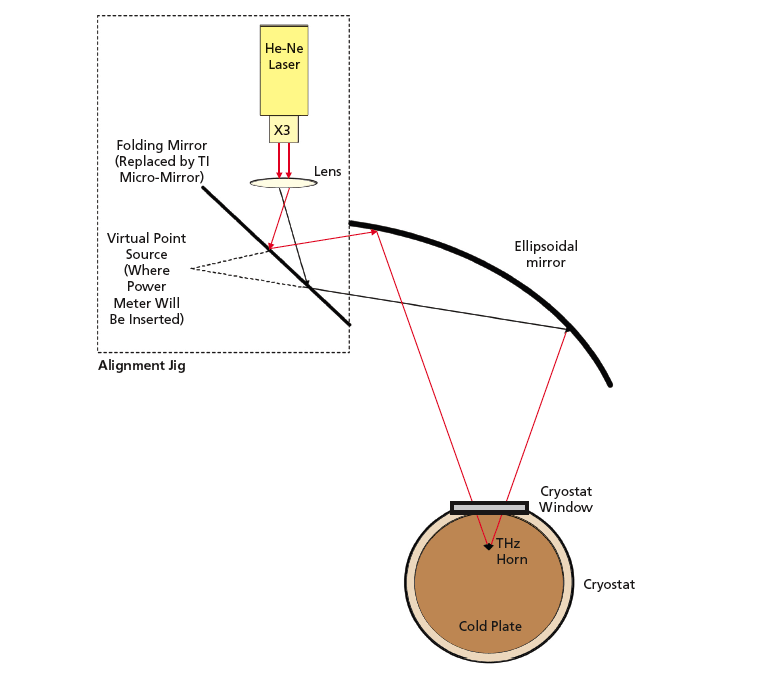
An alignment jig (see figure) places a THz horn and power detector at the proper locations with respect to the focal points of a conic reflector in order to couple total power of the THz source radiating out of its horn into the power detector for precise measurement of its power. A visible laser beam locates focal points of the conic reflector. Measuring total diverging power from a THz point source is not an easy task. THz radiation has a wavelength range of between 0.1 and 1 mm. The power levels range from a few tens of nW to 100 mW. These power levels are low, and low temperatures (in the range of –173 °C) are typically used to house the THz power source. Because of the small target, the power emitter and the power detectors must be located in exact positions in order to fully capture the radiated energy. At these low powers, there are three common commercial power meters: a bolometer detector, a Golay Cell, and a Keating Meter. These three power meters have specific power ranges where they excel, and they must be calibrated at their overlapped power ranges. Because of the low THz power being measured, conical reflectors are used to send all of the radiated power to the detectors. These reflectors focus the energy of the THz source, and the detectors are placed at a convergent focal point to capture the radiated THz power.
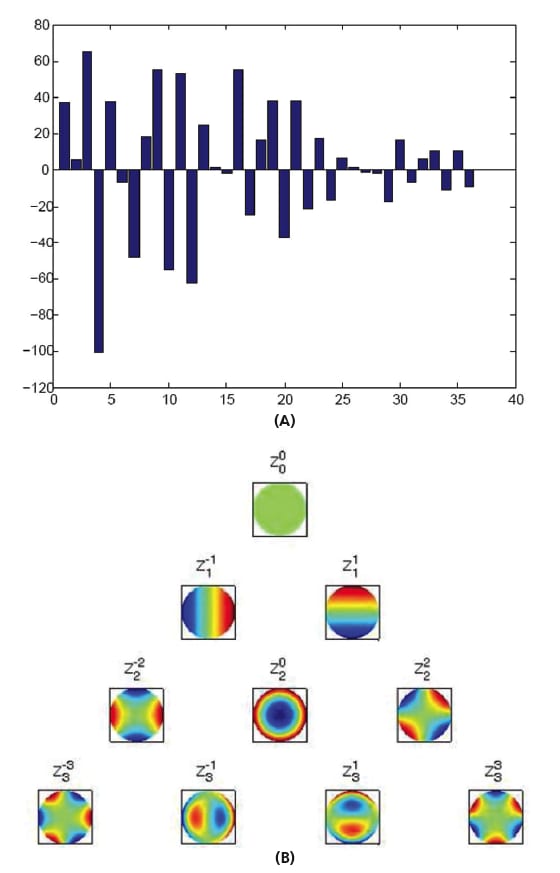
Once the two focal points are found, and the energy source and energy detectors are in place, it is necessary to check calibration. Array of circular patterns can be beamed from the DLP chip to evaluate Zernike’s refraction aberrations in real time (see Figure 2). In addition, various diagnostic patterns can be beamed from the DLP chip in order to measure aberrations associated with field variation. For example, a spot diagram can be beamed off of the DLP in order to analyze point spread.
This method is useful for the semiconductor industry to evaluate surface metrology of thin transparent optics, clinical optometry to measure lens aberration, telescopes and astronomical receivers to align mirrors covering optics and radiation sources, and head-mount displays to evaluate beam splitters.
This work was done by Hamid H. Javadi of Caltech for NASA’s Jet Propulsion Laboratory.
NPO-46373
This Brief includes a Technical Support Package (TSP).
Alignment Jig for Precise Measurement of THz Radiation
(reference NPO-46373) is currently available for download from the TSP library.
Don't have an account?
Overview
The document is a Technical Support Package from NASA's Jet Propulsion Laboratory (JPL) detailing advancements in the precise measurement of terahertz (THz) radiation. It focuses on the construction of an alignment jig designed to accurately measure the total power radiated from THz sources, particularly within cryostats where THz power is critical.
The document outlines the evolution of JPL's waveguide multiplier technology, which has successfully produced sources operating in the frequency range of 100-1900 GHz. This technology utilizes chains of doublers and triplers to extend the frequency capabilities of commercially available sources, starting from 100 GHz. For instance, a typical application can convert 100 mW of power at 100 GHz into several tens of mW at higher frequencies, down to tens of microwatts at 1500-1900 GHz, all while operating at cryogenic temperatures around 100 K.
To measure THz power accurately, the document discusses three types of commercial free-space power meters suitable for low THz powers:
-
Bolometer: The most sensitive option, operating at liquid helium temperatures (~4K). It requires modulation of incoming THz power and calibration against known sources, which can be challenging at these frequencies.
-
Golay Cell: A room-temperature device that measures power in the nW to µW range. It is faster than a bolometer but has a limited response at higher frequencies and requires careful calibration to avoid damage.
-
Keating Meter: Also operating at room temperature, this meter measures in the µW to mW range and has a larger aperture, allowing for easier alignment without the need for beam convergence.
The document also highlights the use of a Texas Instrument’s Digital Light Processing (DLP) micro-mirror chip for optical diagnostics. This chip can dynamically control high-resolution images to diagnose optical aberrations, utilizing techniques such as the Hartmann approach to analyze wavefront phase and determine Zernicke coefficients.
Overall, the document serves as a comprehensive resource for understanding the technologies and methodologies involved in the precise measurement of THz radiation, emphasizing the importance of accurate power measurement in advancing THz applications in various scientific and technological fields.










