

A modified coronagraph has been proposed as a prototype of improved notch filters in Raman spectrometers. Corona-graphic notch filters could offer alternatives to both (1) the large and expensive double or triple monochromators in older Raman spectrometers and (2) holographic notch filters, which are less expensive but are subject to environmental degradation as well as to limitations of geometry and spectral range.
Measurement of a Raman spectrum is an exercise in measuring and resolving faint spectral lines close to a bright peak: In Raman spectroscopy, a monochromatic beam of light (the pump beam) excites a sample of material that one seeks to analyze. The pump beam generates a small flux of scattered light at wavelengths slightly greater than that of the pump beam. The shift in wavelength of the scattered light from the pump wavelength is known in the art as the Stokes shift. Typically, the flux of scattered light is of the order of 107x that of the pump beam and the Stokes shift lies in the wave-number range of 100 to 3,000 cm -1. A notch filter can be used to suppress the pump-beam spectral peak while passing the nearby faint Raman spectral lines.
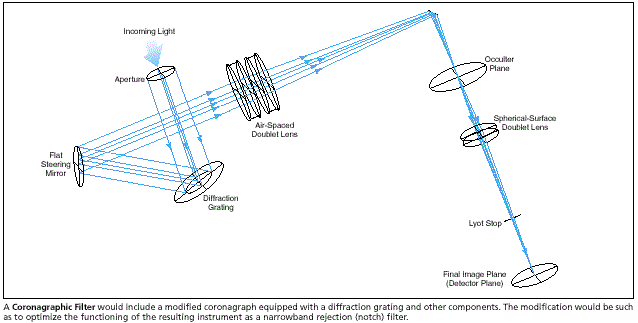 The basic principles of design and operation of a coronagraph offer an opportunity for engineering the spectral transmittance of the optics in a Raman spectrometer. A classical coronagraph may be understood as two imaging systems placed end to end, such that the first system forms an intermediate real image of a nominally infinitely distant object and the second system forms a final real image of the intermediate real image. If the light incident on the first telescope is collimated, then the intermediate image is a point-spread function (PSF). If an appropriately tailored occulting spot (e.g.,a Gaussian-apodized spot with maximum absorption on axis) is placed on the intermediate image plane, then the instrument inhibits transmission of light from an on-axis source. However, the PSFs of off-axis light sources are formed off axis — that is, away from the occulting spot — so that they become refocused onto the final image plane.
A properly designed coronagraph utilizes the diffraction from the intermediate occulting spot. In the exit-pupil plane, this diffraction forms a well-defined ring image in the vicinity of the geometric image of the exit pupil. By placing an aperture stop sized to block the passage of the diffracted light (such an aperture is known in the art as a Lyot stop) in the exit-pupil plane, it is possible, in principle, to obtain an extremely high rejection ratio. While coronagraphs are not new, recent developments make it possible to enhance performance. One such development is that of the ability to write arbitrary absorption patterns on occulting spots at submicron resolution by use of electron-beam lithography. Another such development is that of superpolished optics.
One characteristic of a classical coronagraph essential to the proposed notch filter is that within the narrow typical Raman spectral range associated with a given pump laser line, the size of the PSF changes little with wavelength. However, the position of the PSF (in particular,its displacement from the occulting spot) can be made to vary considerably with wavelength by introducing a diffraction grating or other dispersive element into the optical train. Hence, one could obtain an extraordinarily sharp notch in the spectral transmittance of a coronagraphic filter by designing the dispersive element HI-REL SPACE DC-DC CONVERTERS HI-REL SPACE DC-DC CONVERTERS and the other coronagraphic optics so that at the pump wavelength, the PSF is centered on the occulting spot.
The figure shows the optical layout according to one possible design of the proposed coronagraphic filter for a pump wavelength of 550 nm. The dispersive element would be a 500-line-per-millimeter diffraction grating, of which the first-order diffraction would be utilized. After passing through an aperture, the incoming light would strike the grating, followed by a flat steering mirror. An air-spaced doublet lens incorporating an aspherical element would generate a PSF at the occulter (intermediate-image) plane. A spherical-surface doublet lens would reimage the light onto a detector plane. On its way to the detector plane, the light would pass though a Lyot stop. In principle, a linear array of photodetectors could be placed in the final image plane to measure the Raman spectrum. The depth of the notch at the pump wavelength, as well as other parameters of the performance of the coronagraphic filter, could be tailored through the choice of the parameters of the optical components, including especially the dispersion of the grating; the aperture diameter, focal length, and aberrations of the first doublet lens; the length of the occulting spot along the axis of dispersion; and the diameter of the Lyot stop.
This work was done by David Cohen and Robert Stirbl of Caltech for NASA's Jet Propulsion Laboratory. For further information, access the Technical Support Package (TSP) free on-line at www.techbriefs.com/tsp under the Physical Sciences category. NPO-30504
This Brief includes a Technical Support Package (TSP).
Coronographic Notch Filter for Raman Spectroscopy
(reference NPO-30504) is currently available for download from the TSP library.
Don't have an account?
Overview
The document is a Technical Support Package from NASA's Jet Propulsion Laboratory, detailing the Coronagraphic Notch Filter for Raman Spectroscopy, identified as NPO-30504. It discusses advancements in Raman spectroscopy, particularly the challenges of measuring faint Stokes shifted scattered radiation against a backdrop of much stronger pump light. Traditional Raman spectrometers, often involving complex and costly double or triple monochromators, face limitations in effectively isolating the weak Raman signals.
The document introduces the coronagraphic notch filter as a promising alternative to existing methods, such as holographic notch filters. While holographic filters are less expensive, they suffer from environmental degradation and limitations in their operational range. The coronagraphic filter, on the other hand, offers enhanced robustness and performance, particularly in achieving a sharp notch in the filter transmission. This is crucial for effectively suppressing the pump photons and improving the signal-to-noise ratio in Raman spectroscopy.
Key design characteristics of the coronagraphic notch filter are outlined, including its entrance aperture diameter, grating groove density, and the design wavelength of null. The performance of the system is influenced by several factors, such as the F-number at the intermediate image plane, aberration content, and the spatial extent of the occulting spot along the dispersive axis. The document emphasizes the importance of these parameters in determining the width of the system's transmission null and the depth of the null, which is critical for effective spectral filtering.
Additionally, the document highlights the use of a linear detector array at the second focus, which allows for simultaneous acquisition of spectra while filtering the central band. This capability enhances the efficiency of data collection in Raman spectroscopy.
Overall, the Technical Support Package provides a comprehensive overview of the coronagraphic notch filter's design, functionality, and advantages over traditional methods, positioning it as a significant advancement in the field of Raman spectroscopy. The document serves as a resource for researchers and engineers interested in the application of this technology in various scientific and commercial domains.














