

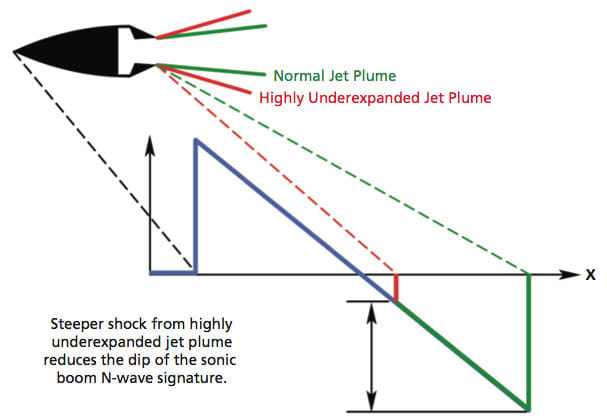
An axisymmetric full Navier-Stokes computational fluid dynamics (CFD) study was conducted to examine nozzle exhaust jet plume effects on the sonic boom signature of a supersonic aircraft. A simplified axisymmetric nozzle geometry, representative of the nozzle on the NASA Dryden NF-15B Lift and Nozzle Change Effects on Tail Shock (LaNCETS) research airplane, was considered. The highly underexpanded nozzle flow is found to provide significantly more reduction in the tail shock strength in the sonic boom N-wave pressure signature than perfectly expanded and overexpanded nozzle flows. A tail shock train in the sonic boom signature, similar to what was observed in the LaNCETS flight data, is observed for the highly underexpanded nozzle flow. The CFD results provide a detailed description of the nozzle flow physics involved in the LaNCETS nozzle at different nozzle expansion conditions and help in interpreting LaNCETS flight data as well as in the eventual CFD analysis of a full LaNCETS aircraft. The current study also provided important information on proper modeling of the LaNCETS aircraft nozzle.

This work was done by Trong Bui of Dryden Flight Research Center. For more information, download the Technical Support Package (free white paper) at www.techbriefs.com/tsp under the Physical Sciences category. DRC-009-032










