Thin-film devices that comprise heaters in combination with thermocouples have been developed for measuring flow velocities extremely close to solid surfaces, at several distances from the surface of interest. Devices that perform this function are denoted generally as "boundary-layer rakes." The measurement data acquired by boundary-layer rakes are needed for calculating viscous shear forces, for developing mathematical models of turbulence to be used in computational fluid dynamics, and as feedback in some flow-control systems.
The present devices overcome the deficiencies of devices used heretofore for the same purpose. Those devices (which include rakes of total-pressure-probes and of hot-film and hot-wire anemometers) are incapable of measuring flow quantities closer than about 0.02 in. (≈0.5 mm) from solid surfaces. In contrast, the present devices can be miniaturized to enable them to measure as close as 0.0002 in. (≈0.005 mm) from surfaces — a hundred-fold improvement. Also, in comparison with the prior boundarylayer rakes, these devices are sturdier.
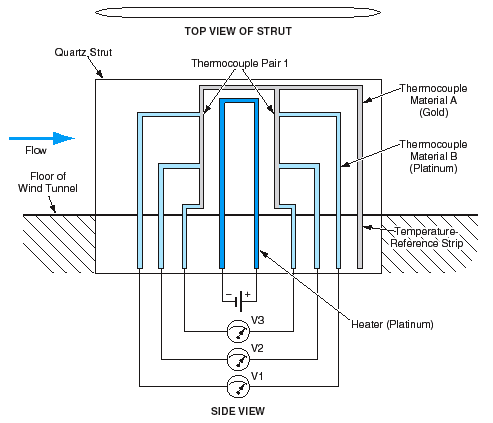
In the absence of flow, the upstream and downstream thermocouples are at the same temperature, so that the voltages generated by the pairs (V1, V2, and V3 in this example) are zero.
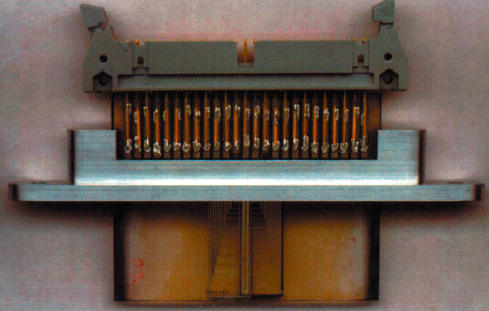
The number of thermocouple pairs can be as many as needed, up to a practical limit set by the number of alloy traces that can be patterned on the quartz surface. Also the miniaturization of a device of this type is limited by the capability for fine-line photolithography. Figure 2 depicts a working prototype. These devices could be batch-fabricated on quartz or other low-thermal-conductivity substrates at relatively low cost. These devices could be particularly useful for measuring flows on the surfaces of airplanes, in ventilation ducts, in jet aircraft engines (most importantly, for detecting incipient compressor stall), and in automotive engines.
This work was done by Danny P. Hwang, Herbert A. Will, and Gustave C. Fralick of Glenn Research Center. For further information, access the Technical Support Package (TSP) free on-line at www.nasatech.com/tsp under the Physical Sciences category.
Inquiries concerning rights for the commercial use of this invention should be addressed to NASA Glenn Research Center, Commercial Technology Office, Attn: Steve Fedor, Mail Stop 4–8, 21000 Brookpark Road, Cleveland, Ohio 44135. Refer to LEW-16999.