

A mathematical model has been developed for use in assessing the performances of direct-contact pyrolysis reactors used to convert particles of raw biomass materials (usually small wood chips) into char, tar, and gas. The optimal designs are here considered to be those that maximize the production of tar. In such a reactor, the particles are injected along with a flow of a hot feed gas (usually, superheated steam), into a chamber with a heated cylindrical or conical outer wall, are blown along the wall by the flow of gas, and are held against the wall by centrifugal force. Thus, the particles are heated primarily by direct conduction from the wall. Incompletely pyrolyzed particles are collected at the outlet and reinjected at the inlet along with the hot gas and the raw feedstock.
The model features a simplified geometry (see figure) and some simplifying assumptions that, together, make it possible to numerically simulate gross features of flow and pyrolysis phenomena without excessive computation. The reactor wall is represented by a flat plate of finite length heated to a constant temperature Twall. Superheated steam is injected in a turbulent flow at the left end of the wall with average lengthwise speed uinflow and with a temperature Tinflow, which is somewhat less than Twall. The particles are assumed to have simple parallelepiped shapes (to represent wood splinters).
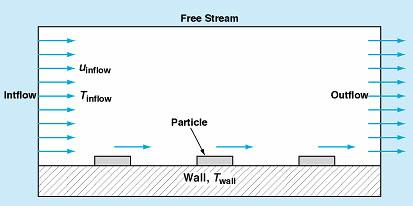
The particles are assumed to remain in contact with the wall (with weight substituting for centrifugal force) with their long axes parallel to the flow. Incompletely pyrolyzed particles that leave the wall at the right end are reinjected at the left end. The reactor is represented as operating in a steady state by specifying rates of injection of feedstocks at various stages of pyrolysis (fresh particles and reentrained particles) and associated particle sizes.
The model includes submodels of pyrolysis of particles, turbulent boundary-layer flow, and particle trajectories. The pyrolysis submodel is the one described in the preceding article, "Generalized Mathematical Model of Pyrolysis of Plant Biomass" (NPO-20068), adapted to the present slab geometry. The flow submodel incorporates the long-time-averaged Navier-Stokes equations with a two-equation sub-submodel of turbulence and a no-slip condition on the wall; the flow submodel simulates the development of a turbulent boundary layer, within which the particles quickly become deeply embedded as they are convected downstream. In the particle-trajectory submodel, each particle is represented as moving under the combined influences of the flow (with drag forces represented by a simplified sub-submodel of flow in the immediate vicinity of the particle) and friction with the wall. These submodels are coupled through boundary conditions and conservation laws, and the resulting equations of the overall model are solved numerically.
Calculations were performed for two-dimensional particles of different aspect ratios as well as one-dimensional particles (in the direction perpendicular to the wall), and it was found that the one-dimensional model gives a conservative estimate of both the conversion time and of the amount of tar collected. Directional effects from variations in thermal conductivity and permeability were found to be relatively small. The evolution of pyrolysis was found to be effectively uncoupled from the boundary-layer flow and to be determined primarily by Twall. The foregoing plus other findings suggest that direct-contact reactors offer potential for tar-production efficiencies greater than those of noncontact and semicontact reactors. Tar yields were found to be maximized for small particles and wall temperatures of about 800 K. Ratios between tar-output and feedstock-input rates were found to be independent of injection rates under the conditions studied.
This work was done by Josette Bellan and Richard S. Miller of Caltech for NASA's Jet Propulsion Laboratory . For further information, access the Technical Support Package (TSP) free on-line at www.techbriefs.com under the Physical Sciences category, or circle no. 113 on the TSP Order card in this issue to receive a copy by mail ($5 charge).
NPO-20069
This Brief includes a Technical Support Package (TSP).
Mathematical model of a direct-contact pyrolysis reactor
(reference NPO20069) is currently available for download from the TSP library.
Don't have an account?
Overview
The document presents a study on the optimization of direct-contact pyrolysis reactors, focusing on the conversion of biomass into valuable products such as char, tar, and gas. Conducted by researchers Josette Bellan and Richard S. Miller, the work emphasizes the advantages of direct-contact reactors over traditional reactor types, particularly in terms of efficiency and product yield.
The study introduces a mathematical model that simulates the behavior of a flat-plate reactor, where biomass particles are heated by a hot gas flow while being held against a heated wall. This configuration allows for effective heat transfer and enhances the pyrolysis process. The researchers explore various theoretical and numerical optimization issues related to the reactor design, aiming to maximize tar production, which is a key product in biomass conversion.
Key findings indicate that the direct-contact method offers significant commercial desirability due to its ability to improve heat transfer and reaction rates. The model incorporates various parameters, including temperature profiles, heating rates, and the physical properties of the biomass, to provide a comprehensive understanding of the pyrolysis process.
The document also discusses the implications of the findings for the design and operation of pyrolysis reactors, suggesting that optimizing these parameters can lead to more efficient biomass conversion processes. The research highlights the potential for scaling up the technology for industrial applications, which could contribute to sustainable energy solutions and waste management strategies.
In conclusion, the study provides valuable insights into the optimization of direct-contact pyrolysis reactors, presenting a robust mathematical framework that can guide future research and development in the field. The findings underscore the importance of innovative reactor designs in enhancing the efficiency of biomass conversion, ultimately supporting the transition to renewable energy sources.











