An interactive software being developed at the University of Tokyo allows architects and furniture makers with little experience in woodworking to more easily design and build structurally sound wood joints.
The system, known as Tsugite (the Japanese word for "joinery"), also provides milling machine instructions to efficiently produce the designed components. With on-screen instructions, users can then piece the object together without the need for additional tools, adhesives, or even nails or glue.
The intention behind the creation of Tsugite, according to its creators, was to make the art of joinery available to people who lacked the specific experience.
Tsugite guides users through the woodworking process one step at a time, starting with a gallery of existing designs that can then be modified for different purposes. The tool supports more complex designs as the builder becomes more comfortable with the software.
"More advanced users can jump straight to a manual editing mode for more freeform creativity,” said Maria Larsson , researcher at the University of Tokyo and Tsguite developer.
Tsugite also only provides designs that can be made by a milling machine, and account for the rotary cutter's degrees of freedom and size.
"[Tsugite] can explore a large variety of joints and yet keeps them within realistic physical limits,” said Larsson.
How Tsugite Works
Tsugite gives users a detailed view of wooden joints represented by small cubes, or "voxels."
Essentially 3D pixels, the voxels can be moved around at one end of a component to be joined. Two or more components can be connected, and the software algorithm will adjust all components accordingly to create a tight fit.
The moving of one cube, for example, automatically adjusts the voxels at the end of the corresponding component such that the fit is strong and reliable, without the need for nails or even glue.
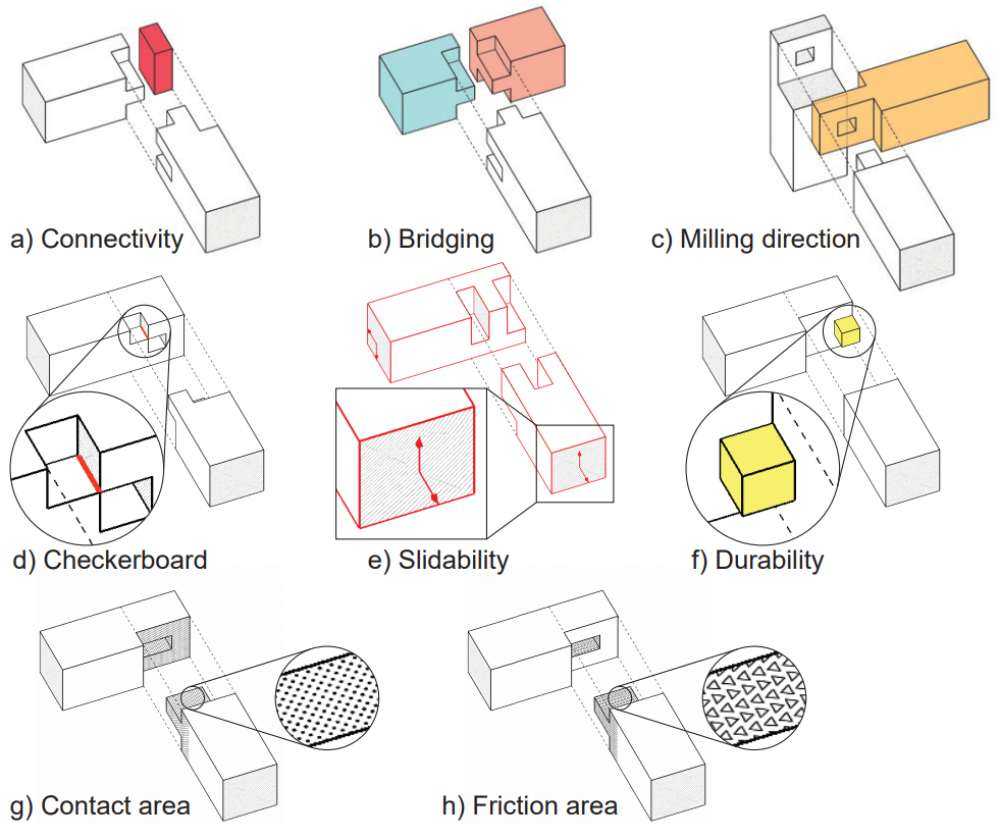
Different colors inform the user about properties of the joints, including how easily two components will slide together.
Simplifying wood designs has its sustainability benefits, according to the University of Tokyo researcher.
"Wood is perhaps the only natural and renewable building material that we have, and efficient joinery can add further sustainability benefits,” said Larsson in an earlier University of Tokyo press release this month . “When connecting timbers with joinery, as opposed to metal fixings, for example, it reduces mixing materials."
In a short, edited Q&A with Tech Briefs below, Larsson explains how the software could someday support the creation of entire buildings.
Tech Briefs: Who is the ideal user for this kind of design software? Who needs to know about this?
Maria Larsson: The ideal user is an architect and furniture designer that is not an expert in joinery and CNC fabrication. I think such users will find this tool empowering. They will be able to design feasible and relatively complex joints that are possible to fabricate at a high quality.
The interface is easy enough also for novice users to design joints. But not everybody is comfortable with handing a CNC machine, so the fabrication part would likely need to be outsourced in this case.
Carpenters who specialize in joinery will likely find the voxelized design space, as well as the 3-axis CNC fabrication constraints, limiting. Tsugite would not replace their work. But perhaps it can provide a complement?
So, in summary, Tsugite could be useful to a wide range of people, but the ideal user is probably somebody between expert and novice.
Tech Briefs: In your opinion, what is the most exciting way that this design software simplifies the design process?
Maria Larsson: Tsugite is a single-purpose interface with a rather clean design. Also, the user does not have to worry about CNC compatibility or other basic practical constraints. Therefore, the cognitive load is rather light, and the user can really focus on how they want the joint to look.
At the same time, the voxelized design space is rather limited — there are not infinite possibilities — which makes it easier to complete a design, I think.
Tech Briefs: What needs to happen for this kind of approach to be scaled up to make buildings?
Maria Larsson: There are some very attractive points about a building made from joinery. Imagine all beams and columns are pre-fabricated and just assembled like a puzzle on the building site?
Making a building is, however, a very complex process, which includes client, budget, building regulations, and more, and making anything out of the ordinary has a risk.
For a long time, the building industry has been focused on concrete and steel. Wood is starting to make a strong comeback, but we need to build up a collective knowledge about how to make good modern wood buildings. To make a building with Tsugite, or other wood joint techniques, many people of different expertises need to come together. And it would make sense to start at a small scale (think, a kiosk), then gradually move on to larger buildings while gathering experience and refining the technique. I would be very excited to see this happening.
Tech Briefs: What kinds of objects have you seen made with this?
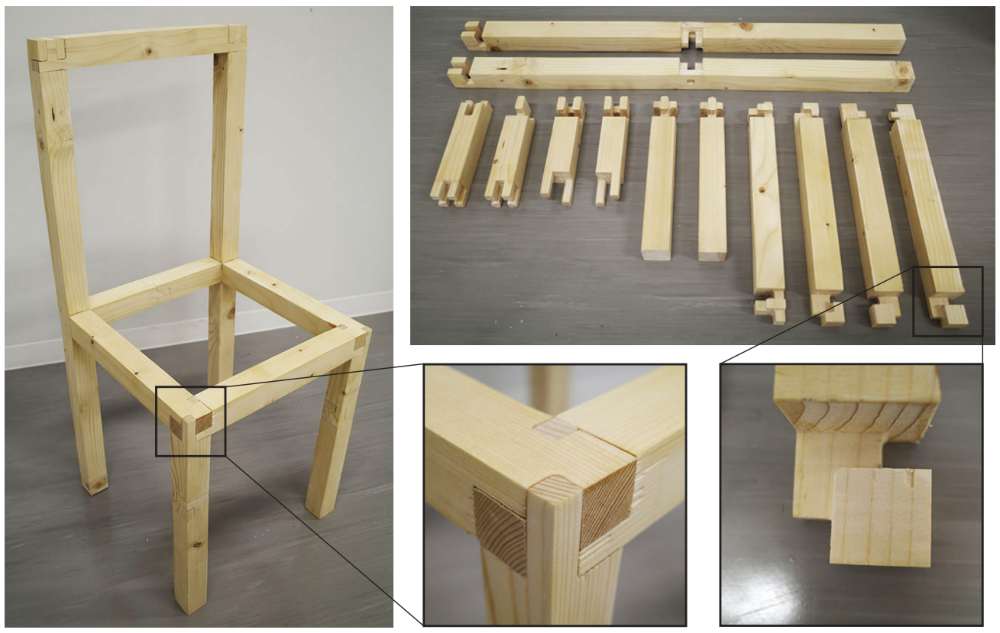
Maria Larsson: What we have made so far is a chair, a table, and a food stand. The food stand especially demonstrated the good point of glue-free joints — that you can easily, transport, assemble, disassemble, and store it.
Tech Briefs: What has been the reaction from people who have seen the project?
Maria Larsson: We have gotten a rather overwhelming response from people ranging from woodworkers to HCI [human control interface] researchers.
There has been a lot of interest in using the software, and we have shared both an executable file and the source code for people to test it out. However, Tsugite was developed as a proof of concept by a small group of researchers. It is not a consumer-ready software.
I would be happy if a stable version becomes available to as many people as possible, but for that to happen, we need a software company to approach us, acquire the rights for Tsugite, and then do their magic to perfect the software and distribute it.
Learn more about the Tsugite Project.
Research Citation:
Maria Larsson, Hironori Yoshida, Nobuyuki Umetani, and Takeo Igarashi. 2020. Tsugite: Interactive Design and Fabrication of Wood Joints. In Proceedings of the 32nd Annual ACM Symposium on User Interface Software and Technology (UIST '20). Association for Computing Machinery, Virtual Event, USA.
What do you think? Share your questions and comments below.
Transcript
00:00:00 Tsugite. Interactive design and fabrication of wood joints. Wooden joinery is used to connect wooden pieces for building traditional architecture and furniture. However, it is very difficult to design such complicated joinery and to fabricate it from wood. We present Tsugite. An interactive computational system to design wooden joinery that can be fabricated using a 3-axis CNC milling machine. In Tsugite, the user can easily design a connection
00:00:30 by pulling and pushing the voxelized geometry of the joint. The user can edit the orientation and the position by dragging the mouse. And set the sliding direction, the number of timbers, the voxel resolution, the angle of intersection, and the timber dimensions. While editing the joint the user receives real-time feedback about eight performances of the current design.
00:00:56 Unconnected voxels are shown in red. An unbridged timber is indicated by separate colors. For fabricability we check so that each timber can be milled out from one direction. If a timber violates this fabrication constraint the piece is colored orange. The system also detects so-called checkerboard patterns which are indicated by a thick red vertical line. This pattern is problematic to fabricate and to assemble. Tsugite analyses the slidability of the current design. Unblocked sliding directions are shown by arrows at the end of each timber.
00:01:33 A red outline indicates that a timber is sliding too much. Voxels that are likely to break off are given a yellow fill. These are voxels that stick out perpendicular to the grain orientation which is 10-20 times weaker compared to the fiber direction. Finally, the area of friction or the area of contact is optionally shown with distinct textures. To assist the user while editing the joint the system gives real-time suggestions. The user can also browse through a gallery of pre-calculated valid joints.
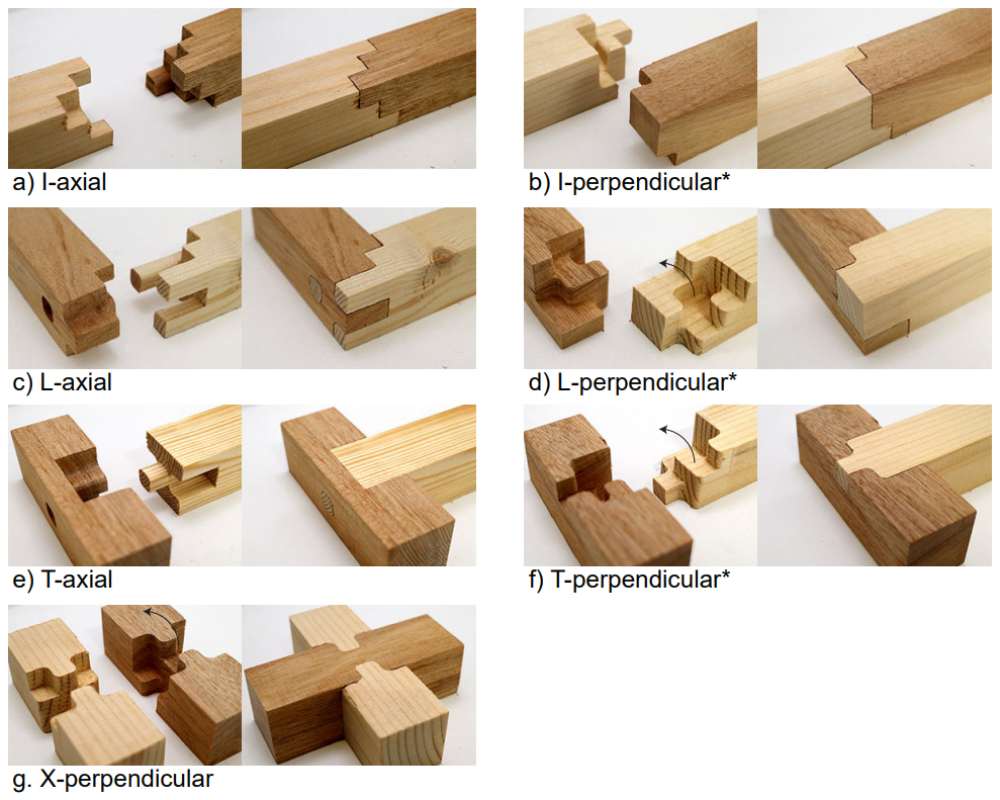
00:02:06 After finalizing a design, Tsugite generates milling paths to fabricate the joinery using a specialized path planning algorithm that selectively rounds outer corners to achieve assemblability. Using Tsugite, we could fabricate many functional joints. This is a classical straight joint design. This example shows the design of a joint with three timbers. In this example, we tried a higher resolution of 5x5x5 voxels. And here is a joint with a non-orthogonal angle of intersection.
00:02:40 Using Tsugite, we fabricated a real-sized chair that a person can sit on. And a sturdy table that has some non-orthogonal joints. We also designed an interlocking stool with all unique and non-symmetrical joints. Thank you for your attension.