
White Paper: Medical
Design of Advanced Catheters Using Flexible Circuit Boards
SPONSORED BY: ![]()

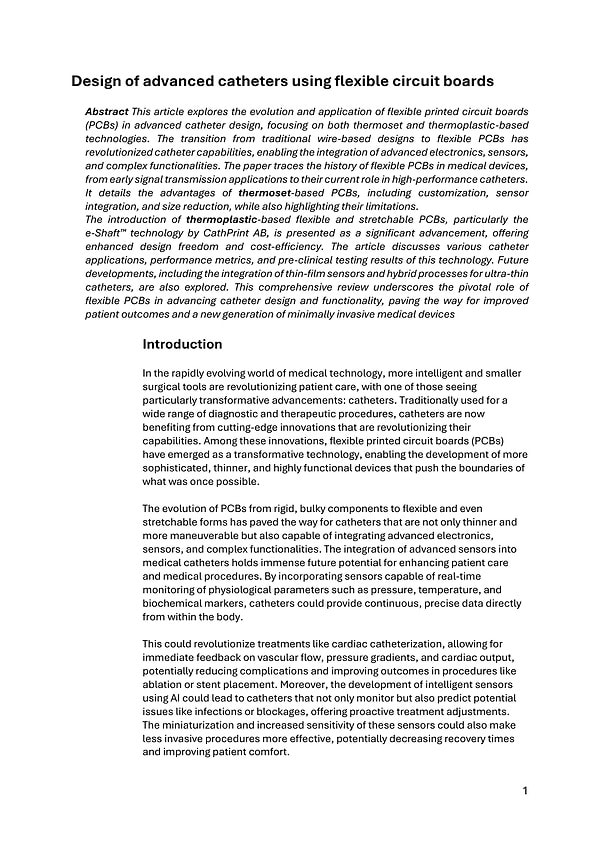
This white paper examines the evolution of flexible printed circuit boards (PCBs) in advanced catheter design, highlighting the transition from wire-based systems to flexible PCBs. It explores thermoset and thermoplastic technologies, emphasizing the advantages of CathPrint’s e-Shaft™ technology. Key applications, performance metrics, and future advancements, such as thin-film sensors, are discussed. This review underscores the transformative role of flexible PCBs in enhancing catheter functionality and driving innovation in minimally invasive medical devices.
Don't have an account?
Overview
This white paper discusses the transformative role of flexible printed circuit boards (PCBs) in the design and functionality of advanced catheters, highlighting significant advancements in medical technology. It introduces the e-Shaft™ technology by CathPrint AB, which utilizes thermoplastic-based flexible PCBs, offering enhanced design freedom and cost-efficiency. The paper emphasizes the evolution of PCBs from rigid components to flexible and stretchable forms, enabling the development of thinner, more maneuverable catheters that can integrate advanced electronics and sensors.
The integration of sensors into catheters is particularly noteworthy, as it allows for real-time monitoring of physiological parameters such as pressure, temperature, and biochemical markers. This capability could revolutionize procedures like cardiac catheterization by providing immediate feedback on vascular flow and pressure gradients, potentially reducing complications and improving patient outcomes. The paper also discusses the potential for intelligent sensors powered by AI to predict issues like infections or blockages, leading to proactive treatment adjustments.
The advantages of flexible PCBs include improved flexibility, enhanced signal integrity, and simplified manufacturing processes, which have led to their widespread adoption in high-performance catheters. However, challenges remain, particularly in high-volume production processes for these innovative technologies. The white paper concludes by underscoring the substantial potential of flexible PCBs in advancing catheter technology, paving the way for a new generation of minimally invasive medical devices that promise better patient care and outcomes.
Overall, the white paper serves as a comprehensive review of the current state and future prospects of flexible PCBs in catheter design, emphasizing their critical role in enhancing medical procedures and patient experiences.