
White Paper: Test & Measurement
Vibration Testing FAQs: Your Quick-Reference Guide to Mechanical Stress Validation
SPONSORED BY: ![]()

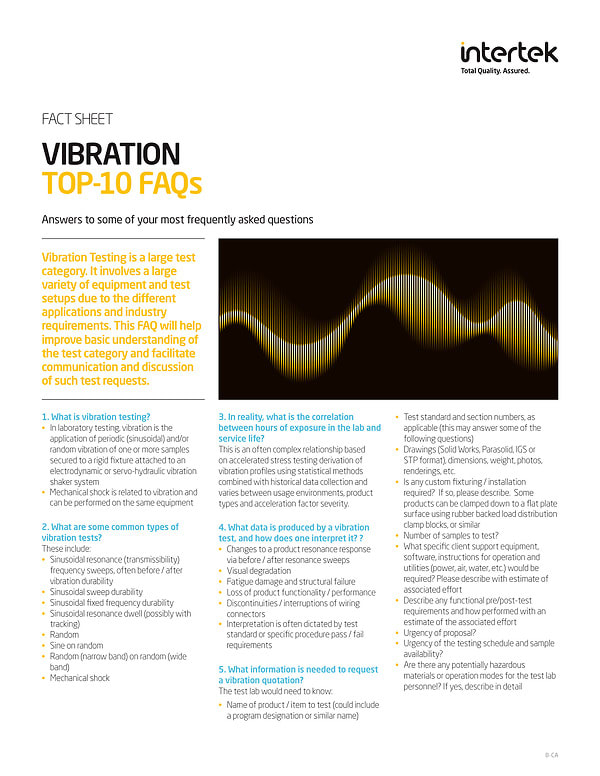
This FAQ sheet addresses the top 10 most frequently asked questions about vibration testing, helping engineers understand how to properly plan, execute, and evaluate a vibration test program. From selecting test types to interpreting results, this resource outlines the fundamental principles needed for successful vibration testing.
The questions cover essential test modalities such as sinusoidal sweeps, random profiles, and mechanical shock, and explain how resonance changes, fatigue failures, and functional degradation are typically measured. Commonly referenced standards from ISO, SAE, and MIL-STD are summarized, including OEM-specific protocols for automotive applications.
The FAQs highlight key factors to communicate when requesting a quote from a third-party test lab, including sample dimensions, functional requirements, and hazardous considerations. It also outlines how many samples may be needed depending on the product and test objective, and offers real-world guidance on correlating lab exposure to service life.
Regardless of your product, this guide can help demystify the test planning process and set realistic expectations for timelines, outcomes, and program complexity.
Don't have an account?
Overview
The provided document serves as a comprehensive FAQ on Vibration Testing, a critical process used across various industries to assess the durability and performance of products under vibrational stress. Vibration testing involves applying periodic (sinusoidal) and random vibrations to samples secured on a rigid fixture, typically using electrodynamic or servo-hydraulic shakers. This testing is essential for ensuring that products can withstand the conditions they will encounter in real-world applications.
The document outlines several common types of vibration tests, including sinusoidal resonance frequency sweeps, random vibrations, and mechanical shock tests. It highlights the importance of these tests in industries such as automotive, aerospace, medical, and consumer goods, among others. The FAQ addresses how to determine if samples pass or fail a vibration test, noting that visual degradation, changes in resonance responses, and functional performance are key indicators.
Additionally, the document discusses the duration of vibration tests, which can range from a few minutes for resonance sweeps to several hours or even hundreds of hours for durability tests. It emphasizes the complexity of correlating lab exposure hours to actual service life, as this relationship varies based on product type and usage environments.
To request a vibration test quotation, specific information is required, including product details, test standards, and any custom fixturing needs. The document also specifies the number of samples typically needed for testing, which can vary based on the industry and product type.
Overall, this FAQ serves as a valuable resource for understanding vibration testing, its applications, and the necessary steps to engage in the testing process, ultimately aiding in the development of reliable and durable products.