
Innovators at NASA Johnson Space Center have developed additively manufactured thermal protection system (AMTPS) comprised of two printable heat shield material formulations. These formulations are directly applied by 3D printer or other robotic extrusion system and bonded to a spacecraft to devise a heat shield suitable for atmospheric entry. This technology could significantly decrease heat shield or thermal protection system (TPS) fabrication cost and time.
Current state-of-the-art TPS manufacturing and application methods are expensive, labor-intensive, and complex. These drawbacks are primarily due to the amount of skilled, manual labor needed for form fitting and bonding individual TPS tiles across a spacecraft’s forebody — each tile comprised of differing thermal properties and layers — and includes filling the gaps in-between the tiles with an additional component formulation. This AMTPS technology can solve these challenges by reducing the complexity of TPS integration and easing the production of large and specially contoured heat shields. Additionally, this technology allows heat shields to be created as a single mold and prevents the need to treat the tile gaps of current heat shields, thus eliminating numerous potential failure points.
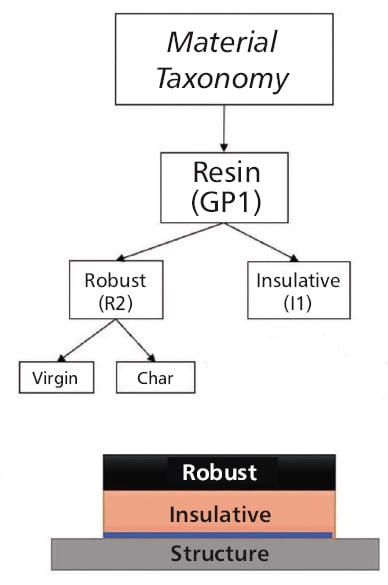
One inner insulative layer, and one outer robust ablative layer comprise the AMTPS technology. When applying the heat shield to the surface of a spacecraft, the insulative layer is printed first and primarily functions to reduce the amount of heat soak into the vehicle. The formulation of the insulative layer has a slightly lower density (as compared to the robust layer) and is adjusted using a differing constituent ratio of phenolic and/or glass microballoon material. Both formulations combine a phenolic resin with various fillers to control pre-and post-cure properties that can be adjusted by varying the carbon and/or glass fiber content along with rheology modifiers to enhance the fluid flow for deposition systems.
The robust layer is applied next and functions as the ablative layer that ablates away or vaporizes when subjected to extremely high temperatures such as those achieved during atmospheric entry. The formulation of the robust layer produces a gas layer as it vaporizes in the extreme heat that acts as a boundary layer. This boundary prevents heat from further penetrating the remaining robust material by pushing away the even hotter shock layer. The shock layer is a region of super-heated compressed gas, positioned in front of the Earth-facing bottom of the spacecraft during atmospheric entry, that results from the supersonic shockwave generated.
Commercial space applications for this AMTPS technology include use on any spacecraft that transits a planetary or lunar atmosphere such as Mars or Saturn’s moon Titan. Additionally, the invention may be useful for launch system rockets to provide heat shielding from atmospheric reentry or to protect ground equipment on the launch pad from rocket exhaust plumes. As the number of government and commercial space missions to primary Earth orbits, the Moon, and the Solar System increase, there will be a growing need for cost-effective, on-demand, and timely fabrication of heat shields for space-related activities.
NASA is actively seeking licensees to commercialize this technology. Please contact NASA’s Licensing Concierge at