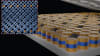


Researchers have developed a soft robotic skin that enables vine robots a few millimeters wide to navigate convoluted paths and fragile environments. To accomplish this, they integrated a very thin layer of actuators made of liquid crystal elastomer at strategic locations in the soft skin. The robot is steered by controlling the pressure inside its body and temperature of the actuators. The researchers showed that a robot equipped with this skin could successfully navigate a model of the arteries in a human body and a model of the interior of a jet engine.
The research team published their results in the October 15 issue of the journal Science Advances.
“Our work represents a step toward small, steerable, soft vine robots for applications in delicate and constrained environments,” said Tania K. Morimoto, an associate professor in the Department of Mechanical and Aerospace Engineering at the University of California San Diego, and the paper’s corresponding author.
Researchers overcame these size limitations by integrating a series of actuators made of liquid crystal elastomer at specific locations in a soft, robotic skin. These actuators are very thin but still very strong, which makes them suitable for steering robots at a small scale. The robot can be controlled either by temperature, or pressure, or both. The latter is better, the research team found. They embedded small, flexible heaters under the actuators to control the actuator's temperature and built a system to precisely adjust the pressure inside the robot for steering.
The researchers tested the skin on a flexible, vine robot in the range of 3 to 7 millimeters (about 0.2 inches) in diameter and 25 centimeters (roughly 10 inches) in length. The robots grow from the tip by turning their skin inside out. The study showed that it could make several turns of more than 100 degrees along its body length when the actuators were activated. It could also squeeze through narrow gaps, including some that were half of its diameter. For example, researchers successfully threaded a soft vine robot through a model of a human aorta and a connecting artery. They also equipped the robot with a camera to inspect various targets inside of a convoluted jet engine model.
“The soft skin developed in this work could further be adapted for various other soft robotic systems, such as wearable haptic devices and soft grippers,” said Sukjun Kim, a postdoctoral researcher in Morimoto’s lab. Next steps include allowing the robot to be remote controlled or autonomous, and making it even smaller.